
Mashed Cauliflower Recipe
Published · Updated
Smooth, buttery, and loaded with garlicky flavor, this creamy mashed cauliflower is the low-carb side dish you've been missing.
Jump To Recipe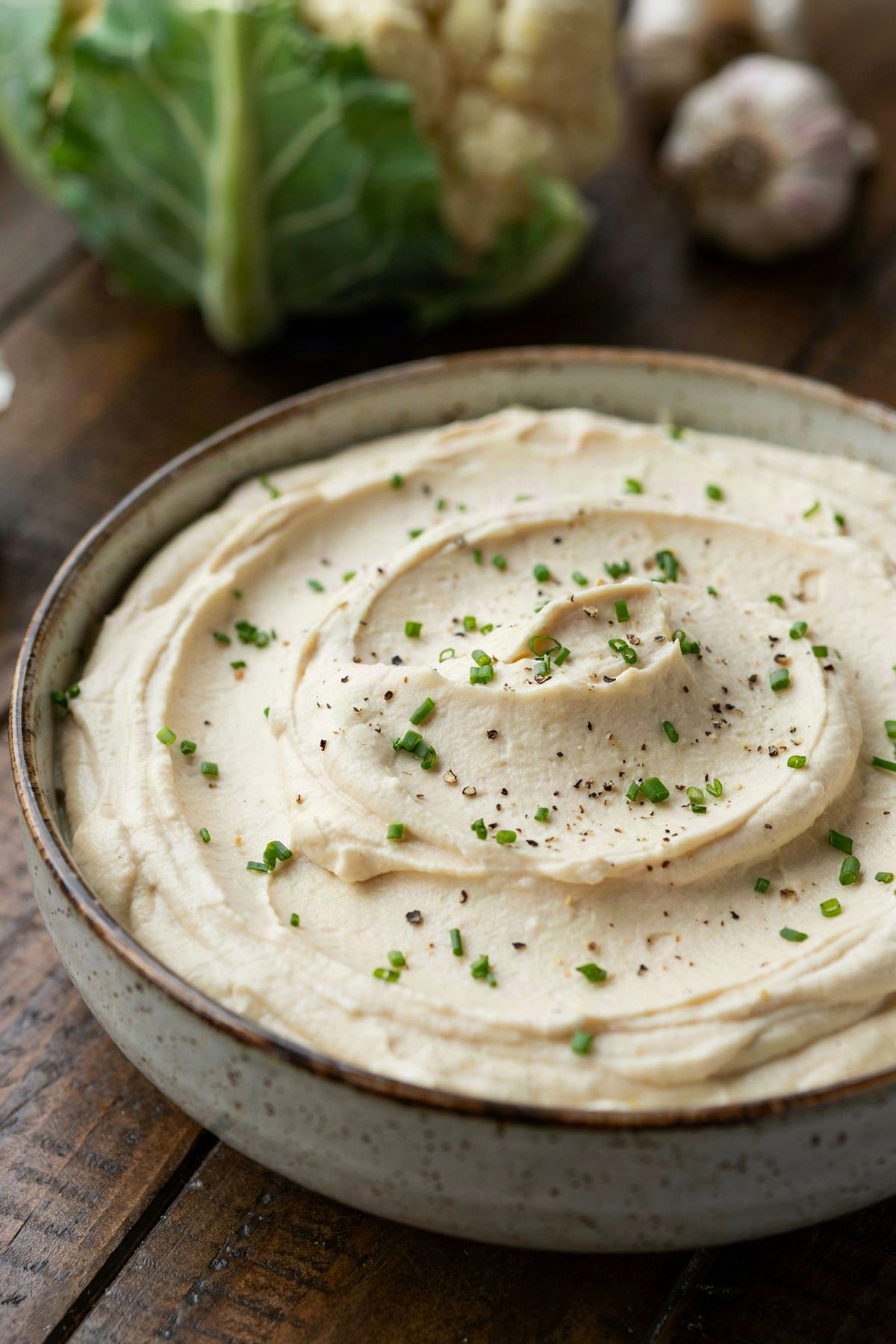
Why You'll Love Creamy Garlic Mashed Cauliflower
There’s something very satisfying about comfort food, and mashed potatoes are often at the top of the list. Sometimes I want that creamy consistency without the carbs. This mashed cauliflower gives you all of that goodness, plus a garlic kick and a little tang from the cream cheese, and you won’t miss a thing.
The whole thing takes about 25 minutes, and most of that is the cauliflower steaming while you do nothing. Serve it with seared tofu, or a big plate of roasted vegetables. Basically, it goes with anything. I always keep going back to it.
A few tips to get the perfect mash:
- Steam the cauliflower to just tender, then dry it out for a minute in the hot empty pot. That minute is the whole difference between creamy and soupy.
- Warm the garlic gently in the butter instead of frying it. Browned garlic turns bitter and speckles a pale purée.
- Skip the milk unless the mash is genuinely too stiff. Cauliflower brings plenty of water of its own.
This is the perfect tummy-loving food for the lighter side of life. If you’re a comfort food fan but want to keep it healthy, this is essential!
The story
Mashed Cauliflower Is a 250-Year-Old French Dish That Lost Its Potato
Mashed cauliflower reads like a 2000s invention, something that arrived with the Atkins boom of 2003 and 2004, when as many as 30 million Americans were counting carbs at once and every starch on the plate was looking for a stand-in. That is when it reached American dinner tables. It is not when it was invented.
In classical French cookery, any dish carrying the name Dubarry or du Barry contains cauliflower. It belongs to Jeanne Bécu, comtesse du Barry, born 1743 and guillotined in 1793, the last official mistress of Louis XV, and tradition holds that cauliflower was her favorite vegetable. Court dishes attract stories like that, so take it lightly. What is not in doubt is that by 1903, when Escoffier codified French cooking in Le Guide Culinaire, Dubarry on a menu meant cauliflower.
The recipe itself is the interesting part. Escoffier’s Purée Dubarry cooks 600 g of blanched cauliflower with 350 g of sliced potato in a liter of milk, then passes the lot through a fine sieve. That is well over half the cauliflower’s weight in potato, and it is not there to stretch the dish. Cauliflower is about 92% water and carries almost no starch of its own, so left alone it cannot hold a purée together. The potato is the binder.
Which is the quiet joke at the middle of the modern version. The low-carb kitchen took a classical French purée, deleted the one ingredient doing the load-bearing work, and then spent twenty years asking why the result slides across the plate. Nearly every complaint about watery cauliflower mash traces back to that removal.
You do not have to put the potato back, and this recipe does not. You do have to replace what it was doing. That is what the method below is built around: drive the water off before you blend rather than trying to thicken afterwards, and let full-fat cream cheese, roughly a third fat and firming as it cools, take over the job the starch used to do.
What to buy
Ingredient Notes
Cauliflower
Buy by weight rather than by the word “large”, which covers anything from 1½ to 3 lb. You want a head that feels heavy for its size with tight, creamy-white curds. Gray or brown speckling is the start of spoilage and it turns the finished purée a dishwater color. The leaves are the better freshness test: crisp and green means it was cut recently.
Frozen cauliflower florets
These work, and they make the fastest version of this dish. They are blanched before freezing, so they need about 6 minutes of steam straight from frozen, but they carry more water than fresh. Give them 3 to 4 minutes in the dry pot at step 3 instead of 1 to 2, and plan on skipping the milk. Do not thaw them first, they collapse and weep.
Cream cheese
Two products share this name and only one belongs here. The foil-wrapped block is dense and full fat. The tub sold as spreadable or whipped has been aerated, given extra moisture and stabilized with guar or xanthan gum, and it releases that water as soon as it warms, which is what this dish can least afford. Buy the block. Reduced-fat versions swap the fat for more water and undo the point of the ingredient.
Garlic
Three cloves, sliced rather than minced. Slices sit in the butter without catching, while minced garlic settles on the pan bottom in a layer and browns while you are watching the cauliflower. It gets blended smooth either way, so mincing buys you nothing. Skip the jarred pre-minced kind: it is packed in acid and you can taste it in a dish this plain.
Butter
Unsalted, because cauliflower takes a surprising amount of salt and you want to be the one deciding how much. Salted is fine if it is what is in the fridge, in which case start with half the salt at step 5 and work up.
Milk (optional)
Listed last and marked optional because most batches never call for it. It is insurance for the times you steamed a smaller head than you meant to, or dried the florets a shade too hard. If you do use it, warm it first. Cold milk dulls a hot purée.
Creamy Garlic Mashed Cauliflower
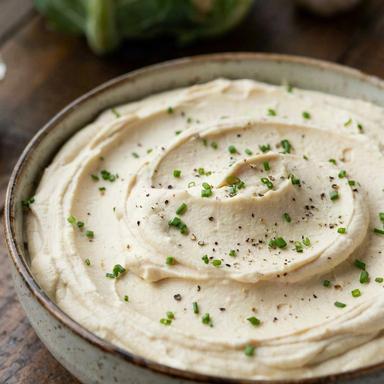
Smooth, rich mashed cauliflower with garlic warmed in butter and cream cheese for body, a low-carb side that stays creamy instead of going watery.
Ingredients
Equipment
As an Amazon Associate I earn from qualifying purchases, at no extra cost to you.
Instructions
- 1
Steam to just tender
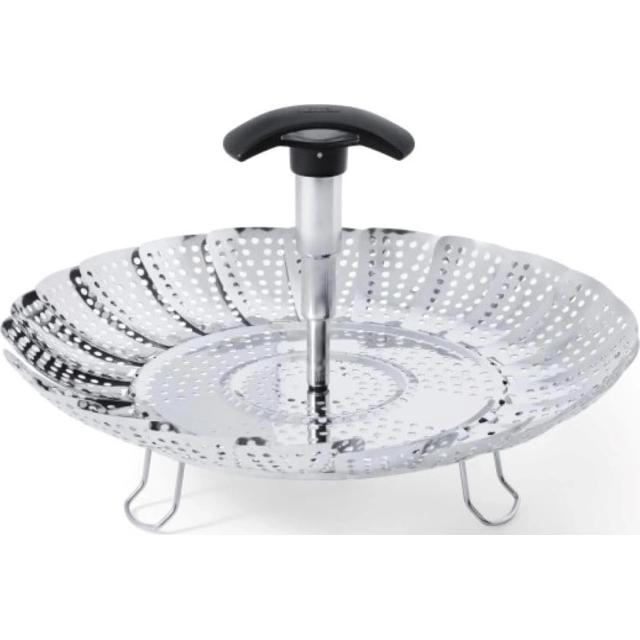
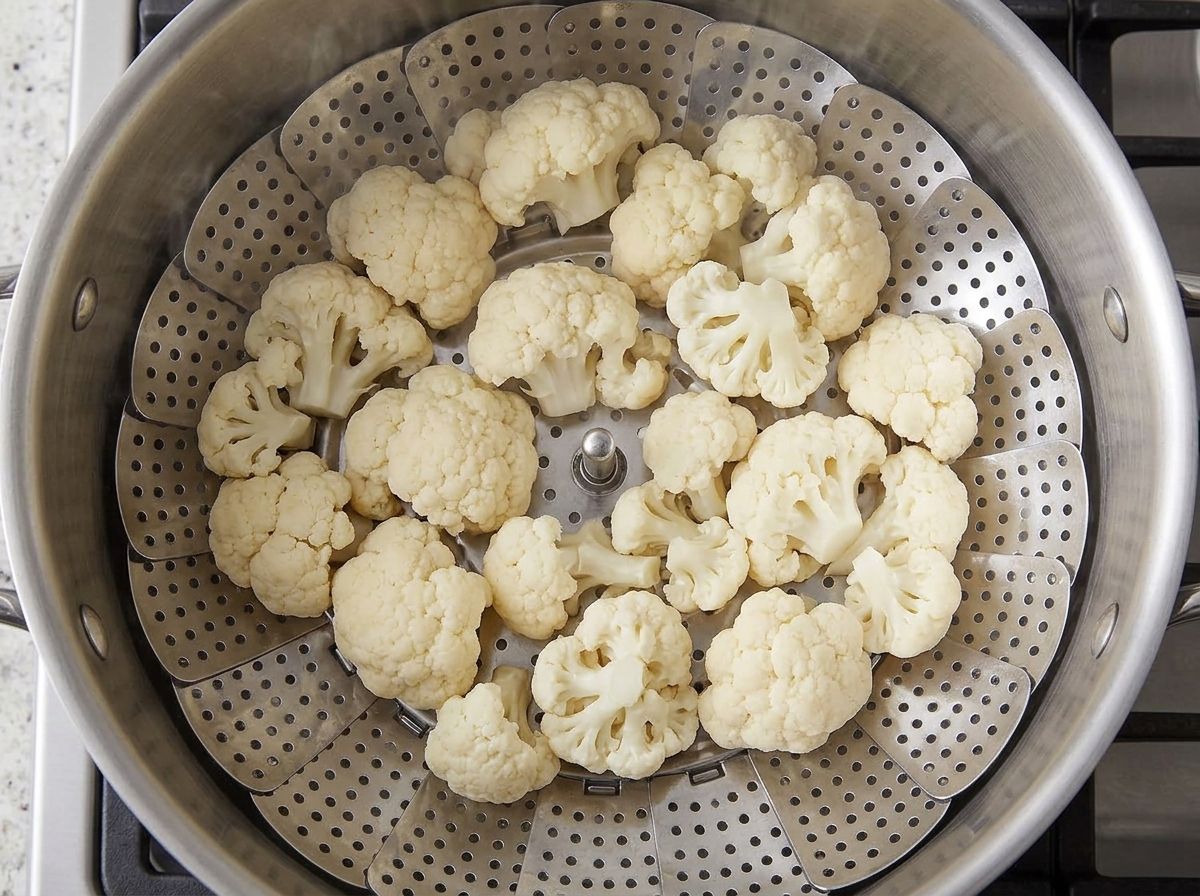
Bring 1 inch (2.5 cm) of water to a boil in a large pot, set the steamer basket over it and add the cauliflower florets. Cover and steam for 8 to 10 minutes, until the tip of a knife slides into a thick stem with no resistance. Stop there. Cauliflower keeps giving off sulfur compounds the longer it cooks, and that is where the strong cabbagey smell and taste come from.
- 2
Warm the garlic in butter
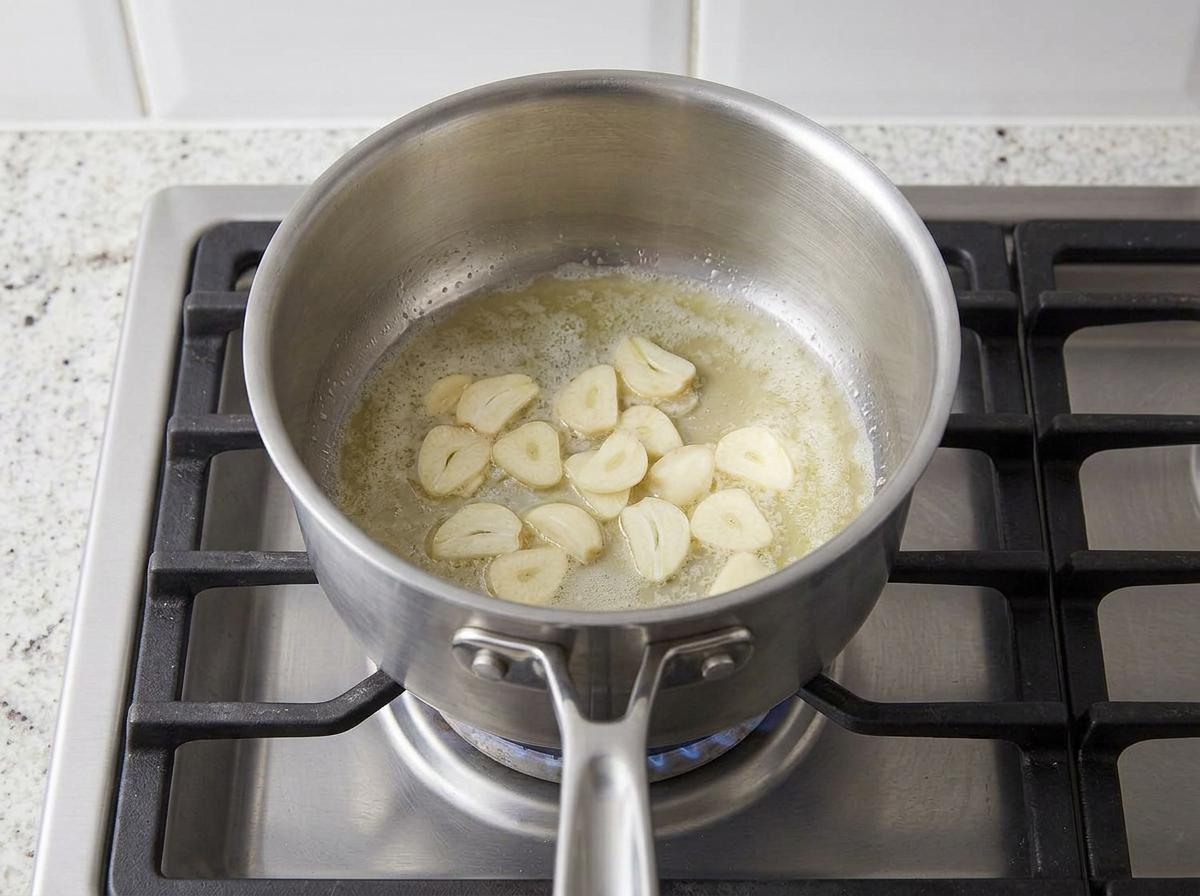
While the cauliflower steams, melt the butter in a small pan over low heat. Add the sliced garlic and warm it gently for 2 to 3 minutes, until it smells sweet and is barely blond at the edges. Do not let it brown. Scorched garlic turns bitter and shows up as dark specks in a pale purée. Take the pan off the heat.
- 3
Dry the cauliflower in the hot pot
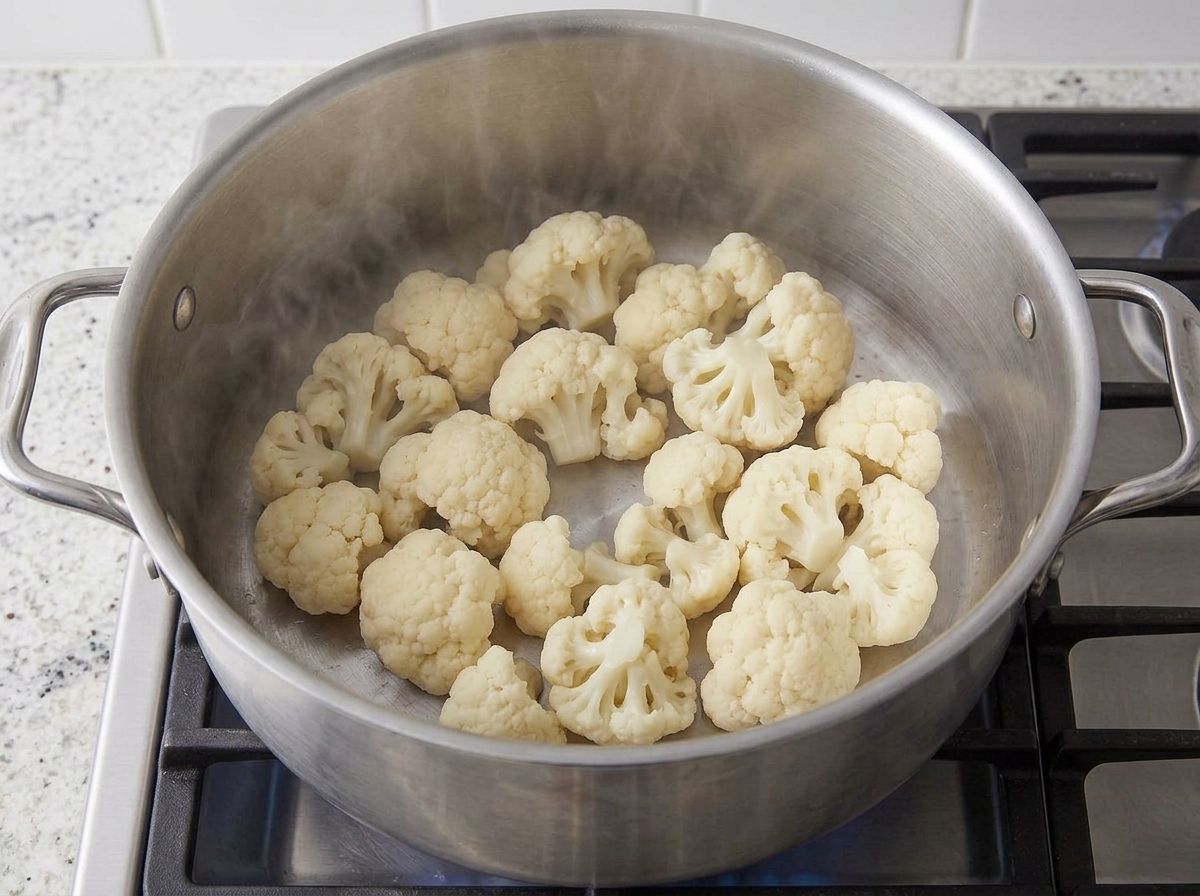
Lift out the basket, tip the water out of the pot and return the florets to the dry hot pot over low heat. Stir gently for 1 to 2 minutes, until you see wisps of steam and the florets look matte rather than wet. This is the step that decides whether you get mash or soup.
- 4
Blend with the garlic butter and cream cheese
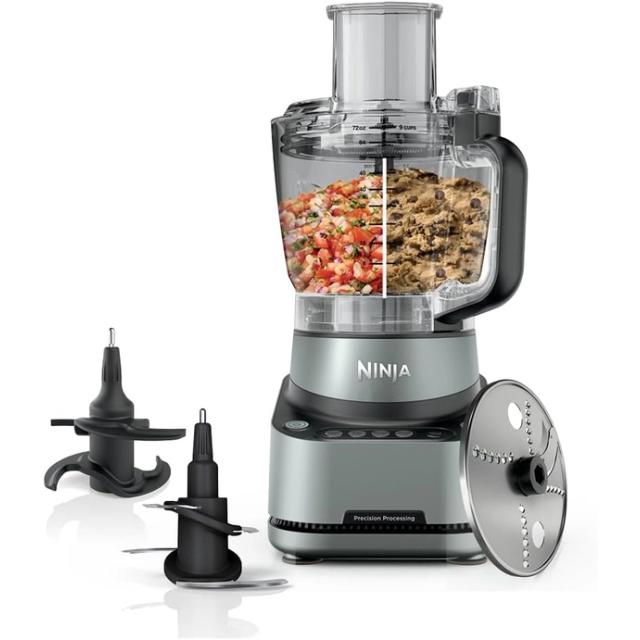
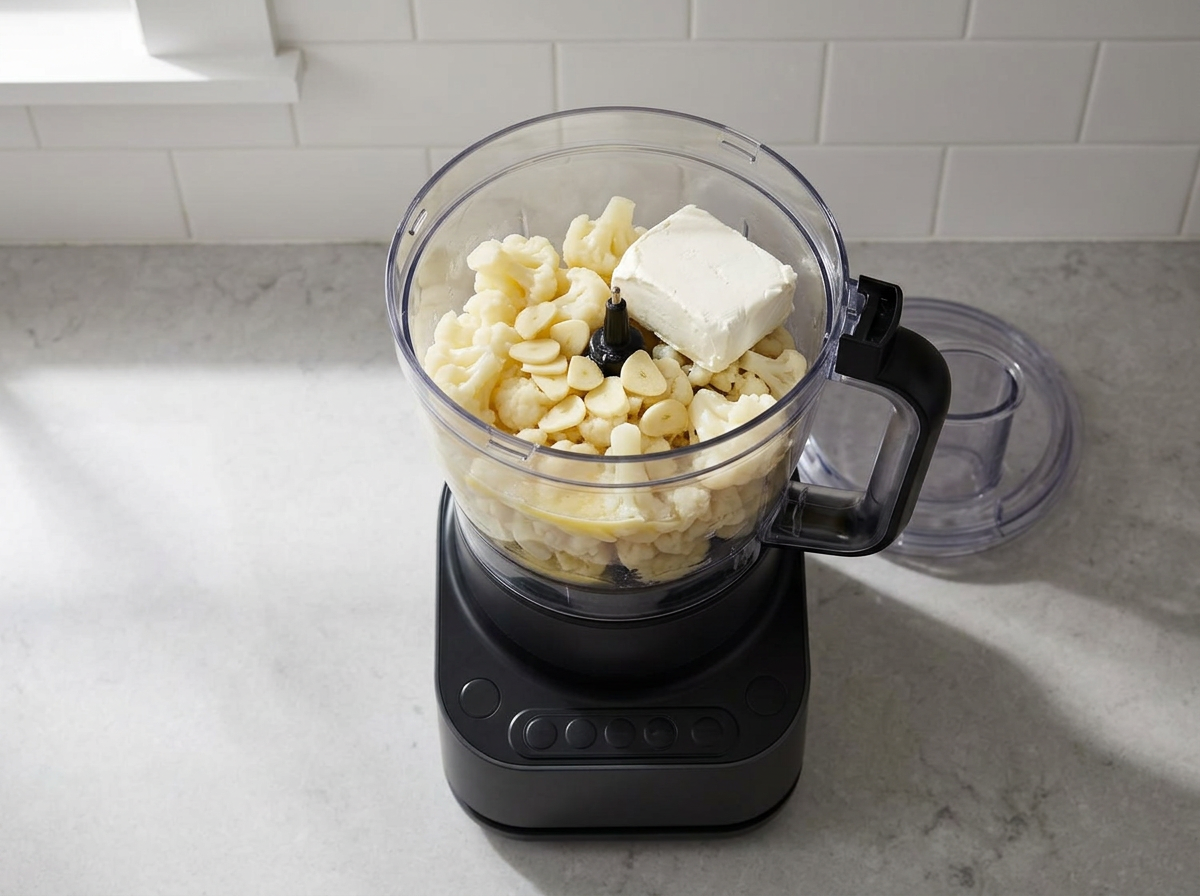
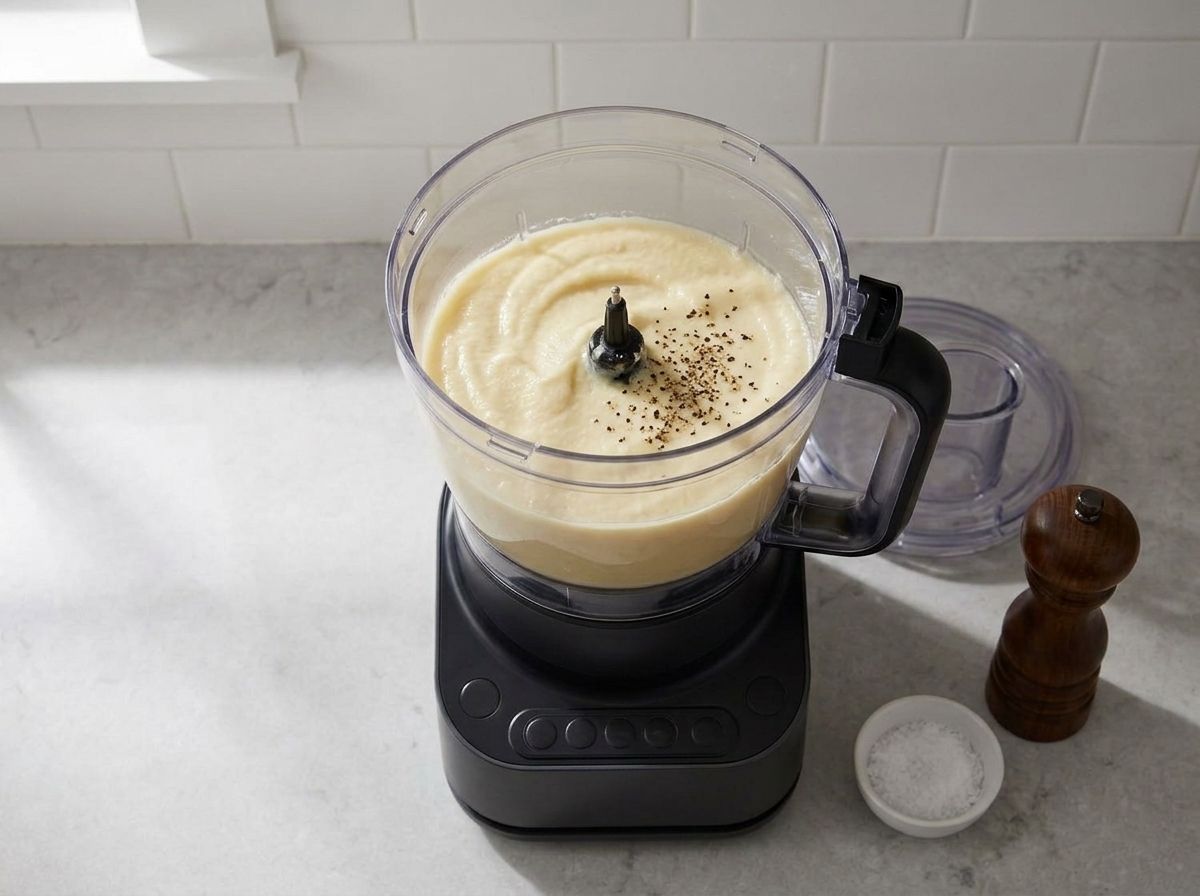
Tip the hot cauliflower into the food processor, scrape in every bit of the garlic butter, and add the cream cheese. Leave the feed tube open so steam can escape, then blend for 30 to 60 seconds, stopping once to scrape down the sides, until it is completely smooth.
- 5
Season, and only then think about milk
Add the salt and a good grind of pepper, pulse to combine and taste. Cauliflower is bland and takes more salt than you expect, so season it properly before you judge the texture. If it is still stiffer than you like, pulse in the milk one tablespoon at a time. Most of the time it needs none.
- 6
Serve it hot
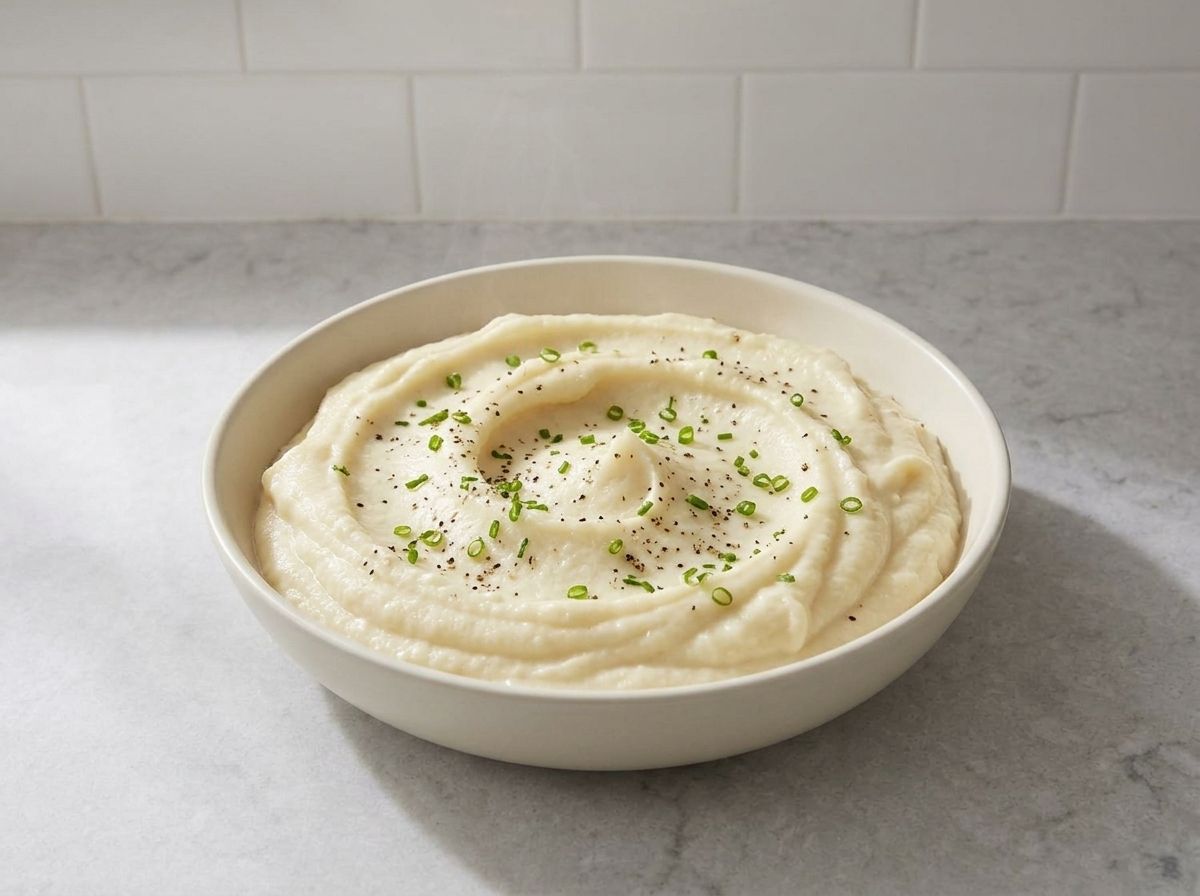
Scrape into a warmed bowl, scatter over the chives if you are using them, and serve straight away. It firms up a little as it stands, and it is at its best in the first few minutes.
Notes
Full-fat Greek yogurt can stand in for the cream cheese, but use about two thirds as much. It is wetter and it will loosen the mash.
For a deeper, sweeter garlic flavor, squeeze a whole head of roasted garlic into the food processor at step 4 and skip step 2, adding the butter straight to the processor instead.
The recipe doubles easily, but steam in two batches or use a wide pot. Florets packed into a crowded basket sit in the condensate and take on water.
Nutrition Facts
4 servings · 217 g per serving
- Calories
- 201 kcal
% Daily Value*
- Total Fat
- 16.2 g21%
- Saturated Fat
- 9.7 g49%
- Sodium
- 580 mg25%
- Total Carbohydrate
- 11.2 g4%
- Dietary Fiber
- 3.5 g13%
- Sugars
- 4.7 g—
- Protein
- 5.5 g11%
Recipe from veggierecipes.blog
When it goes wrong
Troubleshooting
It came out like soup
The cauliflower went into the processor still wet. Steam leaves condensate on every floret and the curds trap more in the crevices between them, and once that is blended in there is nowhere for it to go. Step 3, a minute or two in the dry hot pot until the surfaces look matte instead of glossy, is what prevents it. If it has already happened, stir the purée in a wide pan over low heat until it thickens.
It tastes like cauliflower, in the bad sense
That sulfurous, cabbagey note is not something cauliflower simply has, it is a function of cooking time. Heat breaks its glucosinolates down into isothiocyanates and hydrogen sulfide, and every minute past tender releases more. The 10 to 15 minutes older recipes call for sails well past where that starts. Pull the florets at 8 to 10 minutes, the moment a knife goes into a thick stem without resistance.
There are brown specks through it and it tastes bitter
The garlic browned. Minced garlic in butter over medium heat goes past golden inside the “1 to 2 minutes” recipes usually allow, and a purée this pale hides nothing. Low heat, sliced cloves, off the heat the moment it smells sweet. There is no fixing it after blending, but redoing the step costs two minutes.
It is still grainy, like wet rice
Undercooked. Cauliflower stems are far denser than the curd and stay firm long after the tops look done, which is why the knife test goes into the thickest stem. Graininess cannot be blended out; longer in the processor only makes the mash warmer and grayer. Steam it a few minutes more.
I used a food processor and now I am worried I ruined it
You did not, and this is the one piece of mashed potato lore that does not carry across. Potatoes go gluey in a processor because the blades rupture starch granules and free the starch into the mix. Cauliflower has almost none to free. A processor is the right tool here, a masher only gives you a lumpy version, and you can run it until the purée is as smooth as you want.
It tastes flat even after I salted it
Salt alone will not carry this dish, because there is no acid in it and nothing savory for the seasoning to push against. A squeeze of lemon stirred through at the end is the quickest fix. Two tablespoons of finely grated vegetarian Parmesan blended in at step 4 is the better one, and it adds body too.
Before you serve
Serving & Storage
The classical French way to serve a purée is not in a bowl at the side of the plate. It goes down first, spread in a wide swoop with the back of a spoon, and whatever it accompanies sits on top so the juices run into it. That plays to what this dish is: smoother and glossier than mashed potato, and much better at taking sauce. Spoon it under seared king oyster mushrooms, a wedge of roasted squash, or braised puy lentils.
As a plain side it goes with roasted vegetables, seared tofu, a lentil loaf, or anything that would otherwise have wanted mashed potato. What it will not do is carry a heavy gravy the way potato does. Ladle thick gravy over a mound of cauliflower mash and the mound collapses, because there is no starch holding it up. Serve the gravy alongside, or pour it into a shallow pool of the mash.
It also will not crisp or brown. Leftovers make a poor shepherd’s pie topping: without starch it never sets into a lid, it bubbles and slides off the filling. Where it does work is stirred into a soup, where the same lack of structure makes it a quick thickener.
Making it ahead
It holds for up to two days. Season slightly under where you want it and leave the chives off until serving. Reheat in a pan over low heat with the lid off, stirring, so the water it threw while sitting drives back off instead of being stirred in. A microwave heats it unevenly and does nothing about that water. The mash is at its best in the first ten minutes after blending, so if it is the center of the plate rather than a side, make it the same day.
Storing leftovers
Airtight in the fridge for 3 days. Expect a layer of liquid on the surface by the next morning and pour it off rather than stirring it back through. It freezes for up to 3 months but does not come back the same: ice crystals rupture the cell walls holding the purée together and it thaws grainy and separated. Freeze it only if it is going into a soup or a sauce. To eat it as mash, make it fresh. It takes 25 minutes.
Still wondering
Frequently Asked Questions
Can I make this mashed cauliflower vegan?
Yes. Use plant-based butter and a vegan cream cheese, and leave the milk out. Most vegan cream cheeses are built from soaked nuts or from coconut oil and starch, and nearly all carry more water than the dairy kind, so give the florets 3 to 4 minutes in the dry pot at step 3 rather than 1 to 2. It sets a little looser. A tablespoon of nutritional yeast at step 4 replaces the savory depth the cream cheese was carrying.
Is mashed cauliflower actually low carb?
Yes, by a wide margin. A serving comes to 11.2 g of carbohydrate, 3.5 g of which is fiber, against roughly 35 g for the same volume of mashed potato. It is not a low-calorie dish, though. At 201 calories a serving the butter and full-fat cream cheese are doing real work, and stripping either out is what makes people describe cauliflower mash as bland and watery.
How much cauliflower do I need per person?
About 6 oz (170 g) of trimmed florets per person as a side, which is what this recipe’s 1½ lb (680 g) works out to across four. Buy more than that by weight, because a head loses 30 to 40% of itself to leaves, core and stem: a 2½ lb (1.1 kg) head gives you roughly the 1½ lb you need. For eight, buy two large heads and steam them in two batches.
Featured In These Collections

More Go-To Cozy Veggie Sides
Made this?