
Sweet Potato Cobbler Recipe
Published · Updated
Rounds of sweet potato candied in a brown sugar and orange syrup, under a lattice of pastry and over a hidden layer that bakes soft as a dumpling. This is the Southern cobbler, not a sweet potato pie in disguise.
Jump To Recipe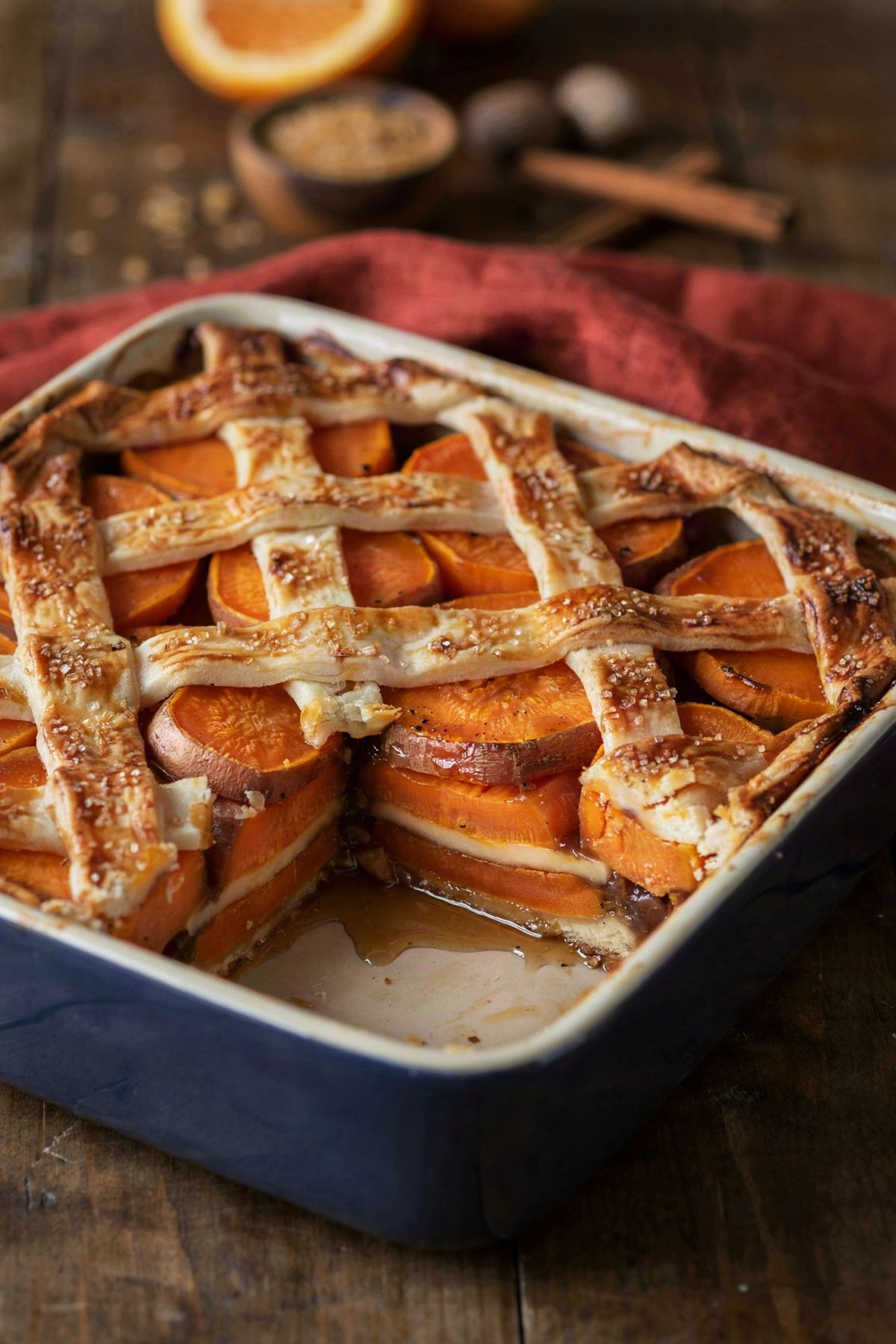
Why I Stopped Making This One as a Pie
For years the sweet potato cobbler I made was a sweet potato pie wearing a different name. Mashed filling, one crust underneath it, forty minutes in the oven. It was a perfectly good pie. It was not a cobbler, and the first time I ate a real one I understood what I had been missing.
What changed my mind:
- the sweet potato still tastes like sweet potato. Rounds that hold their shape in the syrup keep their own flavor, where a mash bound with egg mostly tastes of custard.
- the syrup does something a custard cannot. Brown sugar, orange and butter reducing around the slices lands much closer to candied yams than to pie filling.
- the crust in the middle. Nobody expects a soft layer of pastry down in the filling, everybody asks about it, and it costs one extra round of dough.
Serve it warm in a bowl, with vanilla ice cream sliding off the side into the syrup. It is a spoon dessert rather than a slice, and it is better for it.
The story
A Sweet Potato Cobbler Is Not a Sweet Potato Pie
The two get swapped constantly, and always in the same direction: somebody publishes a sweet potato pie and calls it a cobbler. A pie is a custard, mashed sweet potato bound with eggs and milk, poured into a shell and baked until it sets firm enough to slice. A cobbler is not a custard at all. The sweet potato stays in pieces, sits in a syrup it helped thicken, and gets pastry laid over the top instead of underneath.
The name gives it away. Cobbler in the dessert sense is an Americanism that shows up in print in the 1850s, and the likeliest explanation is the patched, cobbled-together look of dough dropped over fruit. Whatever its root, the word describes what you see from above. A dessert with a smooth surface and its only pastry hidden underneath has failed its own name.
The dish began as a workaround. English settlers who wanted a steamed suet pudding had neither the pudding cloth nor the ingredients, so they put dough over fruit in a Dutch oven and let the fire do the rest. The earliest cobbler recipe anyone has found in print sits in What Mrs. Fisher Knows About Old Southern Cooking, published in 1881. Abby Fisher was born into slavery in South Carolina and could not read or write, so the book was taken down word by word from her instructions. Cobbler enters the written record through Black Southern cooking.
The sweet potato version exists because cobbler is seasonal and the season is the whole argument. Peaches and blackberries carry it through the summer. A cured sweet potato keeps for months in a cool dark place, so this is the cobbler you make in February, when there is nothing left to put in one.
The technique most modern versions drop is the pastry buried in the middle. Traditional Southern cobblers carry crust in two places, squares laid down inside the filling as well as latticed over the top. That inner layer never crisps and is not meant to. It drinks up syrup and comes out somewhere between a noodle and a dumpling, which is why Southern cooks call those middle sheets dumplings outright. Leave it out and you get a decent baked pudding. Put it in and you get the thing people remember from somebody else’s grandmother’s kitchen.
For a vegetarian table it is a piece of luck. A good deal of the Southern dessert repertoire leans on eggs, and a cobbler uses none, so nothing here needs replacing. The only thing worth checking is the pastry, which in America is still sometimes made with lard.
What to buy
Ingredient Notes
Sweet potatoes
Use the moist orange-fleshed varieties American shops label yams: Beauregard, Garnet or Jewel. A slice of those holds its shape in syrup, where the pale dry types such as Hannah and Japanese murasaki go crumbly. Two pounds is about three medium potatoes, and picking them the same thickness is worth a minute at the shelf. Refuse canned sweet potatoes here: they arrive packed in syrup and already fully soft, and they disintegrate in the oven.
Refrigerated pie crust
This is the ingredient that catches vegetarians out. Several widely sold American refrigerated crusts are still made with lard, so read the label rather than assuming. All-butter and all-shortening both work. You need two rounds, one cut into squares for the buried layer and one for the lattice, which is what a standard box holds.
Light brown sugar
The molasses is doing structural work, not just adding flavor. White sugar gives a thin clear syrup that tastes only of sweet; brown gives an opaque one with the caramel edge that makes the dish read as candied yams. Dark brown pushes it further toward molasses, which is a matter of taste. Maple syrup and honey are not swaps, they are liquids, and the ratio breaks.
Cornstarch
A cobbler that runs off the spoon is under-thickened, and the cause is usually technique rather than quantity. Whisk it through the dry sugar and spices before any liquid reaches it, or the granules gel on the outside and stay powdery in, then hold the syrup at a boil for a full minute. Cornstarch does not reach full thickening power until it has actually boiled, so a syrup pulled off at the first bubble looks right in the pan and thins in the oven. Flour is the traditional thickener and still works, but you need twice as much and it comes out cloudy.
Orange juice and zest
The acid is the only thing standing between this and a bowl of sweet starch. Squeeze it fresh if you can, mostly because that gets you the zest, which carries far more of the aroma than the juice. Plenty of old recipes use nothing but the water the potatoes boiled in, so if you would rather not buy an orange, use an extra half cup of that water and a tablespoon of lemon juice.
Freshly grated nutmeg
Ground nutmeg loses most of its volatile oil within months of the jar being opened, and half a teaspoon from a tin that has sat in the cupboard for a year is close to nothing. A whole nutmeg keeps for years and takes fifteen seconds on a microplane.
Old-Fashioned Sweet Potato Cobbler
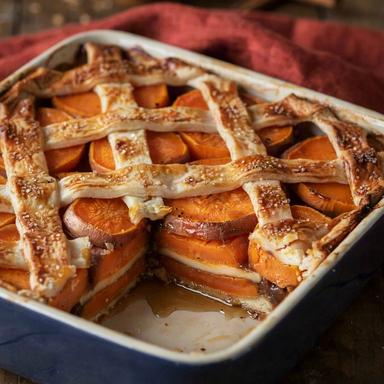
Sliced sweet potatoes candied in a spiced brown sugar and orange syrup, with pastry buried in the middle and latticed over the top. The Southern cobbler, not the pie.
Ingredients
Equipment
As an Amazon Associate I earn from qualifying purchases, at no extra cost to you.
Instructions
- 1
Slice the sweet potatoes
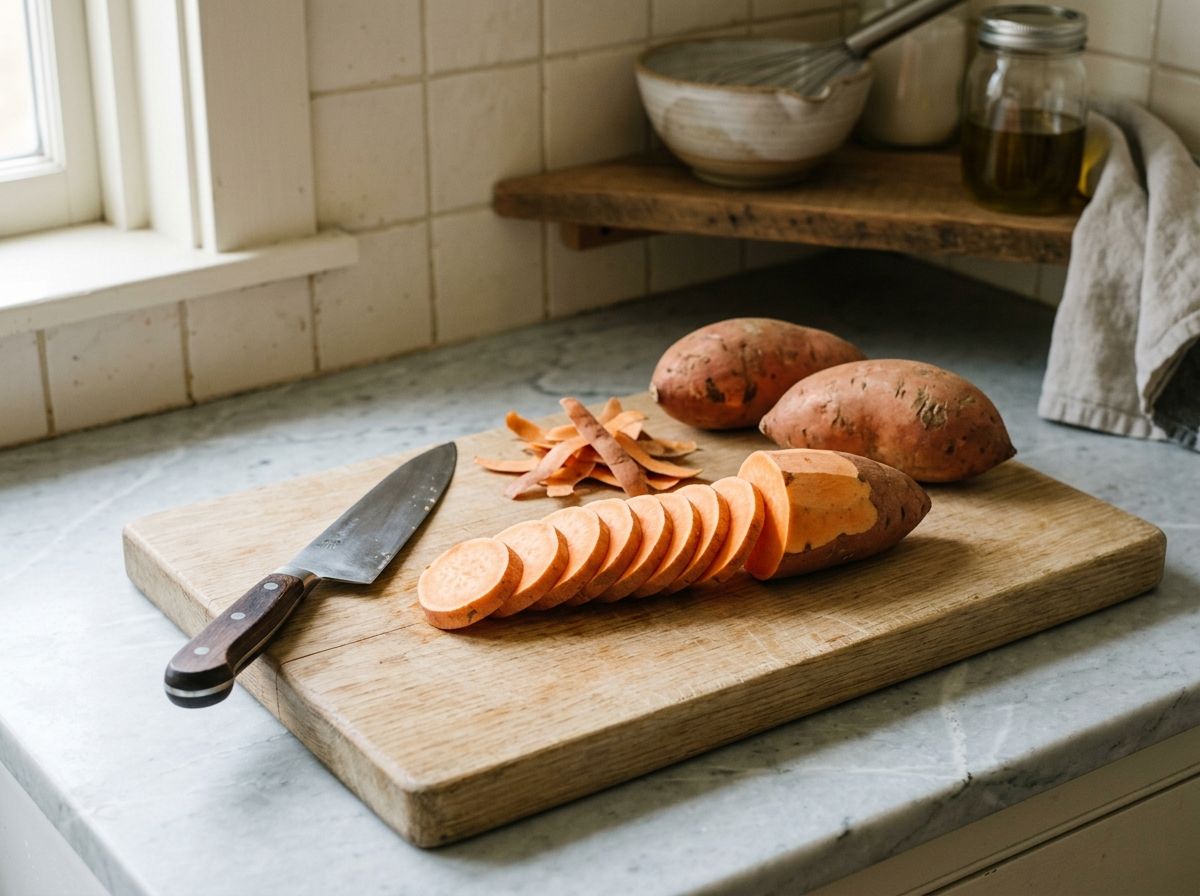
Peel the sweet potatoes and cut them into rounds about ¼ inch (5 mm) thick. Even thickness matters more than neat edges here. Thin slices collapse into puree in the syrup and leave you with a pie, while thick ones stay chalky in the middle.
- 2
Simmer until barely tender
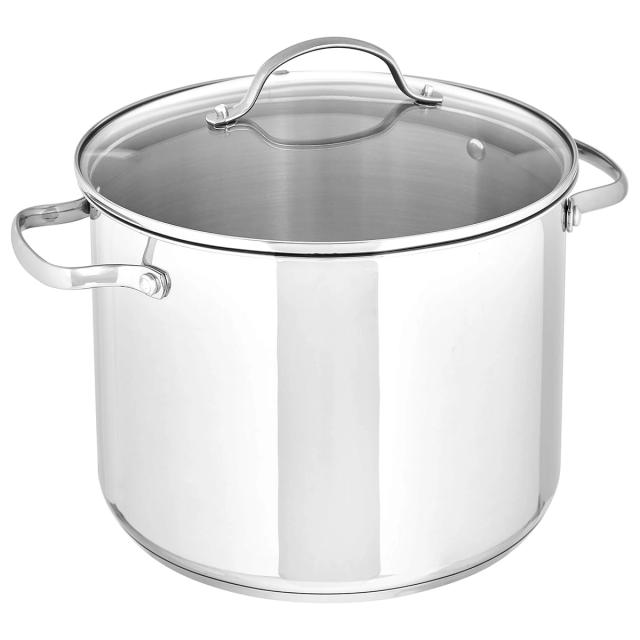
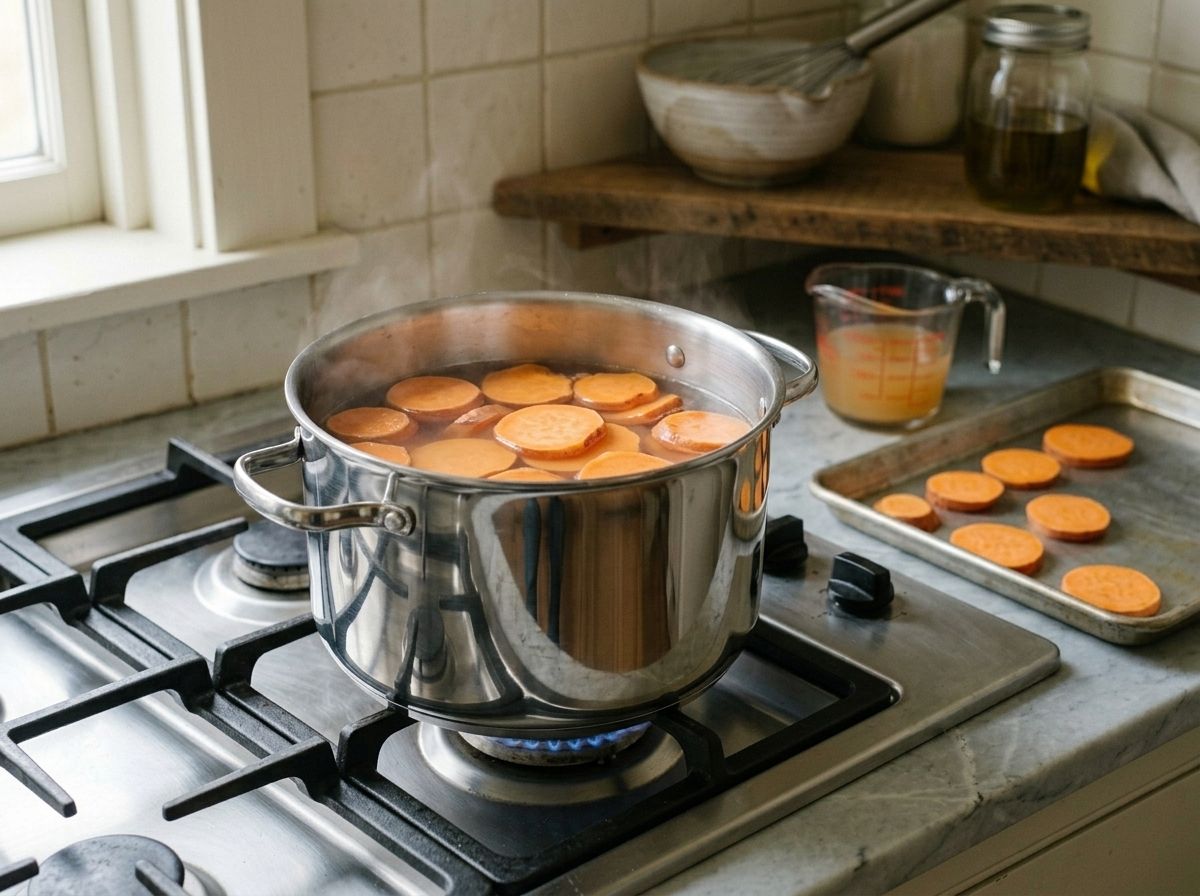
Put the slices in a large pot, cover with cold water by an inch, and bring to a boil. Simmer for 6 to 8 minutes, until a knife tip slides into a slice but still meets a little resistance at the center. Drain them over a bowl, keeping 1 cup (240 ml) of the cooking water, and spread the slices out on a tray so they stop cooking.
- 3
Cook the syrup
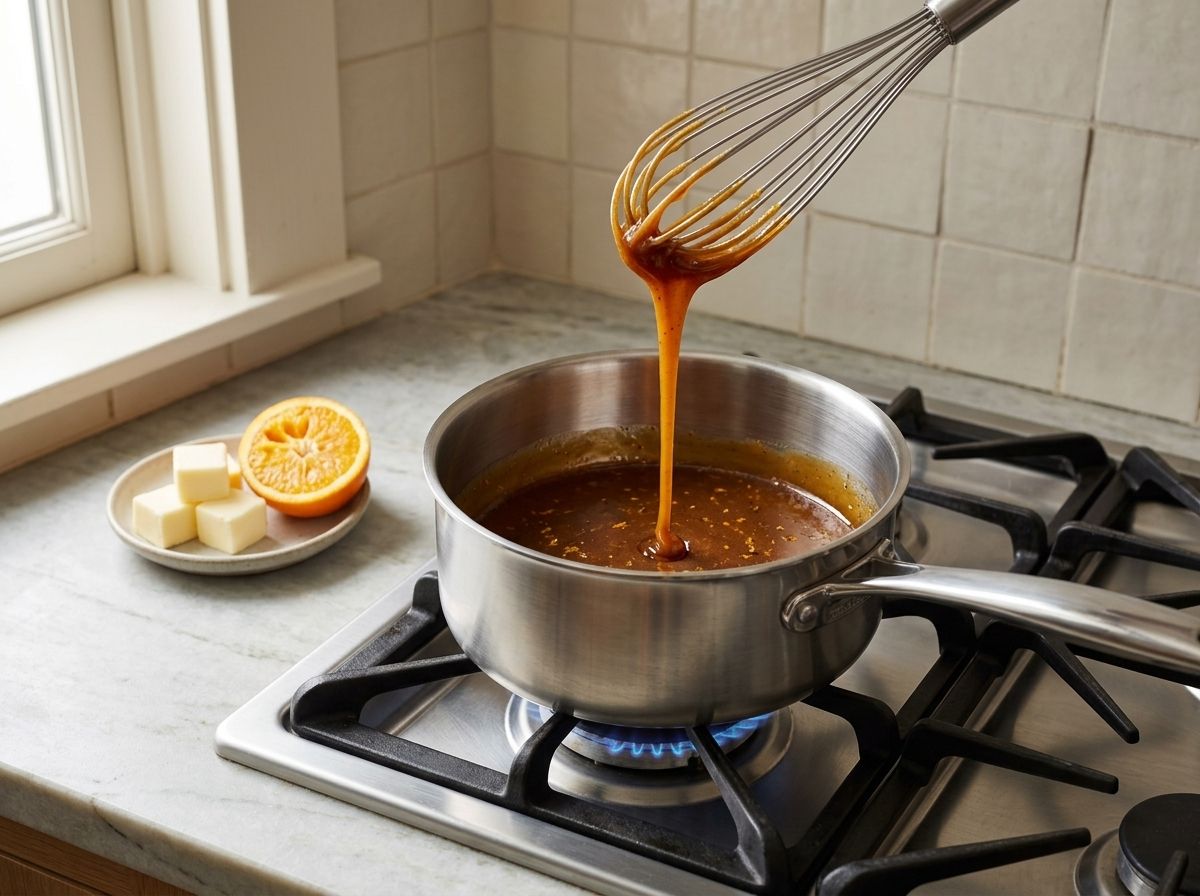
Whisk the brown sugar, cornstarch, cinnamon, nutmeg and salt together in a saucepan while everything is still dry, so the cornstarch cannot lump. Pour in the reserved cooking water and the orange juice, whisk smooth, then bring to a boil over medium heat, stirring the whole time. Let it bubble for a full minute, until it turns glossy and coats the back of a spoon. Off the heat, stir in the butter, vanilla and orange zest.
- 4
Build the middle crust layer
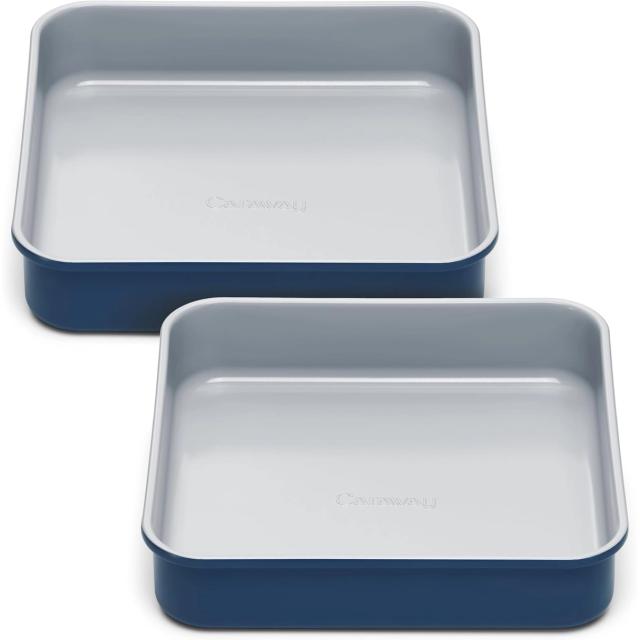
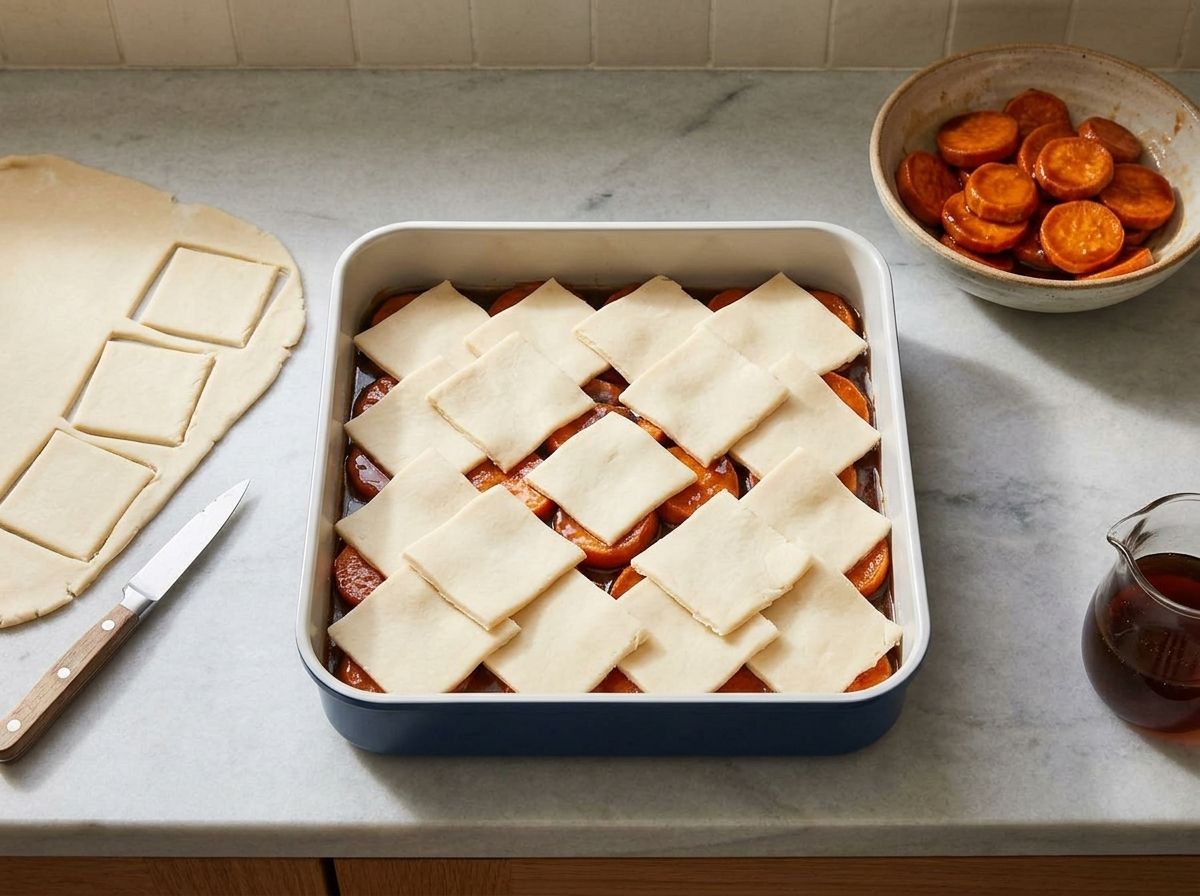
Heat the oven to 375°F (190°C) and butter the baking dish. Cut one pie crust into rough 2-inch (5 cm) squares. Spread half the sweet potato slices in the dish, pour over half the syrup, then lay the squares across in a single overlapping layer. Add the remaining slices and the rest of the syrup.
- 5
Lattice the top and bake
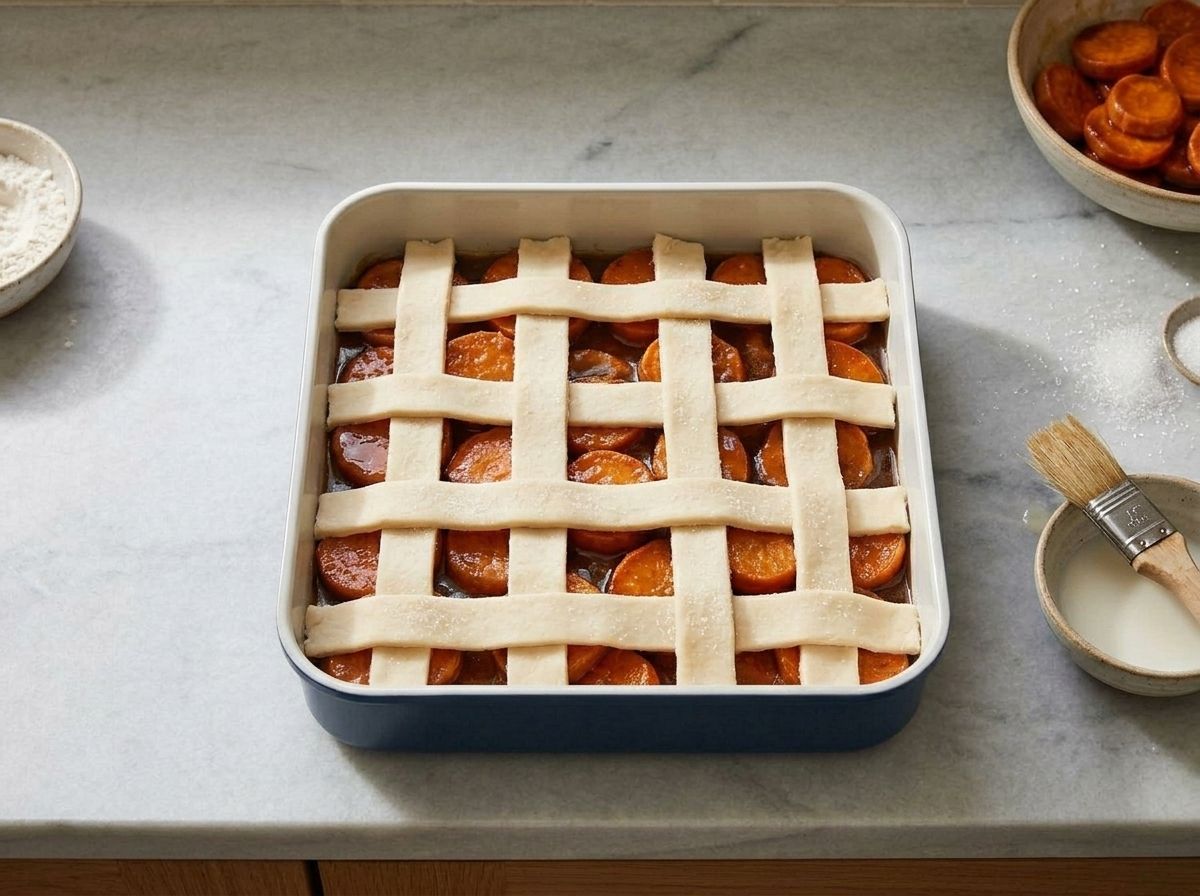
Cut the second crust into strips about 1 inch (2.5 cm) wide and lay them over the top in a loose lattice, leaving gaps for steam to escape. Brush the strips with milk and scatter the granulated sugar over them. Bake for 45 to 50 minutes, until the top is deep golden and the syrup at the edges is bubbling thickly rather than running thin.
- 6
Let it set
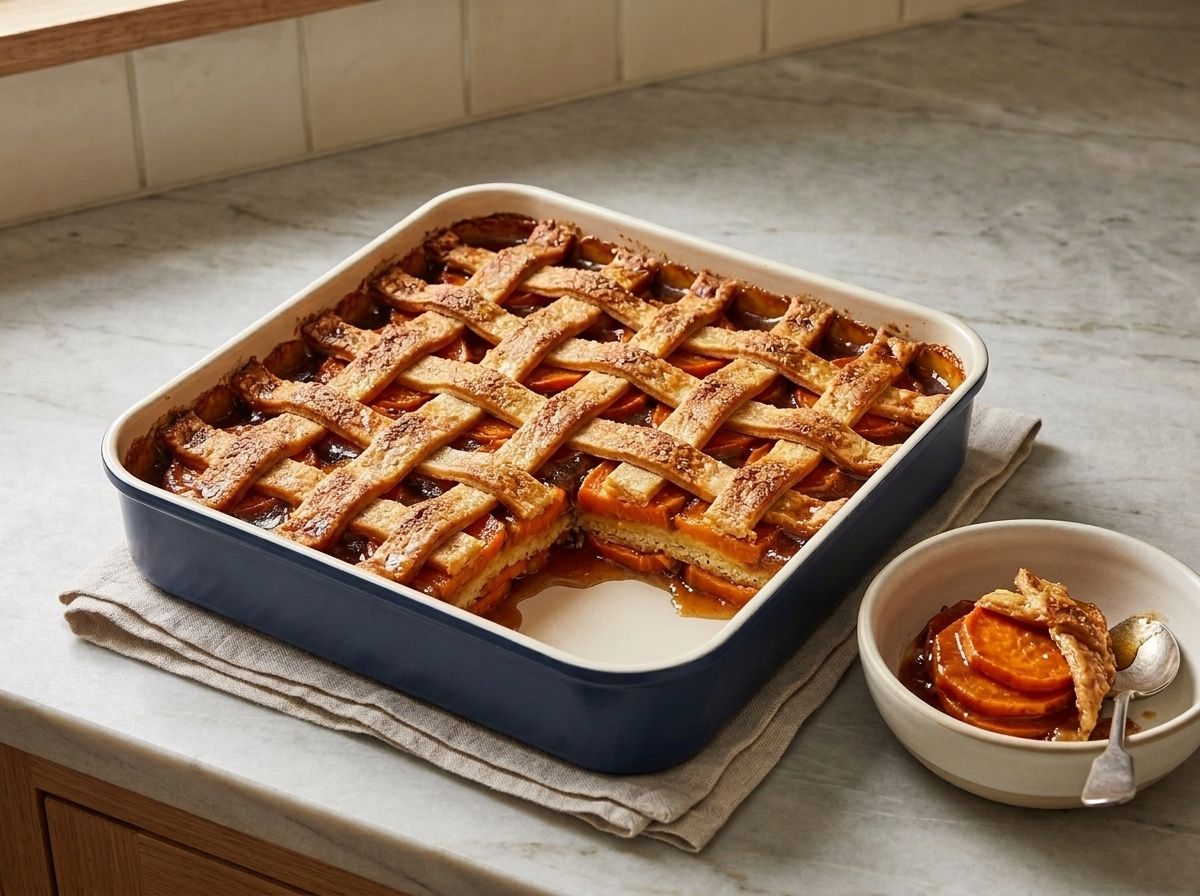
Rest the cobbler for 20 minutes before serving. The cornstarch only finishes thickening as it cools, so a cobbler spooned straight out of the oven runs across the plate. Serve warm.
Notes
Check the pie crust label before you buy. Plenty of supermarket crusts are made with lard, which rules them out for a vegetarian table.
The crust squares buried in the middle are supposed to come out soft. That layer is what makes this a cobbler rather than a pie, and it behaves more like a dumpling than a pastry.
A mandoline gets the rounds even in about two minutes, and even rounds are what stop some slices turning to mush while others stay firm.
Nutrition Facts
8 servings · 259 g per serving
- Calories
- 546 kcal
% Daily Value*
- Total Fat
- 20.3 g26%
- Saturated Fat
- 8.7 g43%
- Sodium
- 426 mg19%
- Total Carbohydrate
- 86.5 g31%
- Dietary Fiber
- 5 g18%
- Sugars
- 41.1 g—
- Protein
- 5.2 g10%
Recipe from veggierecipes.blog
When it goes wrong
Troubleshooting
The crust in the middle came out soft, so I think I did something wrong
You did not, and this is the most misunderstood thing about a Southern cobbler. Pastry sitting in syrup cannot crisp and is not there to. It swells, takes up the spiced liquid and turns into something between a noodle and a dumpling, which is what Southern cooks mean by the dumplings in a cobbler. Crispness is the lattice’s job. If both layers came out soft, that is a different problem: the oven ran cool, or the dish went in too low.
The filling ran all over the plate
Either the syrup never got its full minute at a rolling boil, so the cornstarch never finished swelling, or you served it too soon. Cornstarch does most of its setting on the way back down in temperature, so a cobbler spooned out at ten minutes is always looser than the same one at twenty-five. If it is already running on the table, put it back in a low oven uncovered for ten minutes, then let it cool properly.
The sweet potatoes turned to mush
They were cooked too far before they ever reached the dish. They get another 45 to 50 minutes in the oven, so they have to leave the pot underdone, with a knife still meeting resistance at the center of a slice. Slicing too thin does the same damage; anything under an eighth of an inch has no chance of surviving twice.
It is very sweet but it tastes flat and one-note
Missing acid, missing salt, or both. Sugar with no counterweight reads as heavy rather than sweet, and this is the usual reason a homemade cobbler tastes worse than the one you remember. Do not leave out the half teaspoon of salt and do not skip the orange. If it is already baked, a squeeze of lemon over each portion at the table genuinely rescues it.
The lattice was dark brown before the filling was ready
The sugar on top caramelizes long before the syrup underneath has reduced, and a dish set high in the oven makes it worse. Move it to the middle shelf. Once the top has the color you want, lay foil loosely over the dish for the rest of the bake, then take it off for the last five minutes so the surface dries out again rather than steaming.
Before you serve
Serving & Storage
Cobbler is a bowl dessert and a communal one. It goes to the table in the dish it baked in and gets spooned out, syrup and all, which is why nobody in the South talks about slicing one. Serve it warm rather than hot, about twenty minutes out of the oven, with vanilla ice cream melting into the syrup or cold heavy cream poured straight over. Unsweetened whipped cream is the better call if you used dark brown sugar, because the dish is already carrying plenty.
Making it ahead
Bake it completely, then reheat. That is the only make-ahead route that works. Assembling it raw and holding it overnight is the one to avoid: syrup soaks into the unbaked pastry, the lattice goes gray and slack, and the whole thing bakes up doughy. To split the work, make the filling and the syrup a day early and keep them separately in the fridge, then combine and top with pastry an hour before you eat. A baked cobbler reheats at 350°F (175°C), uncovered, in about 15 minutes.
Storing leftovers
Cover the dish and refrigerate for up to four days. Be honest about the top: the lattice softens overnight and nothing brings back the crackle it had on day one. Fifteen minutes at 350°F (175°C) uncovered gets closest, and it beats the microwave, which warms the filling but leaves the pastry limp. The syrup firms in the cold and loosens as it warms, so cold cobbler straight from the fridge is a denser dessert, which some people prefer for breakfast.
Freezing it
A baked cobbler freezes for up to three months. Cool it fully, wrap the dish in plastic and then foil, and thaw overnight in the fridge before reheating covered at 350°F (175°C) for 25 to 30 minutes, with the cover off for the last 10. Do not freeze it unbaked; raw pastry and wet syrup are the same bad combination as holding it overnight, only slower.
Still wondering
Frequently Asked Questions
Is sweet potato cobbler gluten-free?
Not as written, but closer than most cobblers. The filling here is thickened with cornstarch rather than the all-purpose flour traditional recipes use, so everything except the pastry is already gluten-free. Swap in a gluten-free crust and you are done. Handle it differently, though: with no gluten network holding it together it tears when you lift a 1-inch strip, so cut squares for the top as well as the middle and overlap them instead of weaving a lattice.
Can I make sweet potato cobbler vegan?
Yes, and more easily than most desserts, because a cobbler has no custard in it and so no eggs to replace. Use a block-style vegan butter rather than a soft tub spread, since the spreads carry a lot of water and will thin the syrup. Check the crust for both lard and butter, then buy an all-shortening one or make pastry with a vegan block. Skip the milk wash or use any plant milk. Nothing else changes.
Can I make this in a 9x13 dish instead?
Yes, and it is the right call for a crowd. Multiply everything by one and a half: 3 lb (1.35 kg) sweet potatoes, just under 2 cups (375 g) brown sugar, 3 tablespoons cornstarch, and 1½ cups (360 ml) reserved cooking water with ¾ cup (180 ml) orange juice. You need three crusts, one for the middle and two for the lattice. The layer is barely deeper, so the bake only stretches to 55 or 60 minutes, and it serves 12.
Featured In These Collections
More Comforting Southern-Inspired Desserts
Made this?