
Vegan Miso Soup Recipe
Published · Updated
Vegan miso soup with a proper kombu and shiitake dashi, silken tofu and wakame, and the miso stirred in off the heat so it keeps its aroma.
Jump To Recipe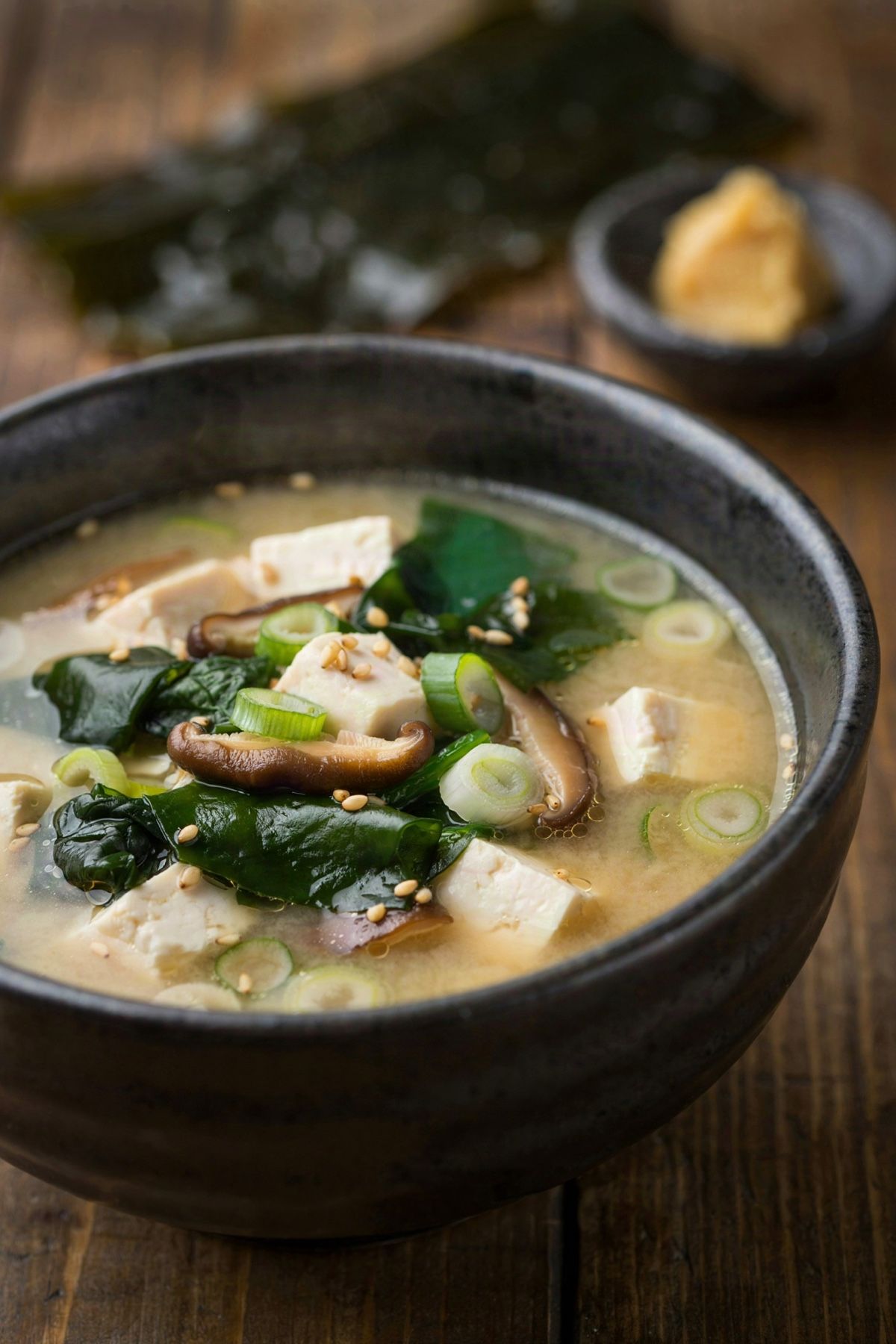
Why Vegan Miso Soup Is a Staple in My Kitchen
There's something incredibly satisfying about a bowl of vegan miso soup. It brings together a deep umami flavor, delicate tofu, seaweed, and crisp green onions into a meal that's both light and filling. Whenever I want something that's quick, nutritious, and still feels like real food, this is my go-to.
The best part is how versatile this soup is. You can take the basic broth and build it into whatever you’re craving on a given day. Some of my top ways to customize it include:
- swapping in different greens (baby spinach, bok choy, or even kale)
- adding noodles for a more substantial meal
- adding fresh mushrooms on top of the dried shiitake that already flavored the broth
- topping with a dash of sesame seeds or a drizzle of chili oil
It earns its reputation honestly too: protein from the tofu, minerals from the wakame, and a fermented paste doing the seasoning instead of a stock cube. The only real waiting is the half hour the kombu and shiitake spend steeping, and you can walk away for all of it.
If you’re after a meal that’s quick, warming, and genuinely satisfying, make this vegan miso soup part of your regular routine. I never get tired of it, and I bet you won’t, either.
The story
Vegan Miso Soup Is The Older Recipe, Not The Substitute
Miso did not start in Japan. It descends from hishio, a Chinese fermented seasoning that arrived by way of the Korean peninsula, most likely alongside Buddhism in the sixth century. What Japan added, around 600 years ago, was a way to propagate single strains of koji mold by mixing the spores with charcoal. That turned koji into something you could buy rather than something you hoped for, miso stopped being a lottery, and by the Edo period most households brewed their own.
The soup came with a meal structure attached. Ichiju-issai, one soup and one dish, was the samurai eating pattern that settled in around the Kamakura period, and the soup in it was miso. The frame has barely moved. Miso soup in Japan is not a starter: it sits beside rice as part of the meal, appears at breakfast more often than dinner, and gets drunk from the bowl rather than spooned.
The vegan question lives in the dashi, not the paste. Alongside mainstream cooking ran shojin ryori, the Buddhist temple cuisine that had worked without fish or meat since the monasteries were founded. Temple kitchens needed a stock and could not use katsuobushi, the dried smoked skipjack that flavors most miso soup today, so they built one from kombu and dried shiitake. Not as a workaround for guests with restrictions. It was the only stock they had, and they had centuries to get good at it.
It runs on the same trick as the fish version, too. Kombu is loaded with glutamate and dried shiitake with guanylate, and glutamate paired with a nucleotide reads as far more savory than the two added up, in the region of seven or eight times either one alone. That synergy is the whole reason kombu and bonito are paired in the first place. Bonito brings inosinate, shiitake brings guanylate, and the receptor on your tongue is not fussy about which. The plant bowl is not a bonito bowl with the bonito removed. It is the same chemistry, worked out first by the people who had no other option.
What to buy
Ingredient Notes
Kombu (dried kelp)
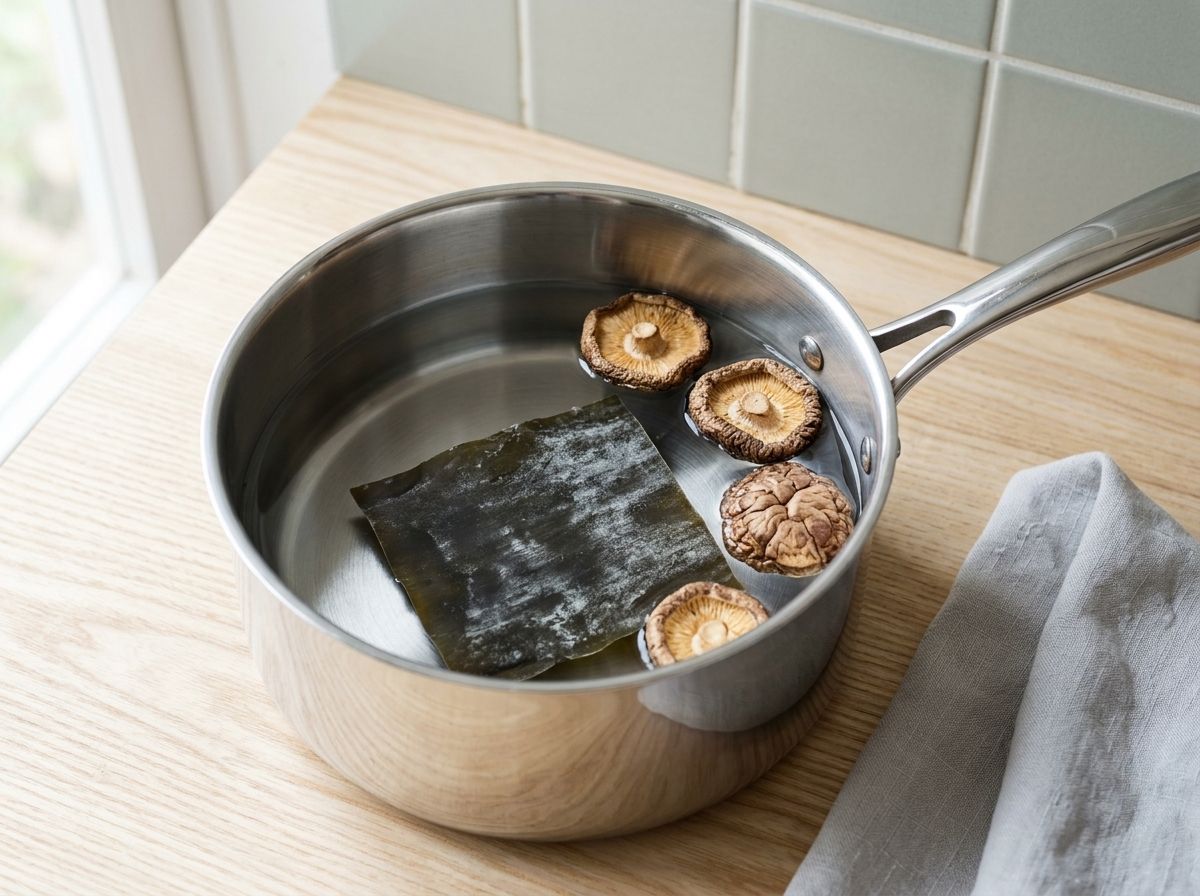
Buy flat leathery sheets, dark green to near-black, and do not wash them. The chalky bloom on the surface is mannitol and much of the savoriness lives there, so wipe with a barely damp cloth and stop. One 4-inch square suits 4 cups of water, and sealed in the dark the rest keeps well over a year.
Dried shiitake mushrooms
Buy whole caps, never pre-sliced, since slices have already lost their aroma to the air. Thick cracked donko cost more and taste more of mushroom than thin flat koshin, though either works. The soak matters: the enzyme that converts the mushroom's ribonucleic acid into guanylate works in cool water and dies in hot, so a cold 30 minutes buys a broth a hot 5 minutes cannot. Never pour the soaking liquid away. It is not a byproduct, it is the dashi.
White or yellow miso paste
Shiro, the pale sweet one, ferments a few months with plenty of rice koji and is what most miso soup uses. Red ferments far longer, is considerably saltier, and takes over a bowl this delicate. Awase is the two blended and a safe middle. Salt varies enough between brands that 4 tablespoons is a starting point rather than a rule, so taste before the last spoonful goes in, and start at 3 with a red or a barley miso.
Silken tofu
Kinugoshi, the silken sort, is what belongs here. It sets in its own container instead of being pressed, so it holds together only just and collapses into soft curds against the spoon, where firm tofu gives rubbery cubes that shove the broth around. The shelf-stable boxed Japanese kind is ideal and cheap. Cut it in the tub with a table knife and tip it straight in.
Dried wakame
Wakame and nori are not interchangeable, whatever a recipe offering you the choice implies. Nori is the pressed sheet from sushi and it disintegrates into slime in hot broth. Wakame comes as dry black-green shreds, often labeled cut wakame, and stays in ribbons. Buy the cut kind and skip the chopping. It is packed in salt, which is why it soaks separately.
Green onions, spinach and bok choy
The green onions are not decoration. They are the raw sharp note the rest of the bowl lacks, so they go on at the table and never into the pan. Slice them thin, green and white both. The spinach or bok choy is where this stops being traditional, and it is a sensible place to do it: neither belongs in a classic bowl, both wilt in the 2 minutes the tofu needs, and they turn a side soup into lunch.
Vegan Miso Soup
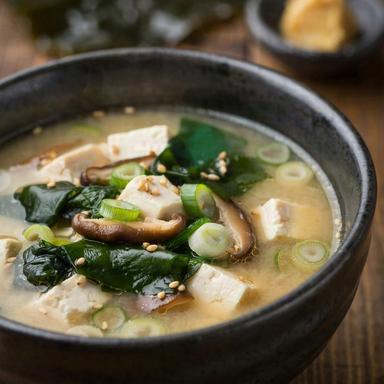
Silken tofu, wakame and shiitake in a kombu and shiitake dashi, with the miso whisked in off the heat so it keeps its aroma.
Ingredients
Equipment
As an Amazon Associate I earn from qualifying purchases, at no extra cost to you.
Instructions
- 1
Steep the kombu and shiitake
Wipe the kombu with a barely damp cloth and leave the white bloom on the surface alone. Put it in a medium saucepan with the dried shiitake and the cold water and leave it to steep for at least 30 minutes, or overnight in the fridge. Use cold water, not hot: the soak is where the mushroom builds its savoriness, and heat stops that before it starts.
- 2
Draw the dashi
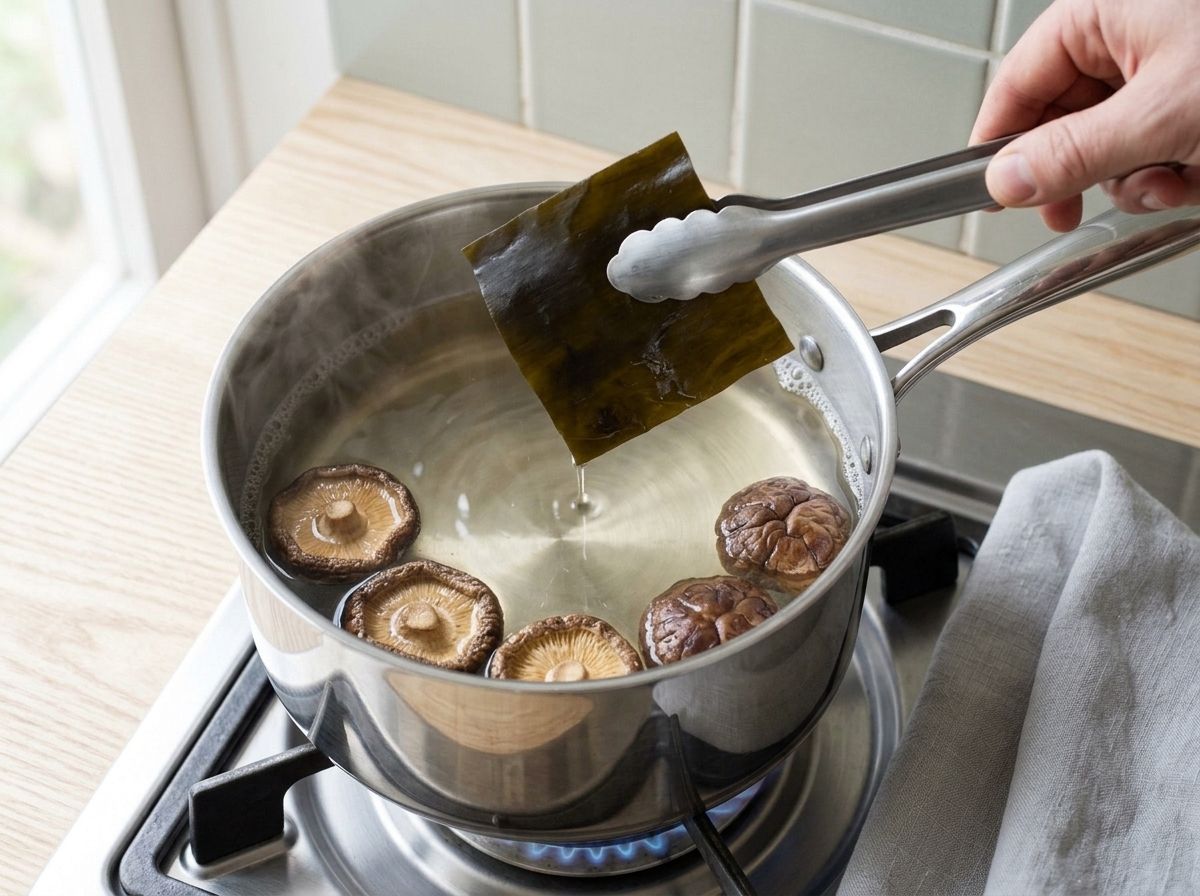
Set the pan over medium-low heat and bring it up slowly, over about 10 minutes. Lift the kombu out just before the surface breaks into a simmer. Kombu held past that point turns the broth slippery and bitter, and there is no undoing it.
- 3
Slice the shiitake back in
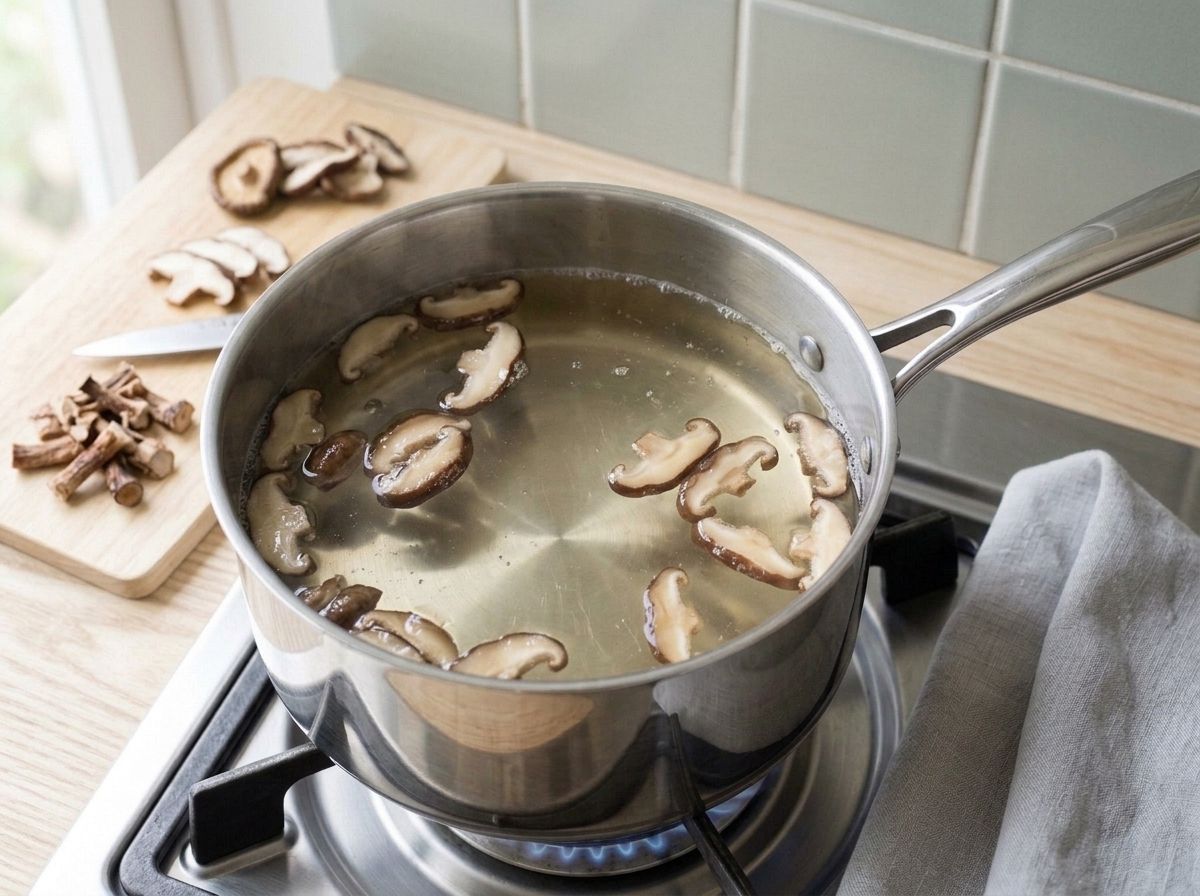
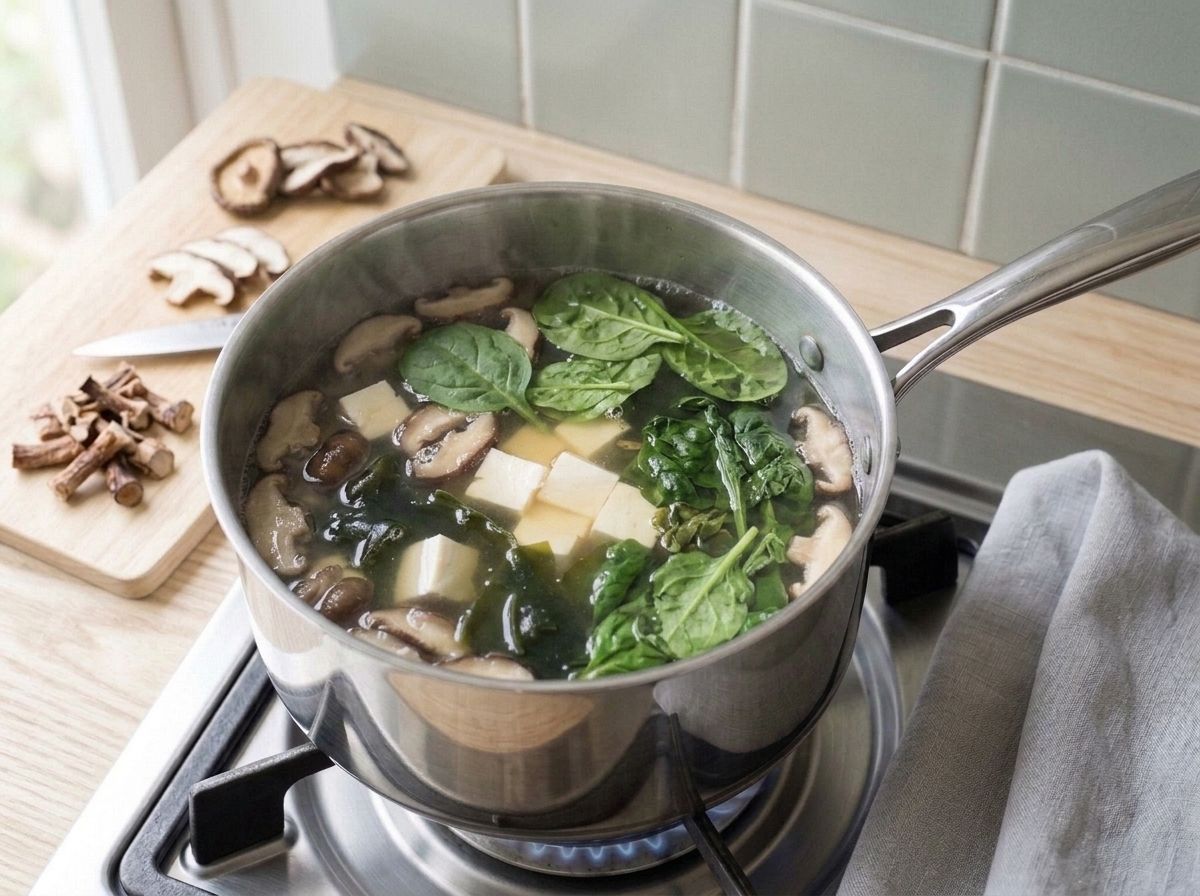
Fish out the shiitake and squeeze the liquid back into the pan. Cut off the woody stems, slice the caps thinly and return them to the broth. Simmer gently for 5 minutes, until the caps are tender.
- 4
Soften the wakame separately
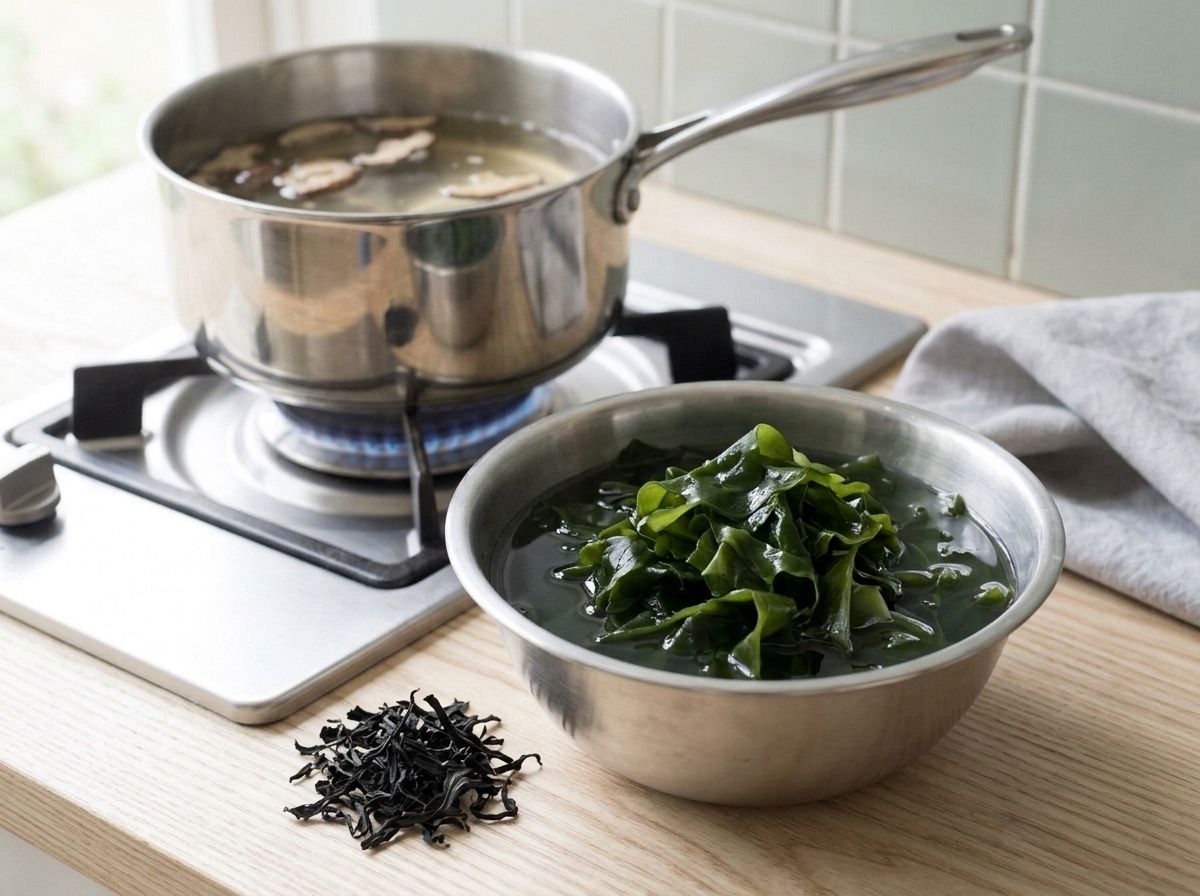
While the shiitake simmer, cover the wakame with cold water in a small bowl for 5 minutes, then drain and squeeze it. It swells about tenfold, so the pinch you started with becomes a handful. Soaking it apart from the pan keeps its packing salt out of the broth.
- 5
Warm the tofu and greens
Slide in the tofu, the drained wakame and the spinach or bok choy. Bring it back to a bare simmer and give it 2 minutes without stirring, until the greens wilt and the tofu is hot through. Move things by swirling the pan, because a spoon shreds silken tofu.
- 6
Miso goes in off the heat
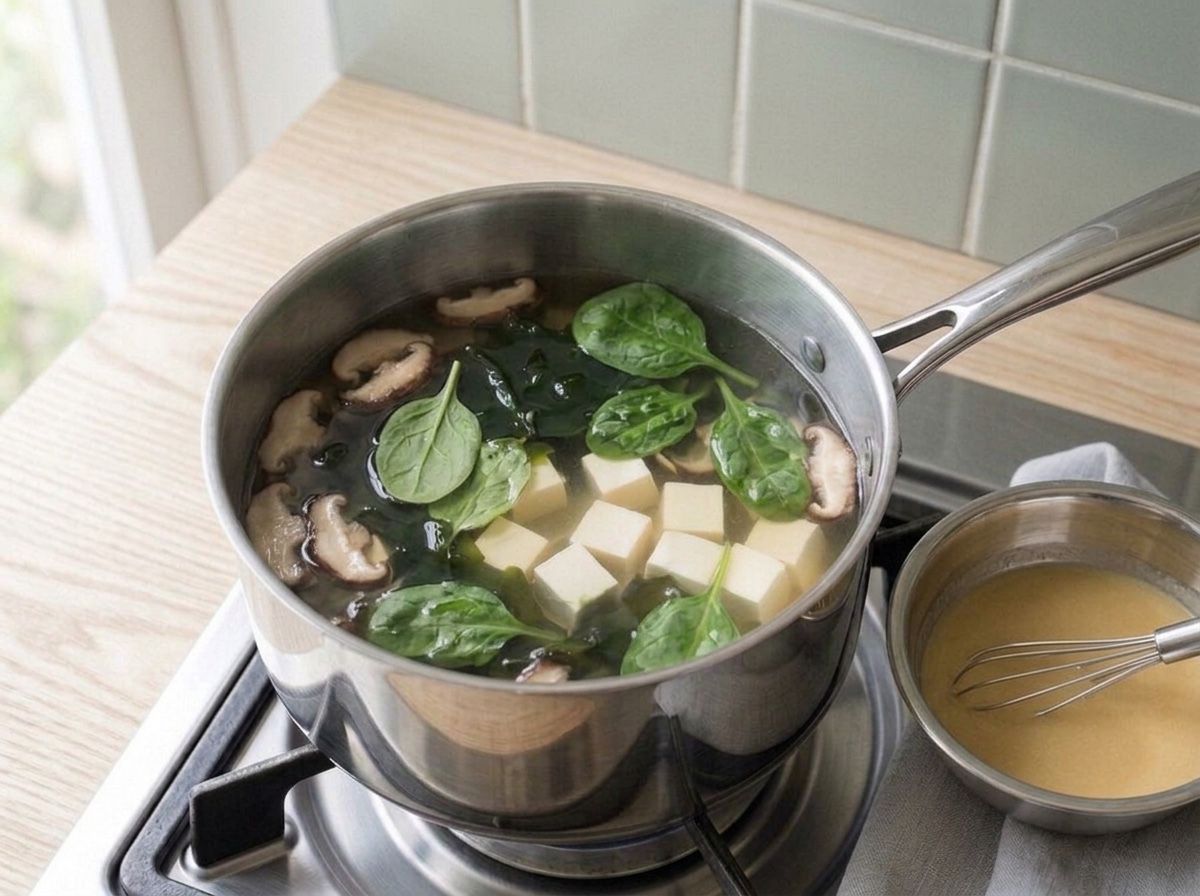
Take the pan off the heat and wait for the bubbling to stop. Ladle a little hot broth into a small bowl, whisk the miso into it until smooth, then stir that back through the soup. Miso added to a simmering pan loses its aroma and turns the broth grainy.
- 7
Taste, then serve
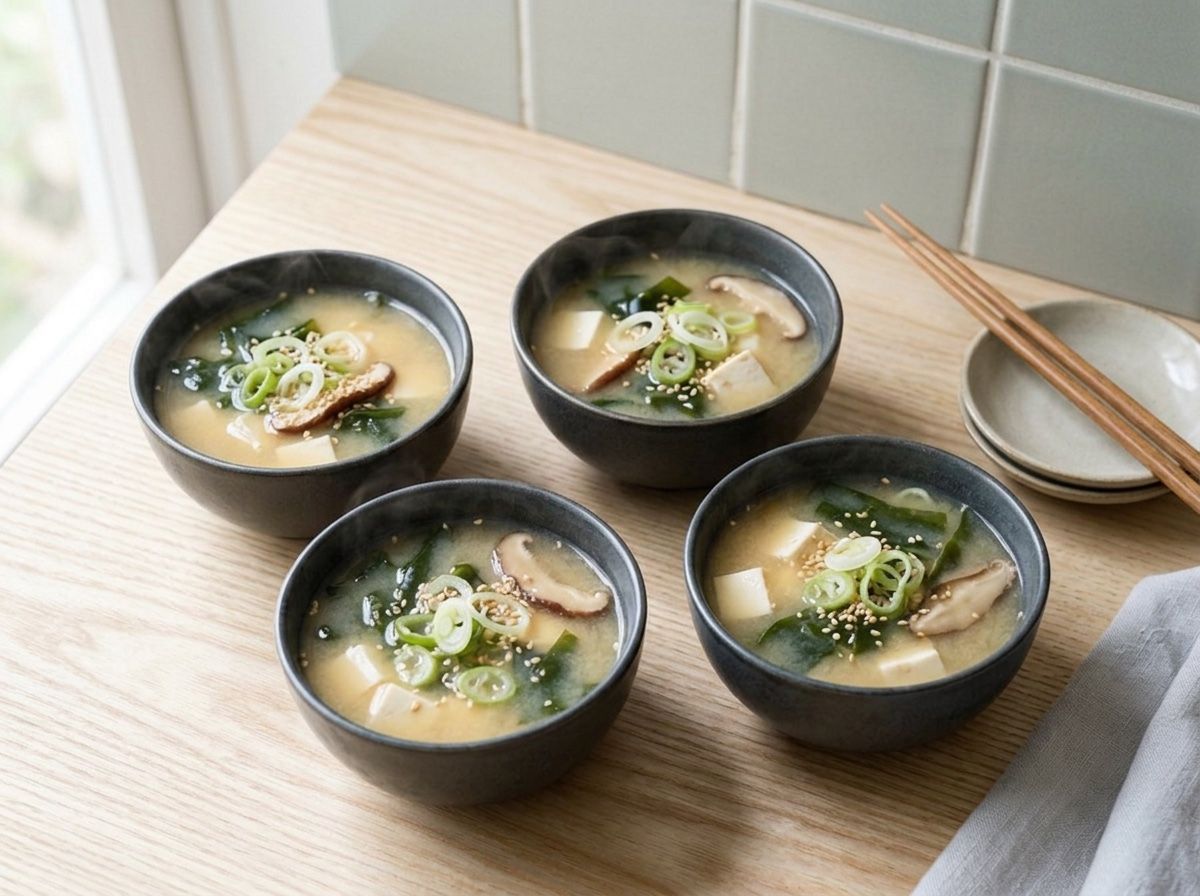
Ladle into four bowls and scatter the green onions over, with sesame seeds if using. Taste before reaching for the soy sauce, because 4 tablespoons of miso in 4 cups of dashi is usually enough on its own. Serve straight away, while the aroma is still there.
Notes
Make the dashi double. It keeps 3 days in the fridge, freezes well, and it is the same broth agedashi tofu is built on.
Short on time: pour just-boiled water over the kombu and shiitake and steep 15 minutes instead of the cold 30. It works, and the broth is thinner for it.
Tamari instead of soy sauce, and a miso labeled gluten free, make this gluten free. Most miso ferments on barley or wheat koji, so read the label.
Add pre-cooked soba, udon or rice noodles to the bowl, not the pan. Noodles boiled in the soup shed starch and cloud the broth.
Nutrition Facts
4 bowls · 346 g per serving
- Calories
- 90 kcal
% Daily Value*
- Total Fat
- 3.1 g4%
- Saturated Fat
- 0.5 g3%
- Sodium
- 765 mg33%
- Total Carbohydrate
- 10.5 g4%
- Dietary Fiber
- 2 g7%
- Sugars
- 2.3 g—
- Protein
- 6.3 g13%
Recipe from veggierecipes.blog
When it goes wrong
Troubleshooting
It tastes like salt water and the smell has gone
The miso boiled. Nearly every recipe that says to stir the miso in and then simmer sets you up for this: the aroma leaves with the steam, the paste separates so the broth goes cloudy and grainy, and the salt is all that survives. Once it has happened there is no fix beyond whisking another spoonful in off the heat to put some aroma back.
The broth is slippery and there is a bitter edge underneath
Kombu, left in too long or boiled. Kelp releases glutamate gently at low temperature and alginates aggressively once hot, and the alginates are both the slimy mouthfeel and the bitterness behind it. If you wandered off and the pan is already simmering, take the kombu out at once and accept a rougher broth. Cooking it longer deepens the bitterness rather than driving it off.
It tastes like vegetable soup with miso stirred into it
You used vegetable broth. Most vegan miso soup recipes tell you to, and it is why so many of them are forgettable. Western stock is built on carrot, celery, onion and often tomato, and those flavors do not vanish behind miso, they sit alongside it and argue. Kombu and shiitake give depth with almost no flavor of their own, which is exactly what a miso broth needs. If there is already broth in the pan tonight, cut it half and half with water and drop in two dried shiitake as it heats.
The tofu came apart into shreds
Either it was stirred or it was the wrong block. Silken tofu sets barely firmer than custard and a spoon dragged through the pan shears it, so add it, swirl the pan, and leave it alone. If it fell apart the moment it went in and you were gentle, check the tub, because some brands sell a very soft unpressed tofu as silken.
There is far more seaweed than soup
Wakame rehydrates about tenfold, which catches out anyone scaling a recipe that measures it by the cup rather than by weight. Two tablespoons dry is right for four bowls. If you have overdone it, lift some out with a slotted spoon before the miso goes in, because you cannot dilute your way out without thinning the seasoning too.
It separates in the bowl and leaves sediment at the bottom
Not a fault. Miso is a suspension of ground fermented soybean rather than a solution, so the solids drift down as soon as the bowl stops moving. Bowls in Japan do this within a minute of being poured and nobody minds. Stir the pan before each ladleful, and swirl your own bowl halfway down. What is not normal is graininess and a flat taste together, because that pair means the miso was cooked.
Before you serve
Serving & Storage
In Japan this arrives as part of a meal rather than before one: ichiju-issai, one soup and one dish alongside rice, and it turns up at breakfast far more often than at dinner. There is no spoon. You pick the tofu and wakame out with chopsticks and drink the broth from the bowl, which is worth trying at home, because the aroma is most of the pleasure and a spoon holds it under your chin instead of in front of your face.
With the dashi already made, the obvious partner is agedashi tofu, built on the same broth, so doubling the dashi at the start covers both. Otherwise short-grain rice and something pickled makes a complete and quick meal. For lunch on its own, put cooked soba or udon in the bowl and ladle over, leaving the miso quantity where it is, because the noodles bring their own salt.
Making it ahead
Make the dashi, not the soup. Cold-steeped kombu and shiitake keep 3 days in the fridge and freeze for a couple of months, and the longer soak improves them. With a jar ready this becomes a 5-minute recipe. The finished soup will not wait: the greens go drab within an hour, the wakame keeps softening, and reheating puts the miso back over heat.
Storing leftovers
Two days in a sealed container in the fridge, reheated gently to just under a simmer, never to a boil. It will not taste the way it did the first time, because the aroma you lost cannot be put back. A fresh spoonful of miso whisked in off the heat does more for a reheated bowl than careful warming does.
Freezing does not work, and it fails in a way worth knowing. Silken tofu frozen and thawed comes out spongy and riddled with holes, its water having crystallized and torn through the protein network. Japan does this deliberately and calls the result koya-dofu, a dried frozen tofu made on Mount Koya for centuries and prized for exactly the texture you would be creating by accident. It is a good ingredient, and it is not what you want in a bowl of miso soup.
Still wondering
Frequently Asked Questions
Is miso soup vegan?
The recipe on this page is. Miso soup in most Japanese restaurants, and almost every instant sachet, is not, and the reason is the stock rather than the paste. Standard dashi uses katsuobushi, dried smoked skipjack shaved into flakes. The miso itself is soybeans, salt and koji, so it is nearly always vegan alone, though a few ready-made soup pastes have fish extract blended in. Eating out, ask what the dashi is made from. The answer you want is kombu, shiitake, or shojin ryori.
Is this miso soup gluten free?
Everything but the seasoning already is. Miso is the complication, because koji grows on a grain and which grain decides the answer. Mugi miso uses barley, which has gluten. Rice-koji miso, covering most white and yellow, has no gluten-bearing grain in the recipe, but many producers ferment it in a facility that also handles barley miso, so read the label rather than the ingredient list. Mame miso, soybeans and nothing else, is the safest of the three. Swap the optional soy sauce for tamari and that is the job.
Does miso soup actually contain live probiotics?
Usually not, and the standard advice to add miso off the heat to protect them is right about the method for the wrong reason. Most supermarket miso is pasteurized, and anything sold shelf-stable certainly is, so the cultures are gone before the tub reaches you. Even with an unpasteurized nama miso, live cultures do not survive much above 115°F, and hot dashi clears that whether the pan is on the burner or off. Off the heat is still correct, because it keeps the aroma and stops the broth going grainy.
Featured In

More Asian-Inspired Cozy Soups

Made this?