
Vegan Mushroom Gravy Recipe
Published · Updated
A deeply savory vegan mushroom gravy, packed with umami and silky texture, perfect for elevating mashed potatoes, roasted veggies, or anything craving cozy comfort.
Jump To Recipe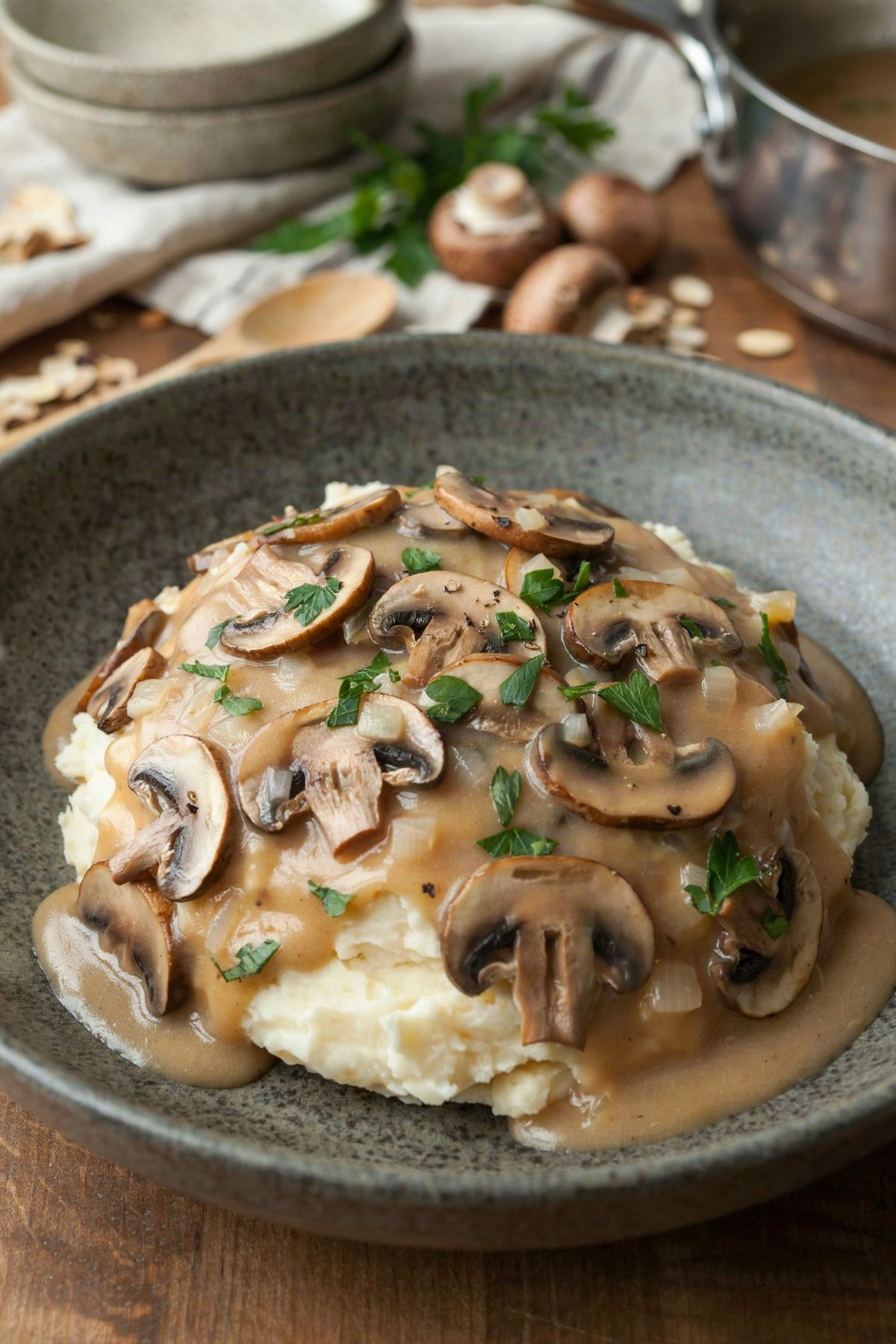
Why I Love This Vegan Mushroom Gravy
There’s something undeniably satisfying about a gravy that’s rich, earthy, and completely plant-based. For me, mushroom gravy is a non-negotiable at any holiday table, but I’d be lying if I said I didn’t make it year-round. The combo of sautéed mushrooms, onions, and garlic builds a classic depth of flavor that’s pure vegan comfort food.
When I’m looking for a gravy that’s easy, adaptable, and crowd-pleasing, this is the one I turn to. It hits all the right notes:
- Rich, full-bodied flavor from mushrooms and onions
- Silky, pourable consistency that hugs mashed potatoes or biscuits
- Simple, wholesome ingredients, no weird thickeners or additives
It also reheats beautifully, so you can make it in advance or enjoy leftovers the next day. Whether it’s smothering a nut roast or just taking your potatoes to the next level, this mushroom gravy delivers every time.
The story
Vegan Mushroom Gravy Is Not an Imitation of Anything
The word itself may be a medieval slip of the pen. Middle English cookbooks call this sort of sauce a gravé, and the best guess at where that came from is the Old French grané, a spiced broth thickened with almonds or bread, named for grain in the sense of spice. The letters u and n are near enough identical in a lot of medieval hands, so grané was read as gravé, and the misreading stuck hard enough to give English a word. The theory is not settled, in fairness: it traces back to the 19th-century lexicographer Frédéric Godefroy, who has been accused of tidying his own citations to fit it. But the older meaning is not in doubt. A gravy was a spiced, savory liquid long before it was the fat and juices off a roast.
That matters here, because it makes the meatless version the older idea rather than the substitute. English cooks spent the 18th and 19th centuries getting savory depth out of mushrooms. What they called ketchup was, for most of that period, mushroom ketchup. Hannah Glasse published a recipe in The Art of Cookery, Made Plain and Easy in 1747 that salts mushroom flaps overnight, boils and strains the black liquor that runs off them, and bottles it with mace and cloves. Cooks kept a bottle on the shelf the way we keep soy sauce, and reached for it whenever a sauce needed weight and color. Tomato only took the name over in the 19th century.
So a mushroom gravy is not an impression of a meat one. It comes down a parallel line that has been running for three hundred years, and the two traditions have borrowed from each other rather than one copying the other.
There is a specific reason mushrooms can carry that weight, and it is more useful than calling them earthy. Savory taste comes from glutamate, which mushrooms have plenty of, but glutamate alone is only half the story. The receptor that registers umami, T1R1 paired with T1R3, fires far harder when glutamate arrives alongside a 5′-ribonucleotide. In mushrooms that nucleotide is guanylate, and the difference is not marginal. In human testing, glutamate plus a nucleotide reads as roughly seven to eight times more savory than the same glutamate on its own.
Drying is what turns that from a footnote into a technique. A fresh mushroom holds very little guanylate. Drying ruptures the cells and lets the mushroom’s own ribonuclease chew its RNA into 5′-nucleotides, and dried mushrooms can end up with something like ten times the guanylate of fresh ones. That is why 15 g of dried porcini does more for this gravy than another 200 g of fresh mushrooms would, and why the soy sauce is not simply there for salt. The soy brings the glutamate, the porcini brings the guanylate, and the two together are the whole trick.
It also makes this one of the very few vegan recipes on a holiday table that needs no stand-in. No beef-flavored bouillon doing an impression, no gravy browning for color. The savory comes from the ingredients being exactly what they are.
What to buy
Ingredient Notes
Cremini mushrooms
Buy them whole and slice them yourself, around 5 mm (¼ inch) thick. Pre-sliced mushrooms are cut thin so they look generous in the punnet, and at that thickness they collapse into threads during the simmer. Do not soak them. A mushroom will take on water if you leave it sitting in a bowl, and every drop you add is a drop you have to boil off again. Wipe them, or rinse them fast under the tap and dry them straight away. Slightly wrinkled mushrooms that have been in the fridge a few days actually brown better than glossy fresh ones, because there is less water to drive off.
Dried porcini (optional)
This is the one item worth going out of your way for, and 15 g is enough to change the gravy completely. Buy porcini specifically. Bags labeled mixed forest mushrooms or wild mushroom medley are usually padded out with cheap oyster and shiitake trim and taste thin. Look through the bag: you want large pale slices with visible sponge on the underside, not the dust and crumbs the cheap ones settle into. Porcini grow in sandy soil and never come fully clean, so the last spoonful of soaking liquid always carries grit. Leave it in the bowl. Porcini powder works too, about 2 teaspoons, and skips the soak, but you lose the pieces.
Vegan butter
Buy the block or stick, not the tub. Tub spreads are formulated with far more water, sometimes close to half, and water is the one thing a roux cannot use. It spits when it hits the pan, and then the flour has less fat to dissolve into than the recipe assumes, which is how you get lumps in a method that should not produce any. If a spread is all you have, use olive oil instead and accept a slightly leaner gravy.
Vegetable broth
This decides more of the final taste than anything else on the list. Most supermarket vegetable broth is built on carrot and celery and comes out noticeably sweet, which fights everything else here. Taste yours on its own before you commit to it. If it tastes like sweet vegetable water, either switch to a mushroom broth or lean harder on the soy sauce and the porcini. Buy low-sodium where you can, because the soy sauce already brings a lot of salt and a reducing gravy concentrates whatever was in the broth to begin with.
Soy sauce or tamari
Check the label for naturally brewed. The cheap alternative is made by boiling soy protein with hydrochloric acid, which takes days instead of months and tastes like it: sharp, salty and flat, with none of the depth. A brewed sauce has been fermented, and that fermentation is where its glutamate comes from, which is the half of the umami equation the porcini cannot supply. Tamari is the gluten-free version and behaves identically. Dark soy sauce is a different product, thicker and molasses-sweet, and it will push the gravy towards caramel.
Dry sherry or white wine (optional)
Fino or amontillado, or any dry white you would happily drink. Not cream sherry, which is sweet, and not the salted bottle sold as cooking sherry, which will wreck your seasoning before you have started. Worth knowing on a vegetarian site: wine and sherry are not automatically vegan. Many are fined with isinglass from fish swim bladders, or with gelatin, casein or egg white. The fining agent is filtered out and does not have to appear on the label, so look for a bottle marked vegan or unfined. If that is a hassle, deglazing with broth costs you a little brightness and nothing else.
Savory Vegan Mushroom Gravy
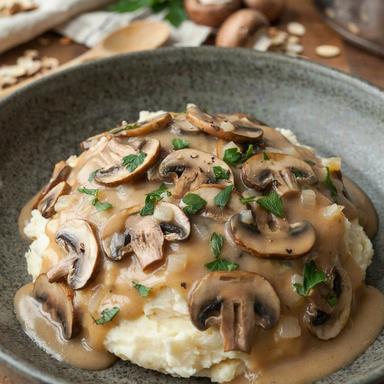
A rich, velvety vegan mushroom gravy packed with umami and perfect for smothering mashed potatoes or nut roasts.
Ingredients
Equipment
As an Amazon Associate I earn from qualifying purchases, at no extra cost to you.

Instructions
- 1
Soak the dried porcini
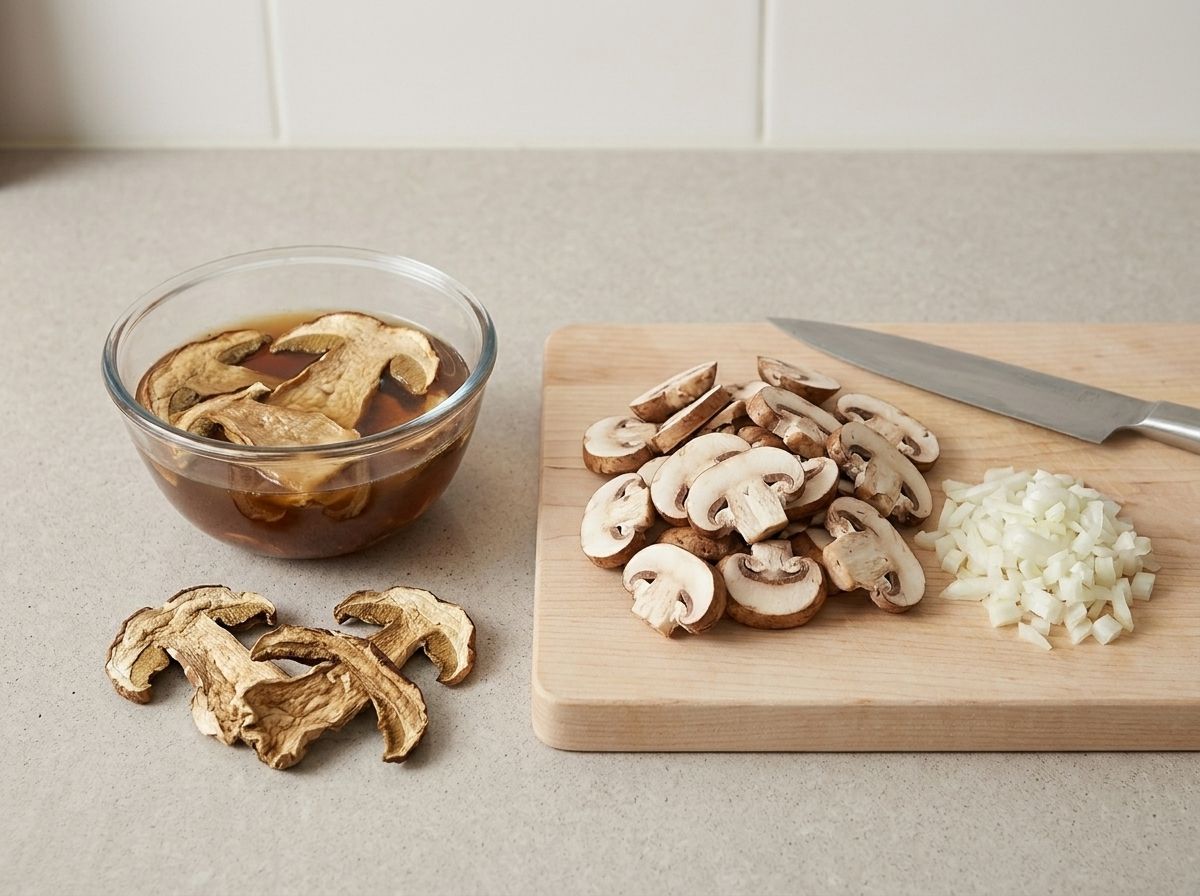
If you are using porcini, warm 120 ml (½ cup) of the vegetable broth and pour it over the dried mushrooms. Leave them for 15 minutes while you slice everything else. Lift them out, squeeze them over the bowl, and chop them finely. Keep the soaking liquid, but pour it off carefully and leave the last spoonful behind, because the grit settles there.
- 2
Brown the mushrooms hard
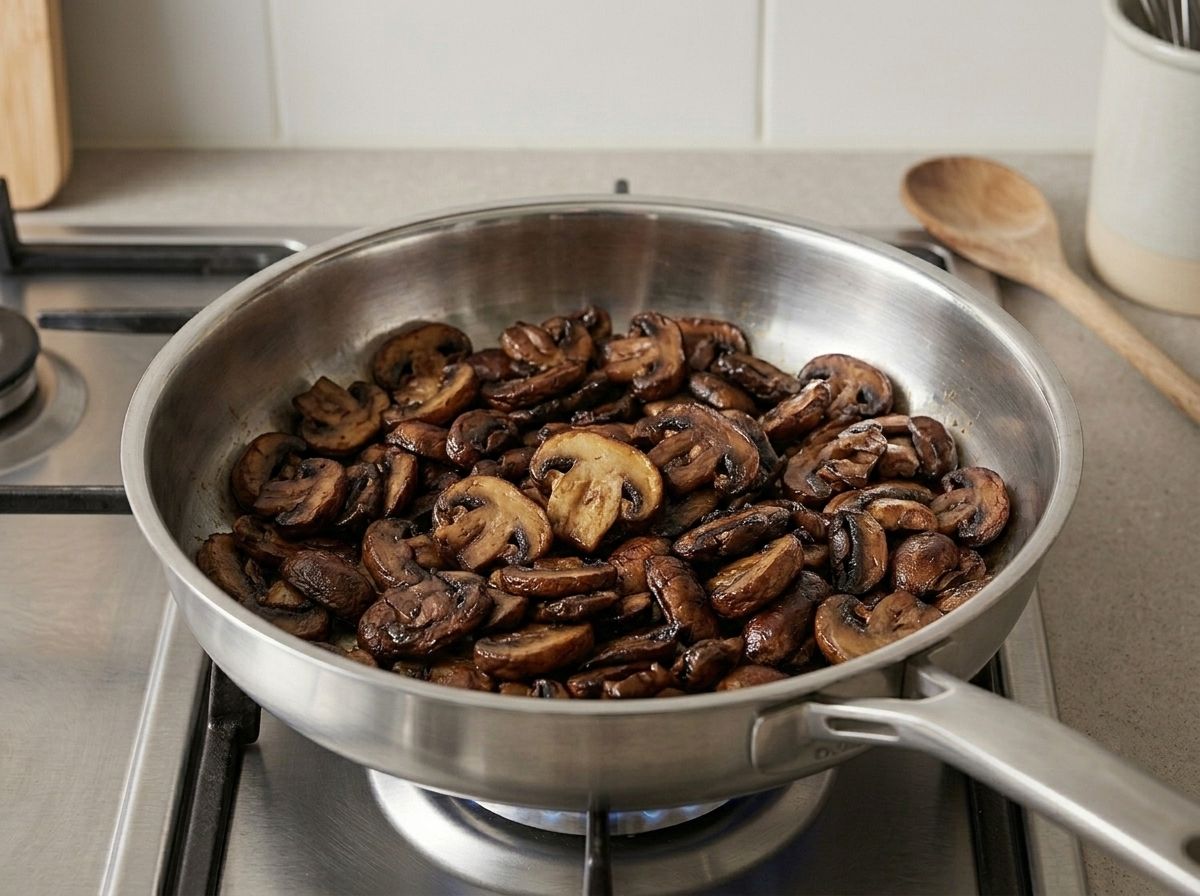
Heat the olive oil in a large skillet over medium-high heat until it shimmers. Add the sliced mushrooms and spread them into an even layer. Leave them alone for 4 to 5 minutes. They will release a lot of water and the pan will look wet, which is exactly what should happen. Keep going for another 6 to 8 minutes, stirring occasionally, until the water has boiled off, the mushrooms have shrunk by about half with deep brown edges, and a browned film has formed on the base of the pan. If your skillet is smaller than 30 cm (12 inches), brown them in two batches, because a crowded pan steams instead of browning.
- 3
Soften the onion and bloom the thyme
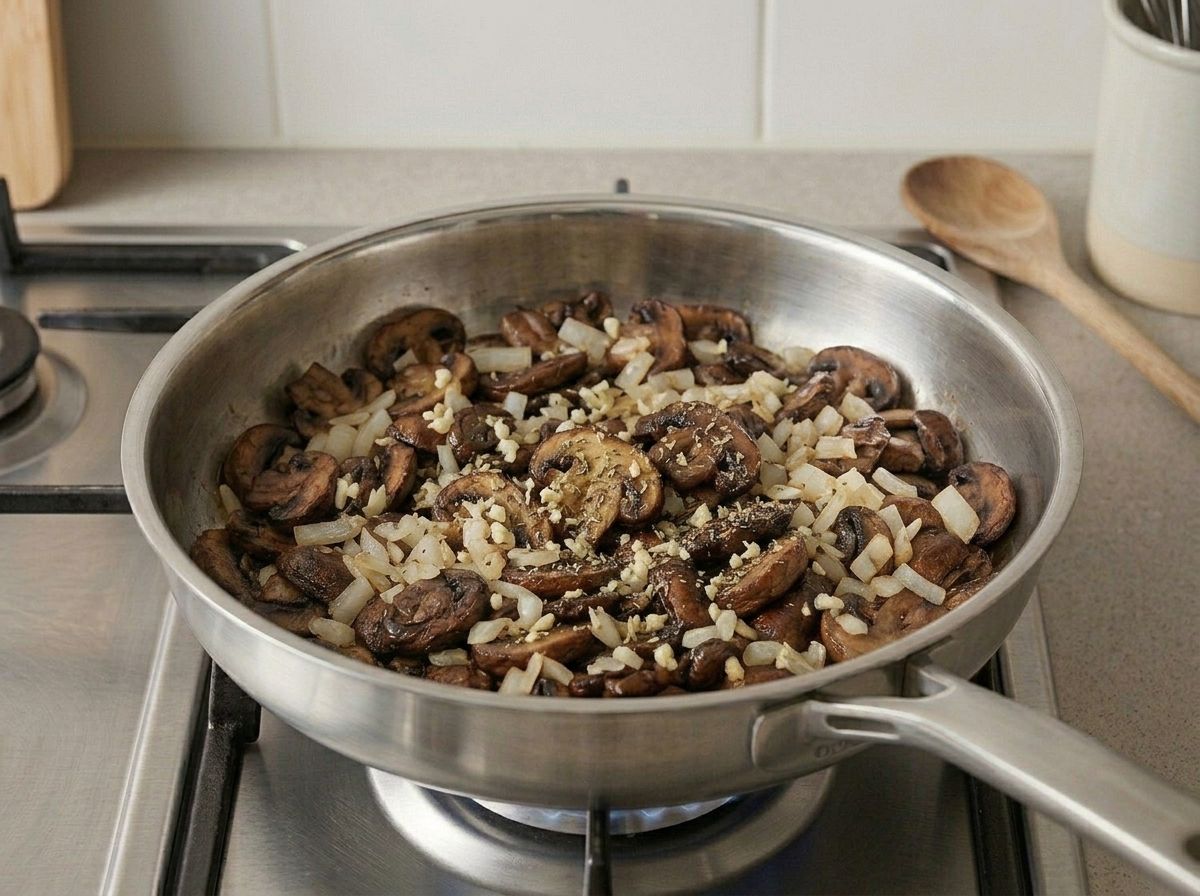
Turn the heat down to medium. Add the chopped onion with a pinch of salt and cook for 5 to 6 minutes, until it is soft and going golden at the edges. Stir in the garlic, the dried thyme, and the chopped porcini if you soaked some, and cook for 1 minute more. Dried thyme needs fat and heat to give up its flavor, which is why it goes in here rather than at the end.
- 4
Deglaze the pan
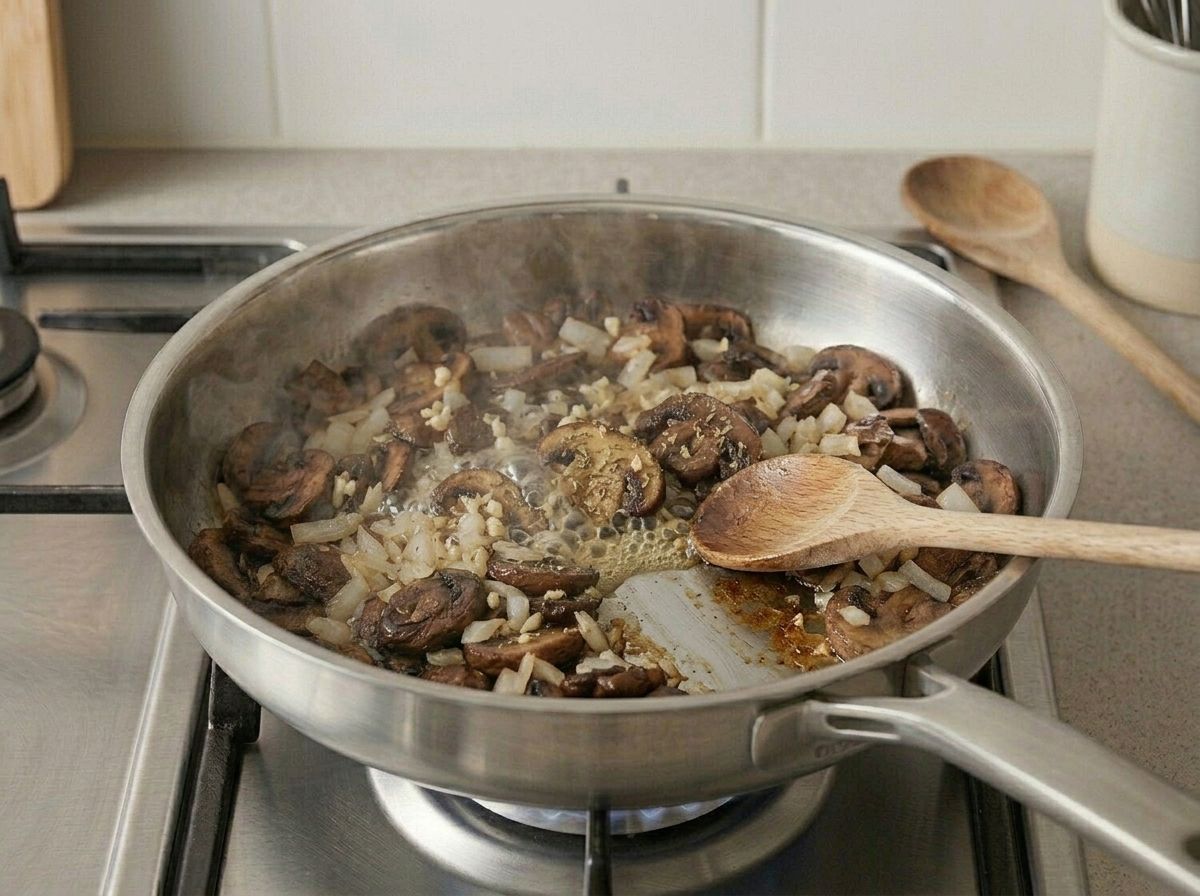
Pour in the sherry or white wine, or 60 ml (¼ cup) of the broth if you would rather skip the alcohol. Scrape the base of the pan with a wooden spoon while it bubbles, and the browned film will lift and dissolve into the liquid. That film carries most of the gravy’s color and depth. Let it cook down until the pan is almost dry again, about 1 minute.
- 5
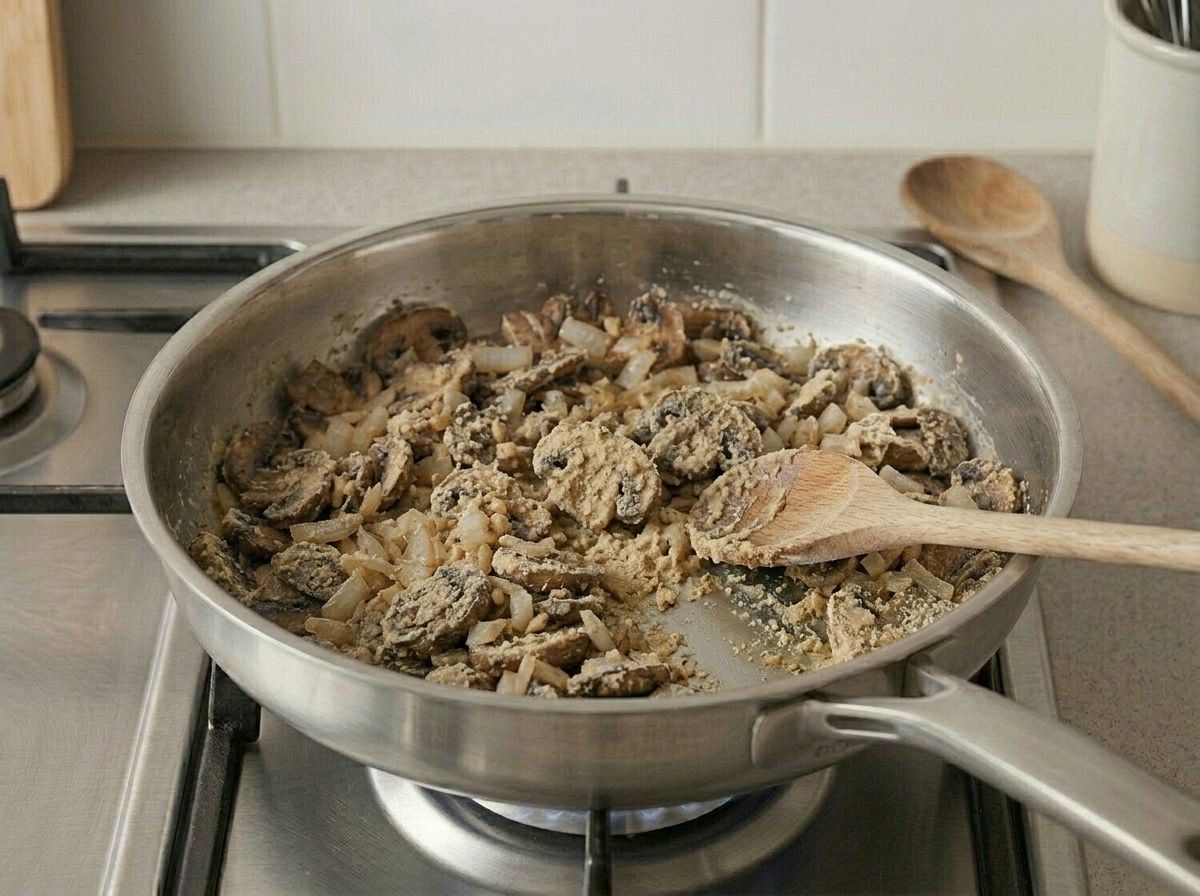
Cook out the flour
Add the vegan butter and let it melt into the pan. Sprinkle the flour over everything and stir constantly for 2 minutes. It should look like damp sand coating the mushrooms and smell toasted rather than raw. Do not skip the extra fat here: the mushrooms have soaked up the olive oil, and flour with nothing to dissolve into sets into lumps the moment liquid hits it.
- 6
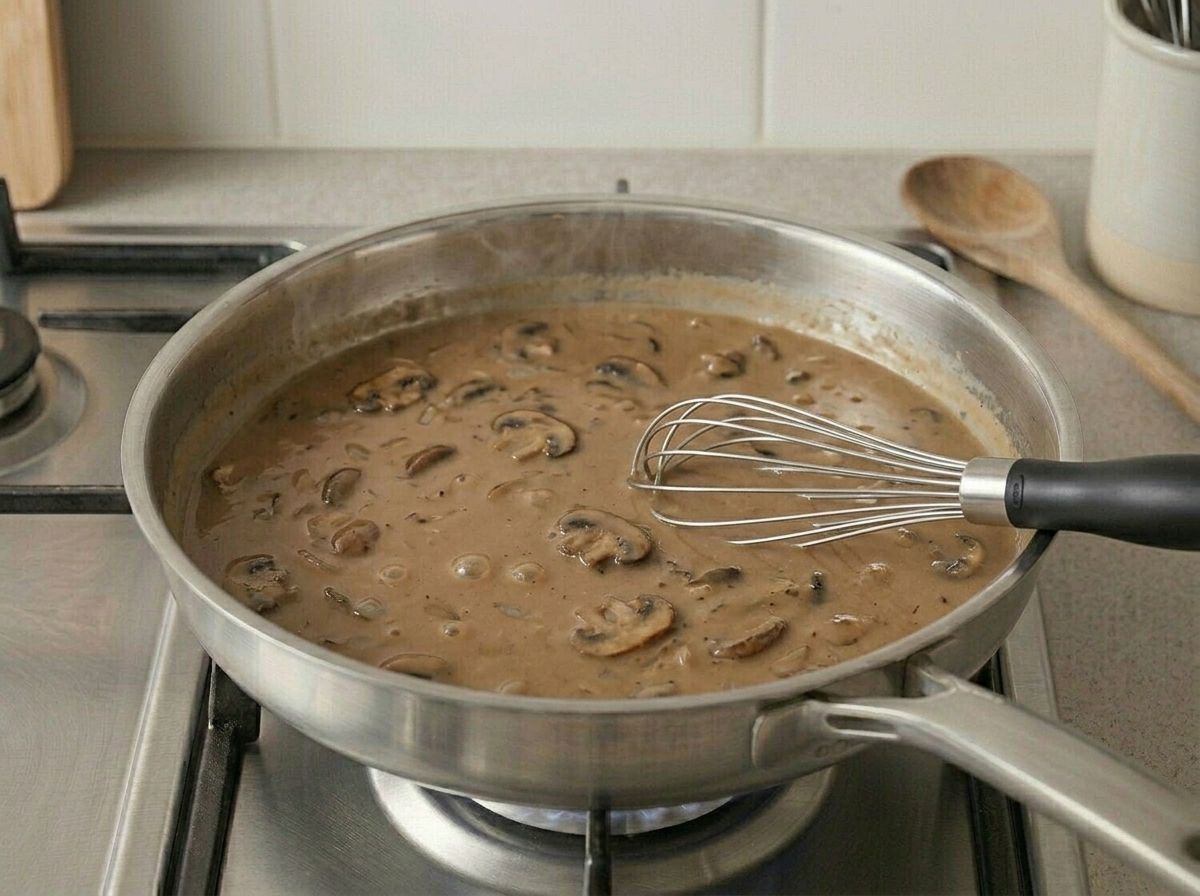
Whisk in the broth in stages
Take the pan off the heat. Pour in about a quarter of the remaining broth and whisk hard until the mixture is completely smooth before you add any more. Whisk in the rest of the broth, the reserved porcini liquid, and the soy sauce. Return the pan to medium heat, bring it to a simmer, then turn it low and cook for 8 to 10 minutes, stirring now and then, until the gravy coats the back of a spoon and a finger drawn across leaves a clean line.
- 7
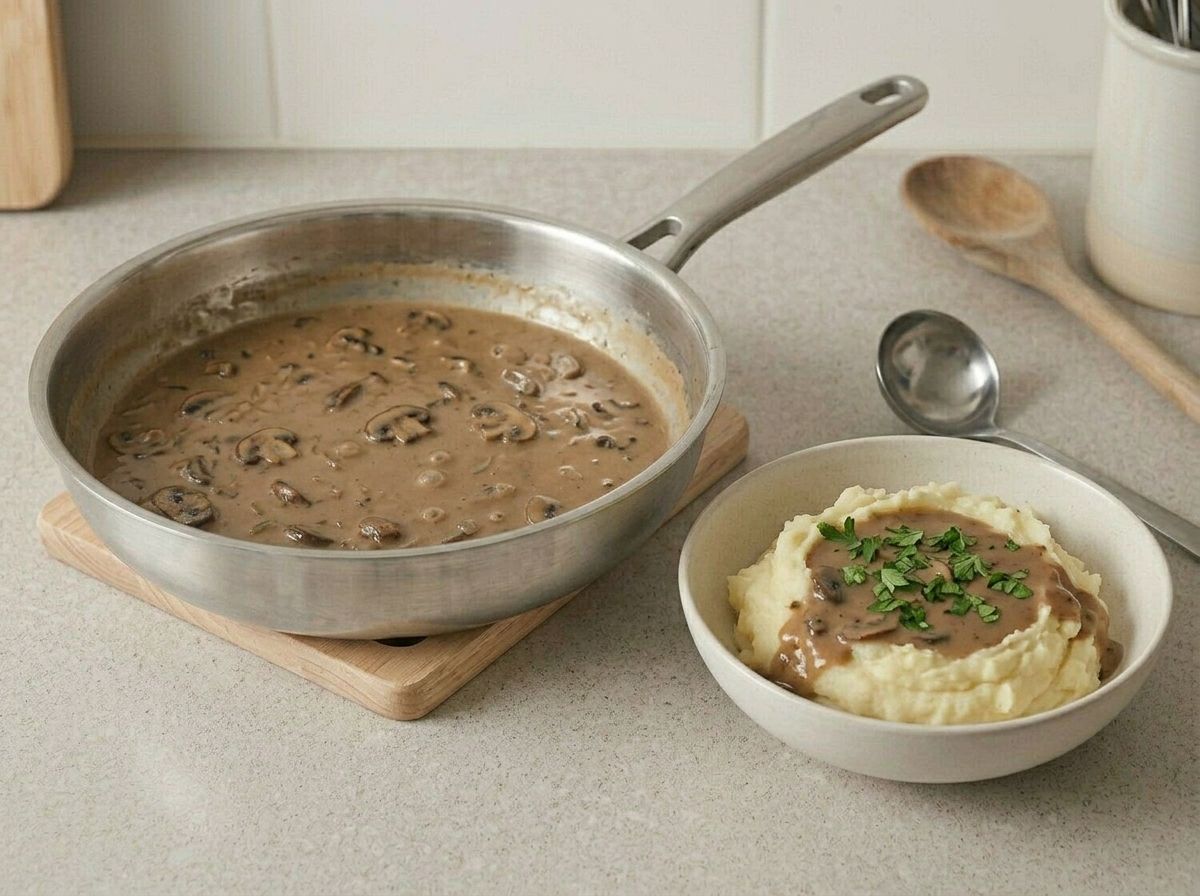
Finish with acid, then season
Take the gravy off the heat and stir in the vinegar or lemon juice. Taste it. A teaspoon of acid will not make it sour, it makes the savory notes read as rounded instead of heavy and flat. Add a few more drops if it still tastes dull. Grind in plenty of black pepper, then add salt only if it needs it, because the soy sauce and the broth have already brought a lot. Serve warm with the parsley scattered over.
Notes
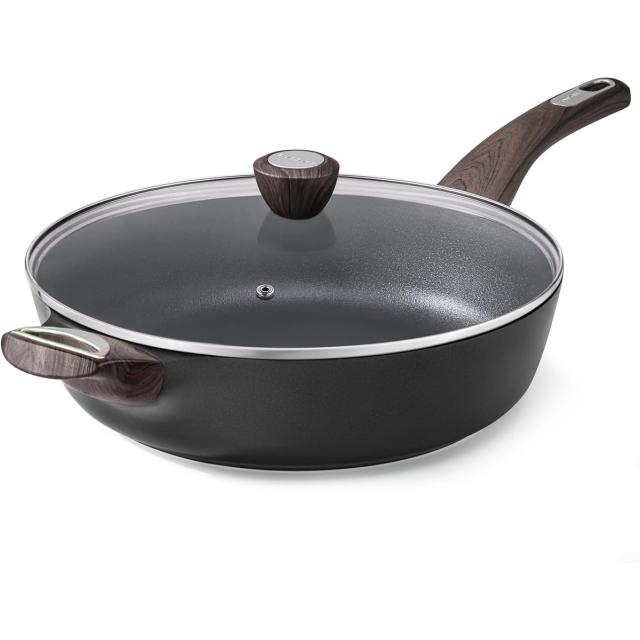
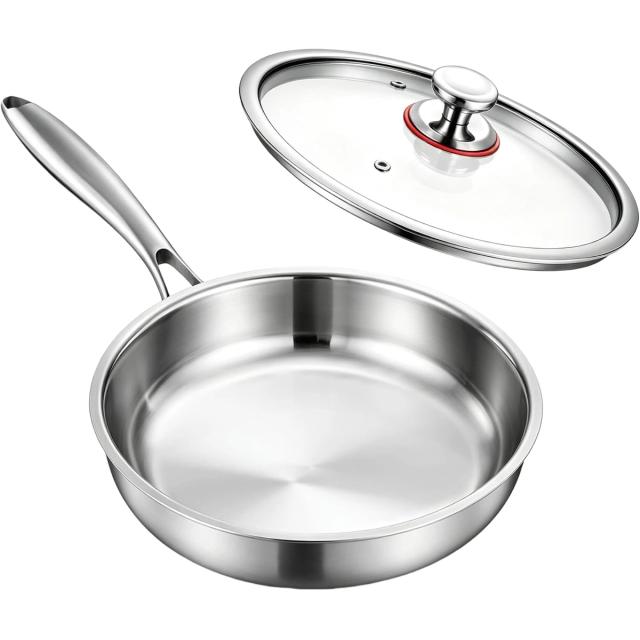
A stainless pan is worth reaching for here if you have one. Non-stick works, but stainless leaves a browned layer on the base that you deglaze back in, and that is where the gravy gets its depth.
For a gluten-free gravy, use a 1:1 gluten-free flour blend in place of the all-purpose flour and tamari in place of the soy sauce. A gluten-free blend browns in the roux the same way wheat flour does.
Olive oil works in place of the vegan butter if that is what you have. The butter adds a dairy-free richness that reads as classic gravy, but the job it is really doing is giving the flour some fat to dissolve into.
For a smooth gravy, run an immersion blender through it before the final seasoning. You lose the pieces of mushroom that way, so blend about half of it if you want both.
Nutrition Facts
4 servings · 309 g per serving
- Calories
- 171 kcal
% Daily Value*
- Total Fat
- 8.4 g11%
- Saturated Fat
- 1.4 g7%
- Sodium
- 745 mg32%
- Total Carbohydrate
- 17.6 g6%
- Dietary Fiber
- 3 g11%
- Sugars
- 4.3 g—
- Protein
- 6.5 g13%
Recipe from veggierecipes.blog
When it goes wrong
Troubleshooting
It went lumpy the second I added the broth
Two causes, and they compound. The flour had nothing to dissolve into, or the broth went in too fast. Flour disperses in fat, and if the mushrooms have soaked up all the olive oil there is nothing left to carry it, so it sits on the vegetables in dry pockets that seize the moment liquid arrives. That is exactly why the vegan butter goes in before the flour. The second cause is pouring all the broth in at once. The first quarter has to be whisked to a completely smooth paste before any more follows, and it is far easier to do that with the pan off the heat. To rescue what you already have, push it through a sieve, or take an immersion blender to it for five seconds.
It is still thin after ten minutes of simmering
Most often the mushrooms were never dried out. If you moved on to the onion while the pan was still wet, all that mushroom water is now in the gravy and you are thickening more liquid than the recipe allows for. Simmering longer does fix it, it just takes longer than you want. The other possibility is that it never truly reached a simmer. Flour has to get to a boil to swell and set, and a sauce held below that stays loose no matter how long you leave it. If you are short on time, mash a tablespoon of soft vegan butter into a tablespoon of flour and whisk that paste in a little at a time, then simmer two minutes to cook the raw taste out.
It tastes brown and heavy but somehow boring
Nine times out of ten this is the acid. A gravy is fat, starch, salt and savory with nothing to cut against, and the tongue reads that as flat even when every individual element is right. A teaspoon of cider vinegar or lemon juice stirred in off the heat is nowhere near enough to taste sour, and it makes everything else snap into focus. The other half of the answer is browning. If the mushrooms went in pale and came out pale, there was no browned film on the base of the pan to deglaze, and the whole layer of flavor the recipe was counting on never existed.
It came out too salty
Soy sauce, salted broth and reduction all stack, and every one of them concentrates as the gravy thickens. There is no clever fix, only dilution: add unsalted broth or plain water a splash at a time, then whisk in a little flour-and-butter paste to bring the body back. The old trick with a raw potato does not work, it is folklore. What does help is acid and fat. A few more drops of vinegar and a knob of vegan butter whisked in at the end will not remove any salt, but they genuinely make it read as less salty. Next time, use low-sodium broth and hold the salt back until the very last taste.
The mushrooms went gray and soupy instead of browning
The pan was crowded, or the heat was too low, or both. 450 g of sliced mushrooms is a lot of volume and the steam needs somewhere to go. In anything smaller than a 30 cm (12 inch) skillet they sit in their own liquid and boil. Medium-high heat, spread them out, then leave them alone. Stirring is the other mistake: every stir drops the pan temperature and lifts the mushrooms off the hot surface just as they were starting to take color. Brown them in two batches if your pan is small. And the wet stage in the middle is not a failure, it is the recipe. You cook through it.
It is nowhere near as dark as the photos
It will not be, and that is not a fault in your cooking. A mushroom gravy lands somewhere around the color of milky coffee, with darker flecks of mushroom through it. The deep mahogany on a meat gravy comes from roast drippings and, very often, from a bottle of gravy browning, which is caramel coloring and nothing else. The color you can honestly build comes from three places: the browned film on the base of the pan, the soy sauce and the porcini liquid. If yours is genuinely pale, it is worth asking whether you got any real browning at all. If you did, leave it alone. It tastes better than a darker one made with coloring.
Before you serve
Serving & Storage
In Britain, gravy is not really an accompaniment. It is the thing the rest of the meal is arranged around, which is why a Yorkshire pudding is essentially a vessel with a dip in the middle and why nobody in recorded history has asked for less of it. Pour this over mashed potatoes first, because that is what it does best, then work outward: roast potatoes, a nut roast or lentil loaf, vegan sausages, roasted carrots and parsnips, stuffing, or a plate of soft polenta. It works just as well in the American register, ladled over split biscuits for a meatless biscuits and gravy, or over fries with vegan curds if you are building poutine.
Make more than you think you need. This yields around 600 ml, which is generous for four people at an ordinary dinner and thin cover for six at a holiday table where the gravy is half the point. It doubles with no adjustment beyond a bigger pan, and for a crowd doubling is the right call.
What it will not do is stay put on anything crisp. Poured over roast potatoes it takes the crackle off them within a minute or two, so bring it to the table in a jug and let people pour their own. It is also not a pasta sauce, whatever the mushrooms suggest. It is thickened with starch rather than emulsified, so it slides off and pools at the bottom of the bowl.
Making it ahead
This is a genuinely better gravy on day two. The thyme and the porcini keep infusing overnight and the flavors settle into each other. Make it up to two days ahead, cool it, and keep it covered in the fridge. It will set to something close to a firm jelly when cold, which is simply what a flour-thickened sauce does and not a sign that anything went wrong. Reheat slowly on the stove, whisking, and add broth a splash at a time until it pours again. Taste it after reheating, because chilling flattens seasoning and it will usually want a little more pepper and a few more drops of vinegar.
For a big meal there is a better split. Cook through step 3, the browned mushrooms with the onion and garlic, and refrigerate just that base for up to three days. On the day it takes about twelve minutes to deglaze, build the roux and finish the gravy, which gives you your stove back during the hour you actually need it.
Storing leftovers
Airtight in the fridge for three days. Reheat gently over low heat and keep whisking as it comes back together, or in short bursts in the microwave with a stir between each one. Left unstirred, the edges break and go oily before the middle has warmed at all.
Freezing works, but it costs you something. Ice crystals break up the starch network, so a thawed gravy often comes back slightly grainy or a little split. Cool it fully, freeze it flat in a bag for up to two months, thaw overnight in the fridge, then reheat slowly and whisk hard. If it still looks broken, five seconds with an immersion blender pulls it back together.
The one thing to avoid is holding it hot for hours in a slow cooker on warm. It carries on reducing the entire time, so it turns pasty, and the mushroom pieces go rubbery. If it has to stay hot through a long meal, use a warmed insulated jug instead.
Using up what is left
Leftover gravy is a head start rather than a leftover. Stir a spoonful of vegan cream or cashew cream into it and you have mushroom stroganoff for pasta or rice. Pour it over roasted vegetables, top with mashed potato and bake it for a shepherd’s pie. Or spoon it through stuffing before it goes in the oven, which keeps the middle soft while the top crisps.
Still wondering
Frequently Asked Questions
Can this gravy be made gluten free?
Yes. The simplest swap is a 1:1 gluten-free flour blend, measure for measure, plus tamari in place of the soy sauce. It behaves like wheat flour in the roux. Cornstarch is not a straight substitute: it has roughly twice the thickening power, so you would need about 1½ tablespoons, and it cannot be cooked in fat as a roux. To use it, skip the vegan butter and the flour, whisk the cornstarch into 60 ml (¼ cup) of cold broth, and stir that slurry in once the gravy is simmering. It thickens in about a minute and gives a glossier, slightly more slippery gravy.
What kind of mushrooms are best for this gravy?
Cremini give the best result of the everyday mushrooms, because they brown darker than white button and hold their texture through the simmer. White button work but taste noticeably milder, so lean harder on the porcini if that is what you have. Shiitake, with the woody stems pulled out, bring the most savory punch of the three. Portobello work if you scrape the black gills out first, which otherwise turn the whole gravy a muddy gray. A mix beats any one of them on its own.
Featured In These Collections
More Cozy Sides & Sauces
Made this?