
Vegetarian French Onion Soup Recipe
Published · Updated
Deeply flavorful caramelized onion soup made vegetarian, finished with broiled cheese and crusty bread. A perfect dish for cozy nights.
Jump To Recipe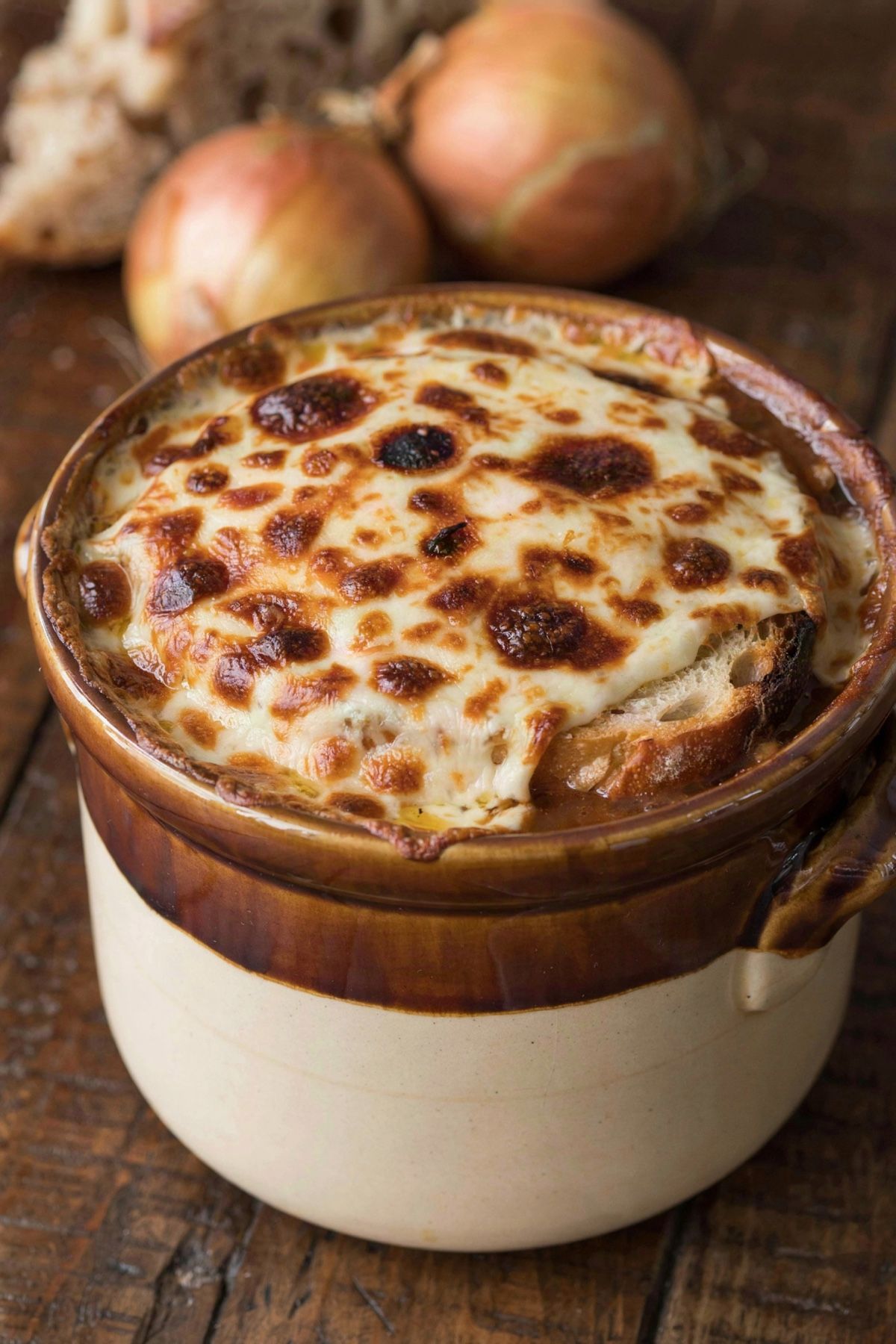
Why I Love Vegetarian French Onion Soup
There is something about a pot of onions going dark on the stove for an hour. Two and a half pounds of raw onion collapsing into a couple of cupfuls of something almost black and sweet is the most dramatic thing that happens in an ordinary kitchen, and it needs no technique beyond turning up and stirring.
The vegetarian version is not a lesser one. Beef stock was doing a job in the original, and once you hand that job to dried porcini and a spoonful of soy sauce the onions have more room rather than less. You lose the beefy background note. You get back a soup that tastes more of onion.
Things I do with it:
- Serve it as the whole dinner for two with a sharp salad, rather than a starter for four
- Make it in individual crocks when people are coming, because the crust is the point and it does not survive a ladle
- Cook the base the day before, which turns a two hour recipe into fifteen minutes
If you have only ever eaten this made with beef stock, the honest thing to say is that it tastes different rather than identical. It also tastes like onions, which the beef version does not always manage.
The story
The Vegetarian Version of French Onion Soup Came First
Onion soup is old, and for most of its life it was poor food. Onions grow anywhere, keep through a winter and cost nothing. A recipe appears in Le Ménagier de Paris in 1393, dressed up with ginger and saffron for a wealthy household, but what most people ate was onions, fat, water and stale bread.
The bread is not a garnish, and the word gives it away. Soupe did not originally mean the liquid. It comes from the Late Latin suppa, bread soaked in broth, and in Old French it meant the slice of bread itself. The soup was the bread. The broth was what you poured over it.
The stock was never fixed either. La Varenne's Le Cuisinier François, 1651, simmers the buttered onions in water or meat broth, the two offered as equals. Alexandre Dumas, writing in 1873, describes the version the exiled Polish king Stanislas supposedly carried to Versailles as fried onions, water and croutons. No beef stock, no cheese, no broiler.
What we picture now is a nineteenth century Paris invention. In the bistros around the Les Halles market, cooks buried the bread under grated cheese and ran the bowl under a grill, then sold it at three in the morning to porters coming off a shift. That is the gratinée des Halles, and that is where the browned lid came from.
Beef stock became the default late, once restaurant kitchens had a stockpot going anyway. So a meatless version is not a workaround. It is the older dish with the good nineteenth century idea kept, and all it needs is something carrying the savory weight the stockpot contributed. Here that is dried porcini and a spoonful of soy sauce.
What to buy
Ingredient Notes
Yellow onions
Yellow onions have enough sugar to caramelize and enough sulfur left over to taste savory. Sweet varieties like Vidalia sound like an upgrade and are not: mostly water and sugar, they cook down nearer jam than soup, and red onions go a muddy gray. Two and a half pounds looks absurd for four bowls until they lose three quarters of their weight.
Dried porcini
The ingredient that separates this from onion-flavored broth. Dried porcini carry free glutamate at a concentration fresh mushrooms never reach, and that is the savory weight beef stock used to supply. Half an ounce is a small handful and a bag keeps a year. Dried shiitake works, a little smokier. Fresh mushrooms bring water where you want concentration.
Soy sauce or tamari
A tablespoon does not make the soup taste of soy sauce, it makes it taste more like itself, finishing the savory job the porcini start and salting it on the way. Tamari keeps the recipe gluten-free. Failing both, a teaspoon of white miso whisked into a ladleful of hot broth off the heat.
Vegetarian Gruyère-style cheese
Read the label on this one. Le Gruyère AOP is made under a specification that requires calf rennet, and Comté and Emmentaler AOP are the same, so all three cheeses these recipes name by default are not vegetarian. Look for an alpine-style cheese set with microbial rennet: every Jarlsberg product is, and most own-brand blocks sold as Swiss or Gruyère-style are too. Grate a block yourself, because pre-grated cheese is dusted with starch that stops it flowing into a sheet.
Vegetable broth
The soup tastes of your broth plus an hour of onions and little else, so one you would not drink makes a soup you will not want. Buy low-sodium: 25 minutes of open simmering concentrates everything in it. From a cube, use about half again as much water as the packet says.
Bread
Day-old baguette or firm sourdough. Soft fresh bread and tight sandwich crumb go to paste in seconds. Cut it thick enough to sit proud of the surface rather than sink into it, and narrow enough to drop inside the rim of your bowls.
Dry white wine (optional)
Boiled almost dry before anything else joins it, so a bottle already open is fine. Sauvignon Blanc, Pinot Grigio or dry vermouth. Avoid anything sold as cooking wine, which is white wine with salt in it. Dry sherry is worth buying for the purpose: half as much, at the same point.

Vegetarian French Onion Soup
Onions cooked down for the full hour, a broth built on porcini and soy sauce for the depth beef stock usually supplies, and a lid of browned cheese over toast.
Ingredients
Equipment
As an Amazon Associate I earn from qualifying purchases, at no extra cost to you.
Instructions
- 1
Soak the porcini and slice the onions
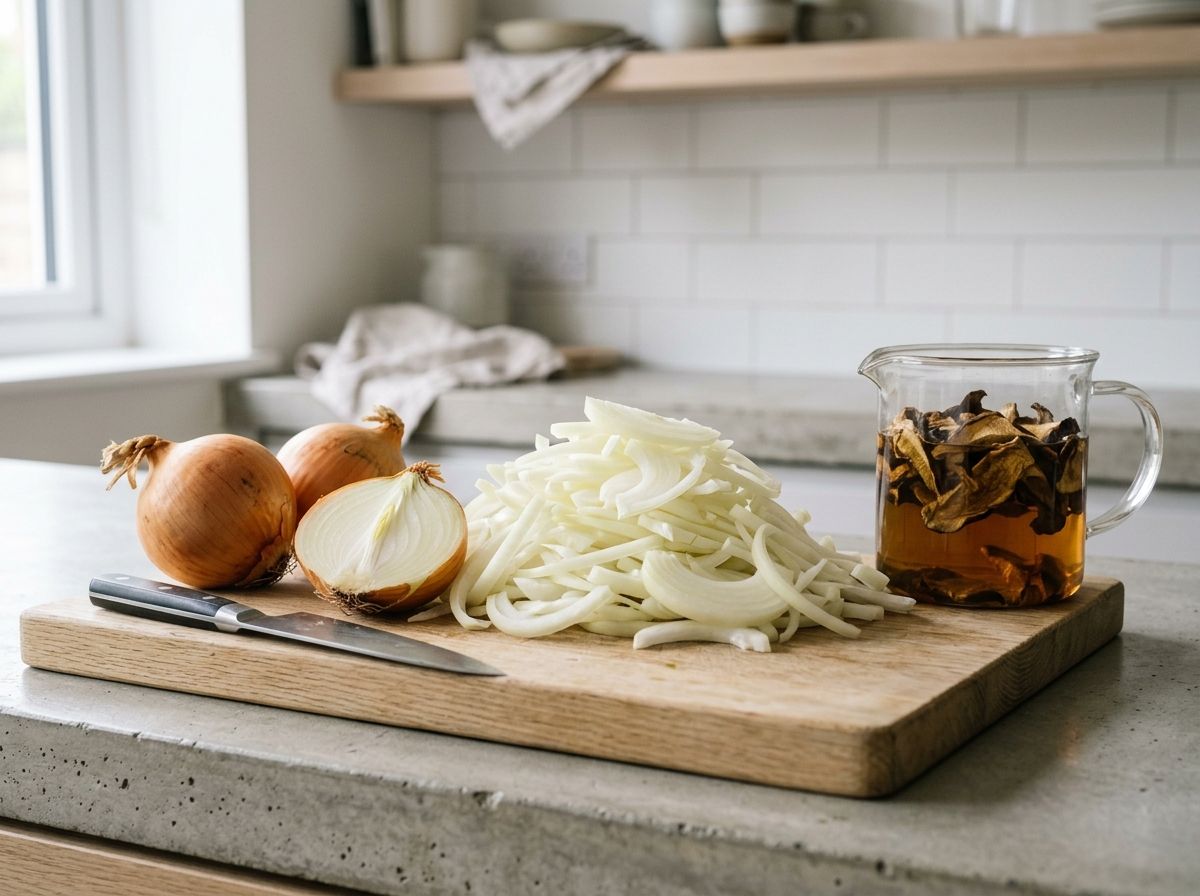
Put the dried porcini in a heatproof jug, pour over the just-boiled water and leave them while you deal with the onions. Halve each onion from root to tip, peel it, then slice it into thin half moons following the lines that run pole to pole. Slicing with the grain rather than across it keeps the strands whole through an hour in the pot instead of collapsing them into puree.
- 2
Sweat them under a lid
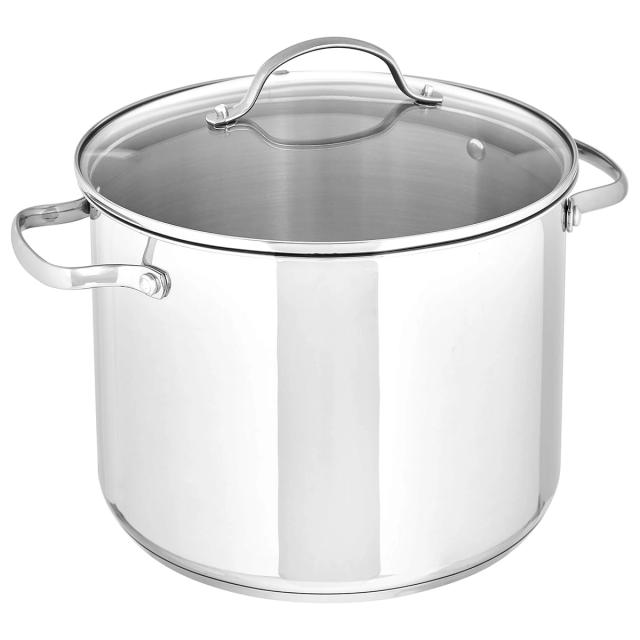
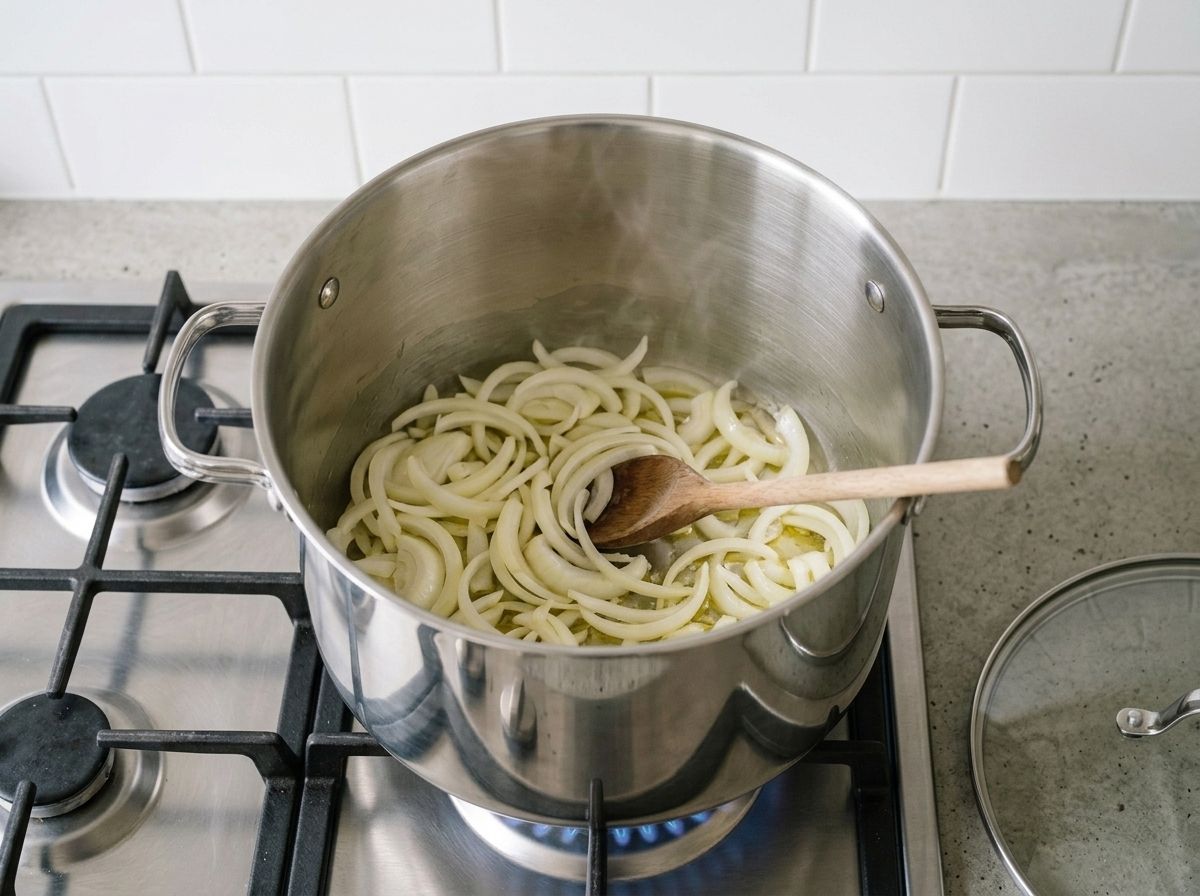
Melt the butter with the olive oil in a large heavy pot over medium heat. Tip in the onions with the salt, put the lid on and leave them for 15 minutes, stirring twice. They give up their water and sink to roughly half the volume, and this is the part of caramelizing that does not need watching.
- 3
Caramelize for 45 to 55 minutes
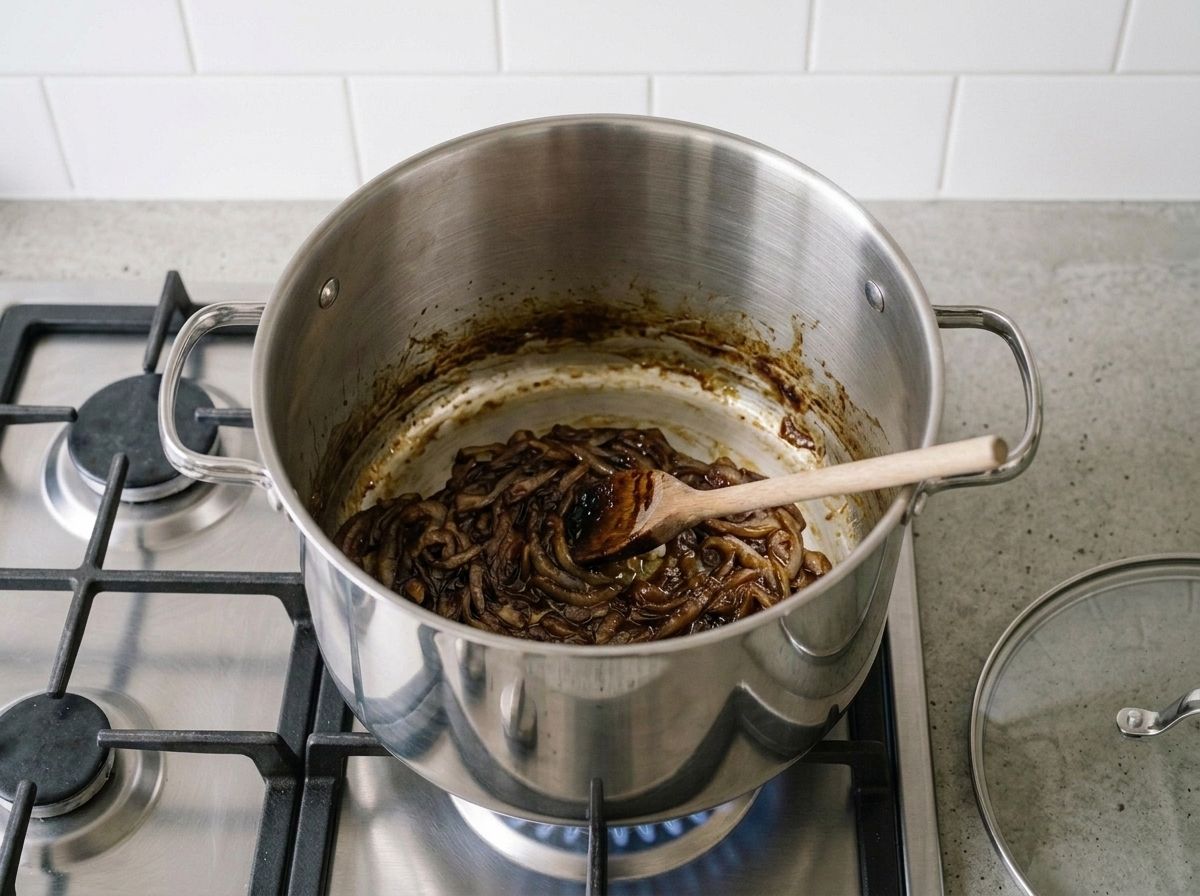
Take the lid off, turn the heat down to medium-low and cook, stirring every five minutes at first and every two or three towards the end. Onions that are merely golden at the 30 minute mark are halfway, not finished. You want the color of dark maple syrup, and about a quarter of the volume that went in. A brown film builds on the base of the pot; that is fond and it holds most of the flavor, so whenever it looks close to catching, add a splash of water, scrape it loose and carry on.
- 4
Deglaze with the wine
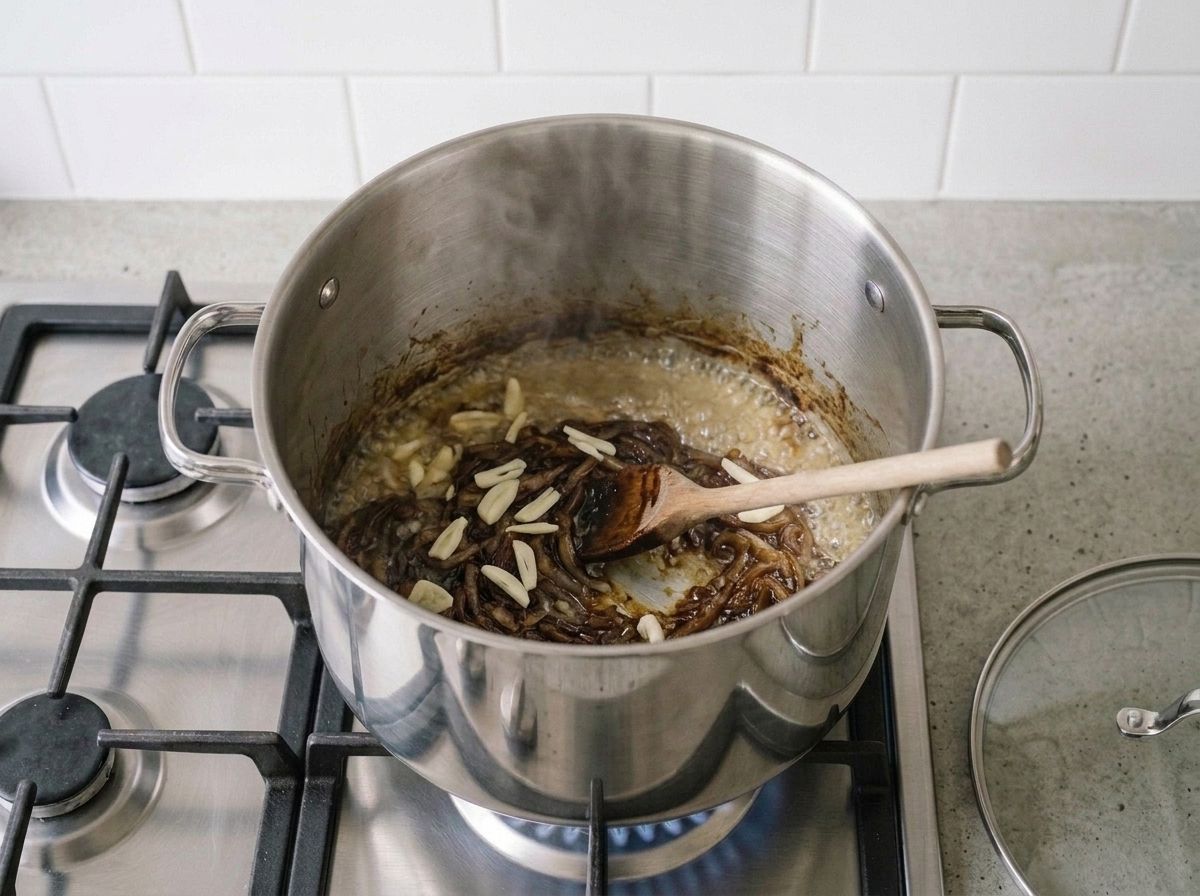
Stir the sliced garlic through the onions and cook for one minute. Pour in the wine, scrape the base of the pot clean and simmer until almost no liquid is left, four or five minutes. Wine tipped in later along with the broth stays raw and sharp all the way to the table; boiled down first it leaves its acidity behind and nothing else. Without wine, deglaze with the same amount of broth.
- 5
Build the broth
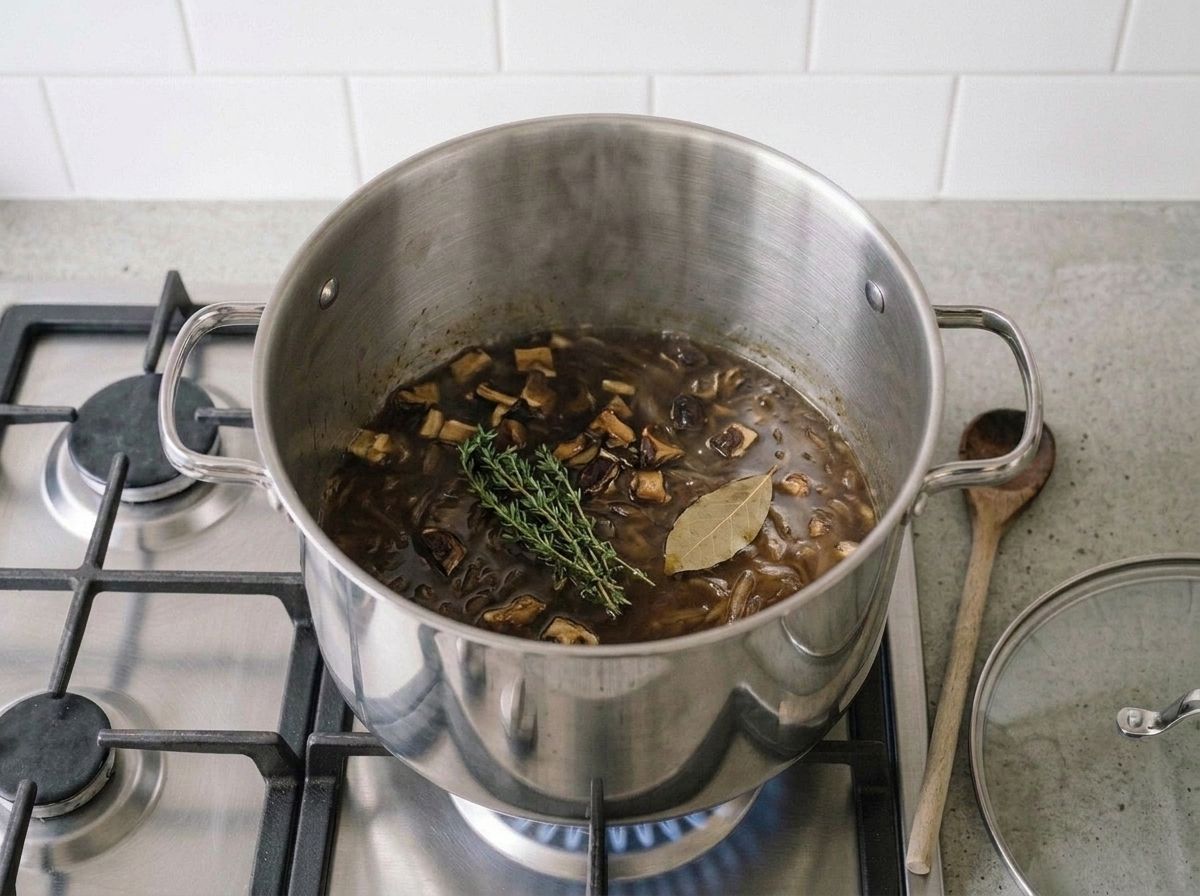
Lift the porcini out of their soaking liquid, chop them roughly and add them to the pot. Pour the soaking liquid in too, stopping before the last spoonful, which carries the grit. Add the vegetable broth, soy sauce, thyme and bay leaf. Simmer uncovered for 25 minutes so it reduces and concentrates instead of staying thin.
- 6
Season it at the end
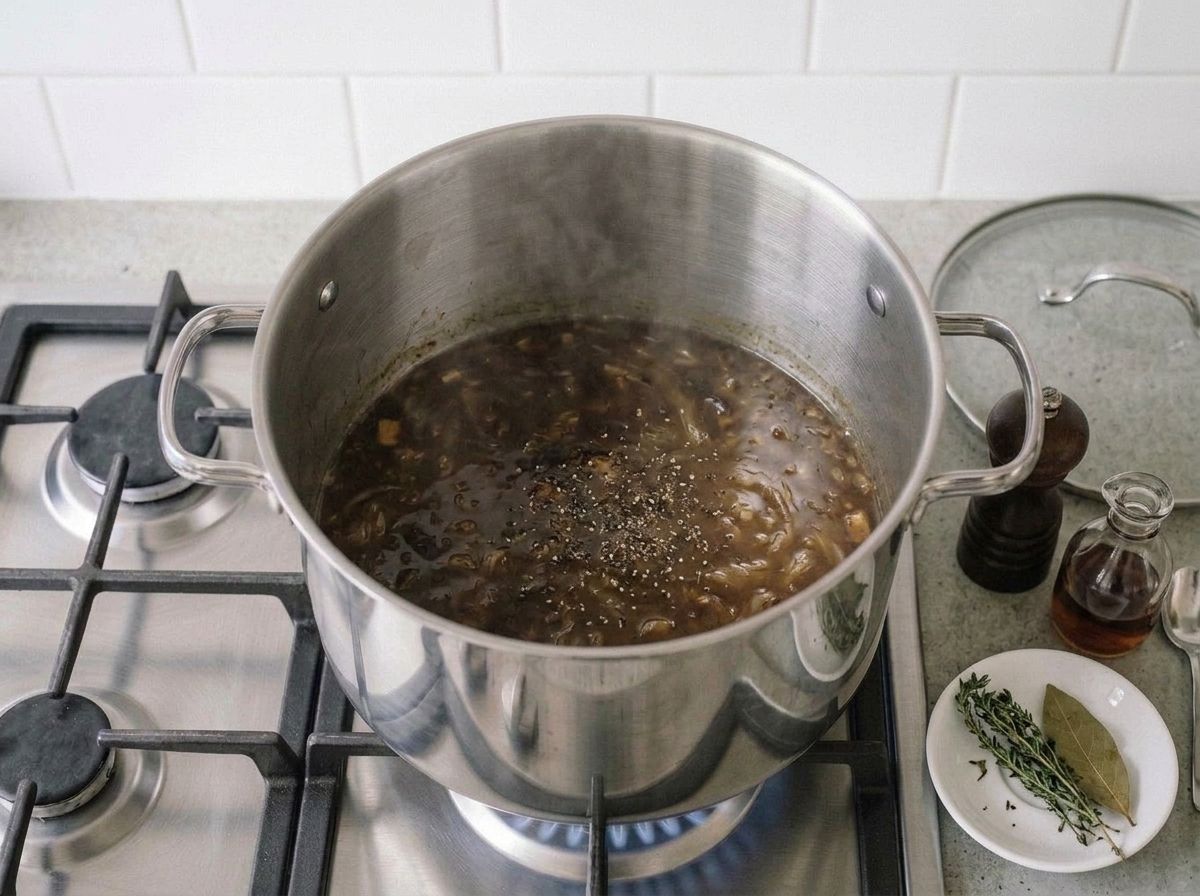
Fish out the bay leaf and the thyme stalks. Stir in the sherry vinegar, then taste and add more salt if it needs it and plenty of black pepper. The vinegar goes in now rather than earlier because acid boiled for half an hour goes flat.
- 7
Toast the bread dry
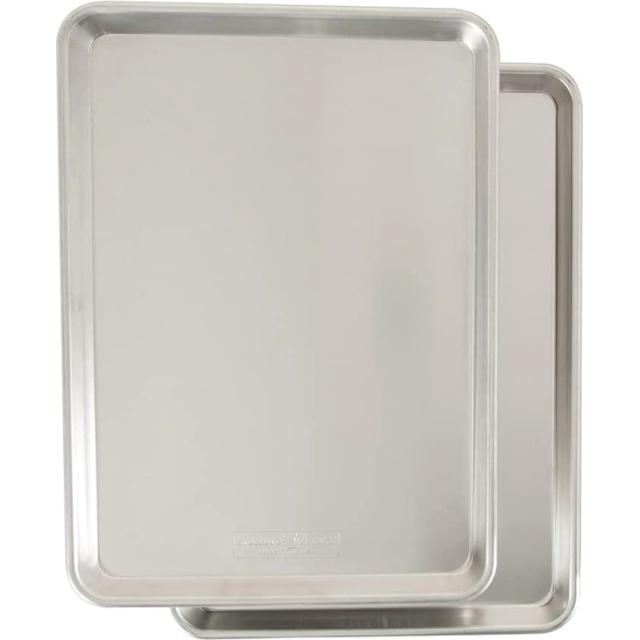
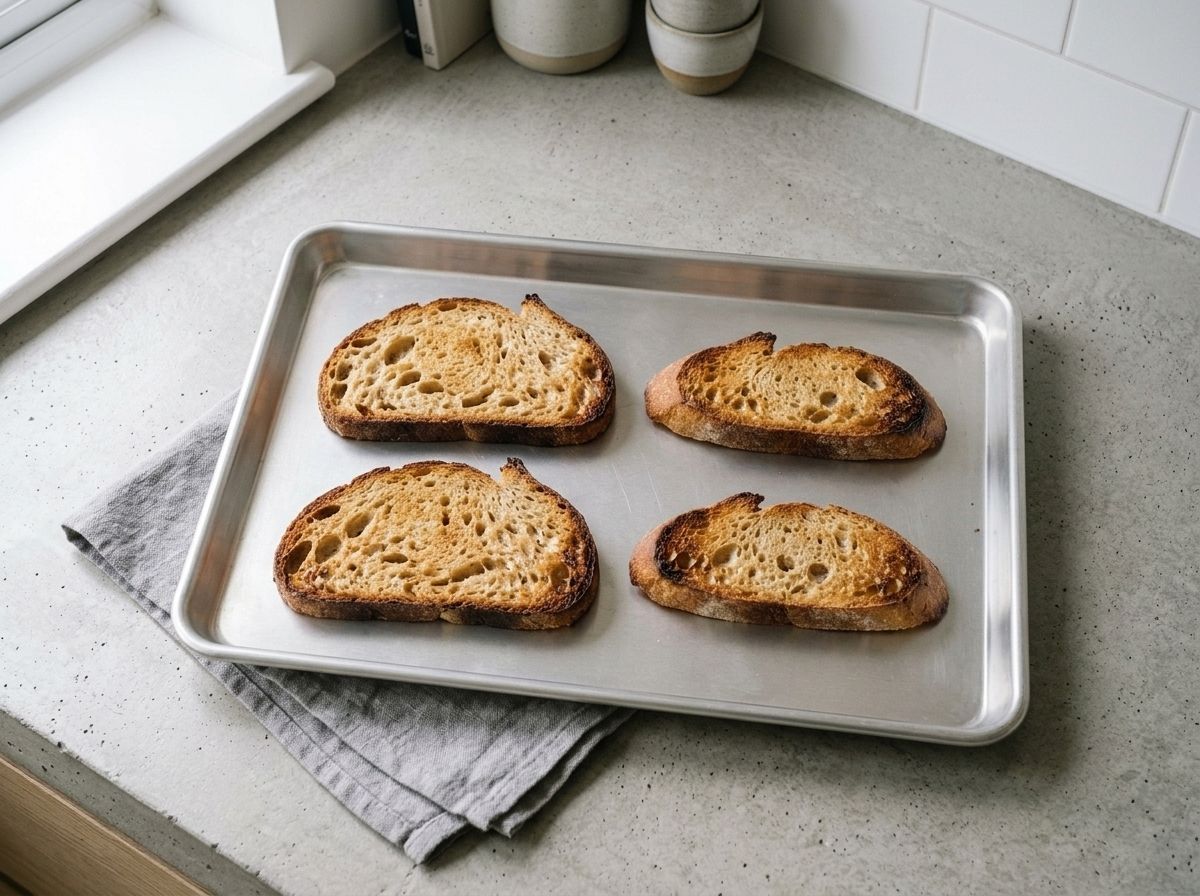
Heat the oven to 400°F (200°C). Cut the bread so each slice will drop inside the rim of your bowls rather than sit across the top, then lay the slices on a baking sheet and toast for 6 to 8 minutes, turning once, until they are crisp the whole way through rather than colored only on the outside. Bread that has merely been warmed dissolves into the soup inside a minute.
- 8
Gratinate under the broiler
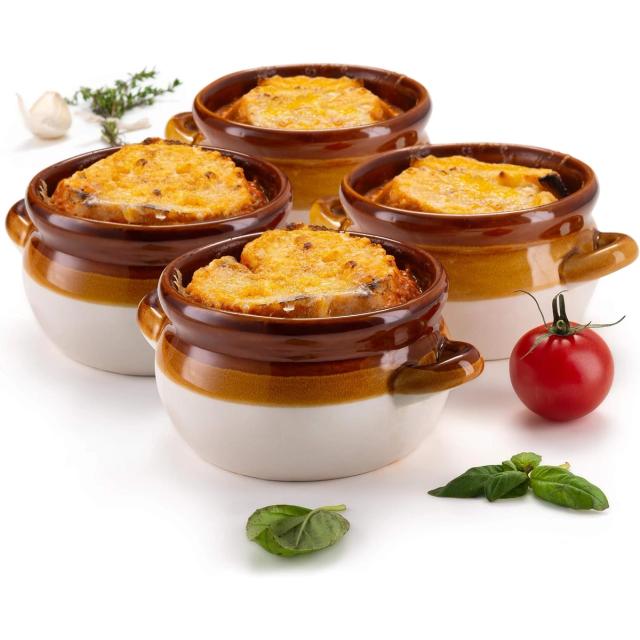
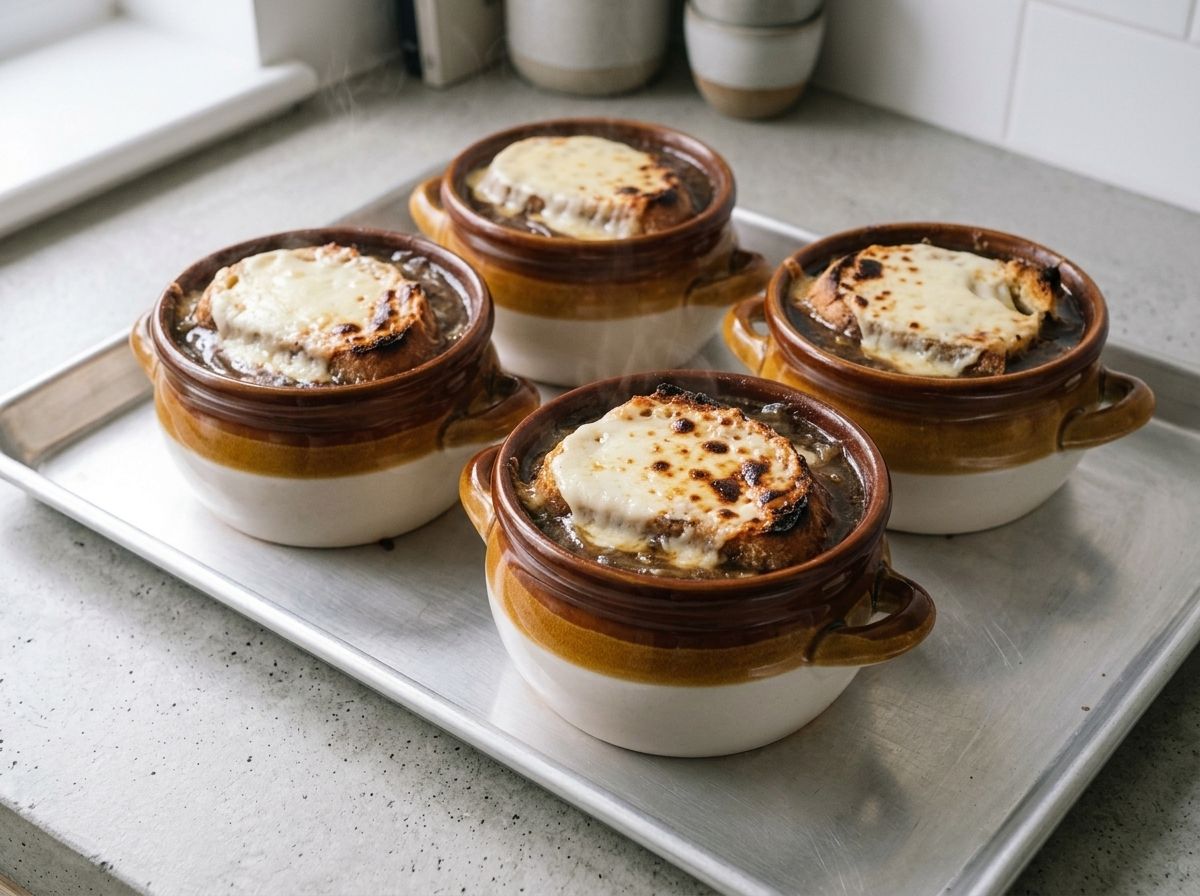
Heat the broiler. Stand the oven-safe bowls on a baking sheet and ladle in the soup, leaving an inch of headroom. Float a slice of toast on each, with a narrow margin of soup showing round it, and mound the cheese over the toast and across that margin right out to the rim. The seal is cheese welded to the ceramic, which is why the bread has to sit inside the rim rather than overhang it. Broil for 3 to 5 minutes, until the top is browned and bubbling at the edges. The bowls come out extremely hot, so serve them on plates.
Notes
Le Gruyère AOP is set with calf rennet, so the classic cheese is not vegetarian. Use an alpine-style cheese made with microbial rennet; every Jarlsberg product is.
The 45 to 55 minutes on the onions is the recipe. Nothing else in the pot makes up for stopping at 30.
For a gluten-free version, use tamari in place of the soy sauce, check the broth, and toast a sturdy gluten-free loaf until it is dry the whole way through.
Nutrition Facts
4 servings · 776 g per serving
- Calories
- 496 kcal
% Daily Value*
- Total Fat
- 20.1 g26%
- Saturated Fat
- 10.5 g53%
- Sodium
- 2534 mg110%
- Total Carbohydrate
- 52.4 g19%
- Dietary Fiber
- 6.2 g22%
- Sugars
- 17.3 g—
- Protein
- 20.7 g41%
Recipe from veggierecipes.blog
When it goes wrong
Troubleshooting
My onions never went brown, they just went soft and wet
Too many onions in too narrow a pot, or the heat too low. They release a lot of water, and if the pan cannot evaporate it faster than it comes out they stew. Use the widest heavy pot you own, and if the base still looks flooded after the covered 15 minutes, raise the heat until the water is steaming off before settling back to medium-low.
It tastes sweet, almost like onion jam
Sweet onions instead of yellow ones, and no acid at the finish. The two usually arrive together. The sherry vinegar in step six is what pulls an hour of concentrated onion sugar back into balance, and a teaspoon stirred through the pot fixes it even after the soup is in the bowls.
The soup is thin and tastes mostly of the broth
It never reduced. The 25 minutes at step five is uncovered on purpose; a lid means you finish with the volume you started with. Simmer on until it has dropped by about a fifth. Then check the onions went the full distance, because a pot pulled at 30 minutes cannot be rescued with liquid later.
The cheese browned but slid off in one piece
The toast was too small for the bowl, or the cheese stopped short of the edge. A gratinée anchors to the bowl, not to the bread. Mound the cheese over the toast and out to the rim so it welds itself to the ceramic, and it holds when the spoon goes in.
The top came out dark and blistered in patches
That is what it should look like. A gratinée is meant to carry near-black blisters across a browned surface, because the broiler runs hot and uneven and the high spots catch first. An evenly pale gold lid came out early and tastes of warm cheese rather than of anything toasted.
My bowl cracked under the broiler
Oven-safe and broiler-safe are different claims. A cool bowl filled with hot soup and pushed close to a grill element is the exact condition that breaks stoneware. Use crocks sold for onion soup, fill them while the soup is properly hot, and keep them a hand's width below the element.
Before you serve
Serving & Storage
It arrives too hot to eat, and it is supposed to. Give it two or three minutes in front of you before the first spoonful.
At 496 calories and most of a day's sodium a bowl, this is a meal for two rather than a starter for four. The only side it needs is a sharp green salad with a mustard vinaigrette, because the soup is rich, sweet and salty at once and wants something bitter beside it. Leave the bread basket off the table; the bread is in the bowl.
Making it ahead
The base is better for a night in the fridge, and this is where a two hour recipe becomes a fifteen minute one. Cook through step six, cool and refrigerate for up to four days, then reheat, toast and gratinate on the night. Assembling in advance does not work: soup with toast and cheese sitting on it in the fridge is soup with wet bread in it.
Storing leftovers
The base keeps four days refrigerated and three months frozen, and it freezes unusually well because there is no cream or starch in it to split. Portion it before freezing, thaw overnight and reheat gently. Anything already gratinated should be eaten rather than kept, since the bread will not survive a second heating.
If you have no oven-safe bowls
Broil the cheese onto the toast on a baking sheet, then float each finished cheese toast on the soup at the table. You lose the seal around the rim and the crust that comes with it, and keep everything else.
Still wondering
Frequently Asked Questions
Can I make it vegan?
The base needs almost nothing: another tablespoon of olive oil in place of the butter, and a broth with no dairy in it. The topping is the awkward part. Most vegan cheeses are starch and coconut oil and melt without browning, leaving a pale slick where the crust should be. Look for one built on cashew or a fermented base. Breadcrumbs tossed in olive oil and nutritional yeast brown more reliably than any of them.
Can I caramelize the onions in a slow cooker or an Instant Pot?
Partly, and not the way it is usually sold. A slow cooker traps its own moisture, so eight hours gives you soft, sweet, pale gold onions that still need about 15 minutes of browning in a pot afterwards. An Instant Pot cannot caramelize under pressure at all, and its sauté function is a pot with a small base. Neither saves time; they save the standing at the stove.
Can I double the recipe?
Yes for the soup, no for the pot. Onions caramelize by evaporating off the surface of the pan, so twice the onions in one pot takes far more than twice as long, and often never gets there because the layer is too deep to dry out. Caramelize in two pots or two batches. Everything from step four scales straight up, and 5 lb of onions with 10 cups of broth serves eight.
Featured In
More Cozy, Comforting Vegetarian Soups
Made this?