
Vegetarian Sundubu Jjigae Recipe
Published
The anchovies, clams and pork that usually carry this stew are replaced by kelp, dried shiitake and sour kimchi, all three straight from the Korean pantry.
Jump To Recipe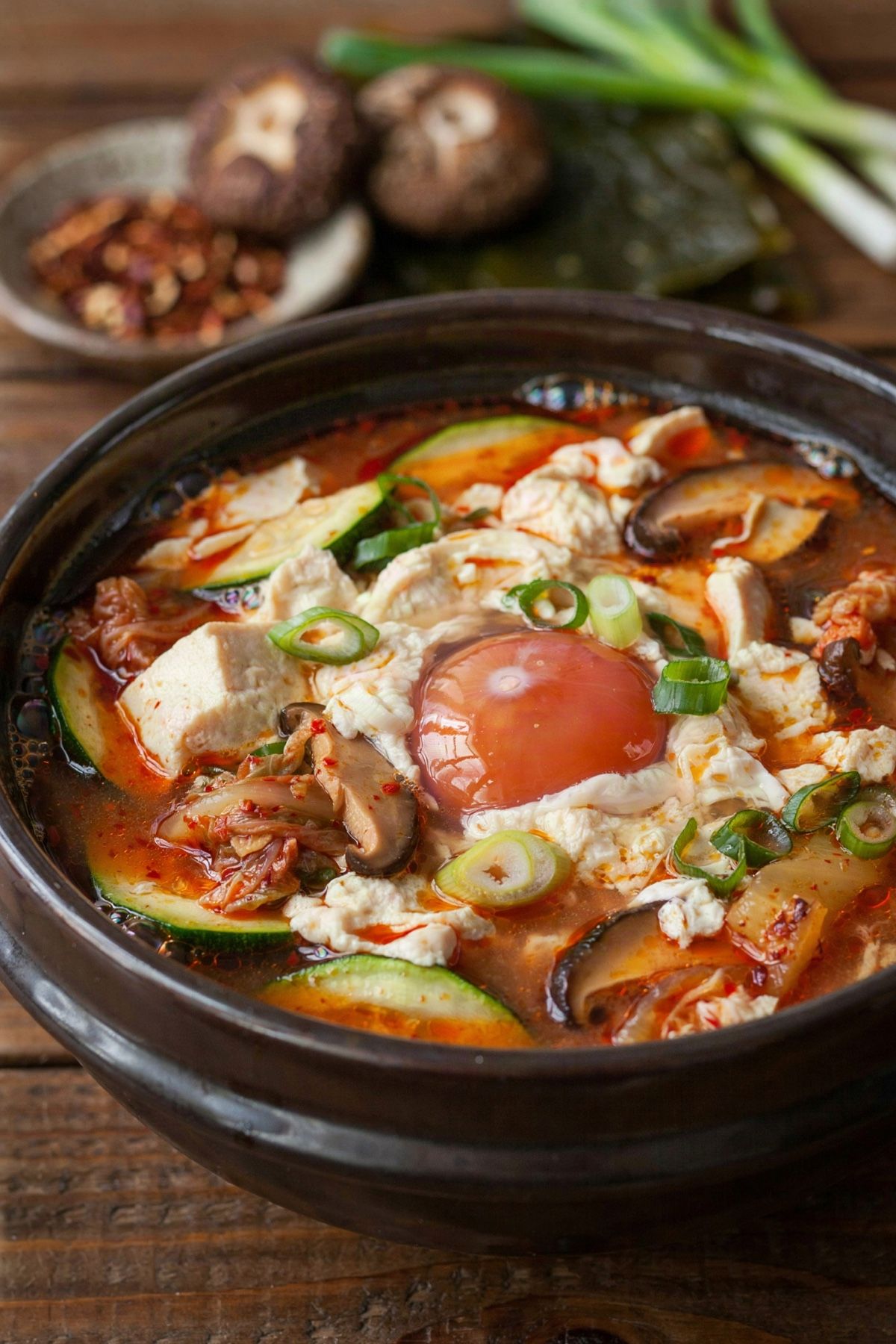
The Vegetable Sundubu Nobody Orders
In most Korean tofu houses the vegetable sundubu sits at the bottom of the menu, below the seafood, the beef, the pork and the dumpling versions, and it tends to taste like the others with the best part taken out. Leaving out the clams does not change the broth underneath, which is often the same anchovy stock as everything else.
What changed it for me was treating the broth as the recipe. Kelp and dried shiitake give the same kind of savory depth anchovies do, and half a cup of properly sour kimchi, fried in the chili oil before the stock goes in, gives the stew its edge. After that the tofu does what it always does: it sits in the red broth, drinks it up and falls apart on the spoon.
I make it for two, in one pan, on nights when I want dinner in under an hour with almost no chopping. The only real rule is to leave the tofu alone once it is in.
The story
Sundubu Jjigae Started With Seawater Tofu
Sundubu is tofu that has been curdled but never pressed, scooped out while it is still closer to custard than to a block. Jjigae is a Korean stew, thicker and more strongly seasoned than a soup, and made to be eaten with rice. The name describes the ingredient more than the dish, and for most of its history the ingredient came first.
The tofu most Koreans connect with the name comes from Chodang, a neighborhood of Gangneung on the east coast. Local tradition credits Heo Yeop, a sixteenth-century Joseon official whose pen name was Chodang, with making tofu from the spring water near his house and setting it with seawater instead of bittern. His children were Heo Gyun, author of The Tale of Hong Gildong, and the poet Heo Nanseolheon, which gives this tofu an unusually literary family tree. The tofu village there today grew up in the 1970s, when restaurants set out to recreate his method, and much of what they serve is white and unspiced, eaten with a little soy sauce.
The fiery red stew most of the world knows traveled farther. In April 1996 Hee Sook Lee opened BCD Tofu House on Vermont Avenue in Los Angeles, named after the Bukchang-dong neighborhood of Seoul where her mother-in-law had run a restaurant. Its menu was built around the stew at a choice of spice levels, served still boiling with a raw egg to crack in at the table, and it grew into a chain reaching from California to New York.
Nearly all of those restaurant versions get their savory base from the same place: a stock of dried anchovies and kelp, with clams, shrimp, beef or pork on top. A vegetarian sundubu jjigae has to rebuild that base, and Korean cooking already has the tools. Temple cooks have made stocks without animal products for centuries from kelp and dried shiitake, and fermented kimchi brings the sour, funky depth the seafood gave. This recipe borrows that pantry rather than inventing a new one.
What to buy
Ingredient Notes
Extra-soft tofu (sundubu)
Sold in a plastic tube in the refrigerated section of Korean and most Asian grocers, usually 11 to 12 oz, and labeled sundubu, soondubu or soon tofu. It is unpressed, so it is softer than even the silken tofu sold in cartons. Silken tofu is the only real substitute. Soft, medium or firm tofu will give you a good tofu soup, not this dish.
Gochugaru
Korean chili flakes, sun-dried and coarsely ground, fruity and only moderately hot. Crushed red pepper from a pizza shop is hotter, full of seeds and turns bitter when fried, and cayenne is heat with none of the color. Buy the coarse grind sold for kimchi and keep it in the freezer; stale gochugaru goes brown and tastes of dust.
Dried kelp and dried shiitake
Together they are the stock. Kelp is rich in glutamate and dried shiitake in guanylate, and the two strengthen each other, which is why the pair has stood in for anchovies in Korean temple cooking for so long. Buy whole dried shiitake rather than sliced, and wipe the kelp instead of rinsing it: the white powder on its surface is flavor, not mold.
Kimchi
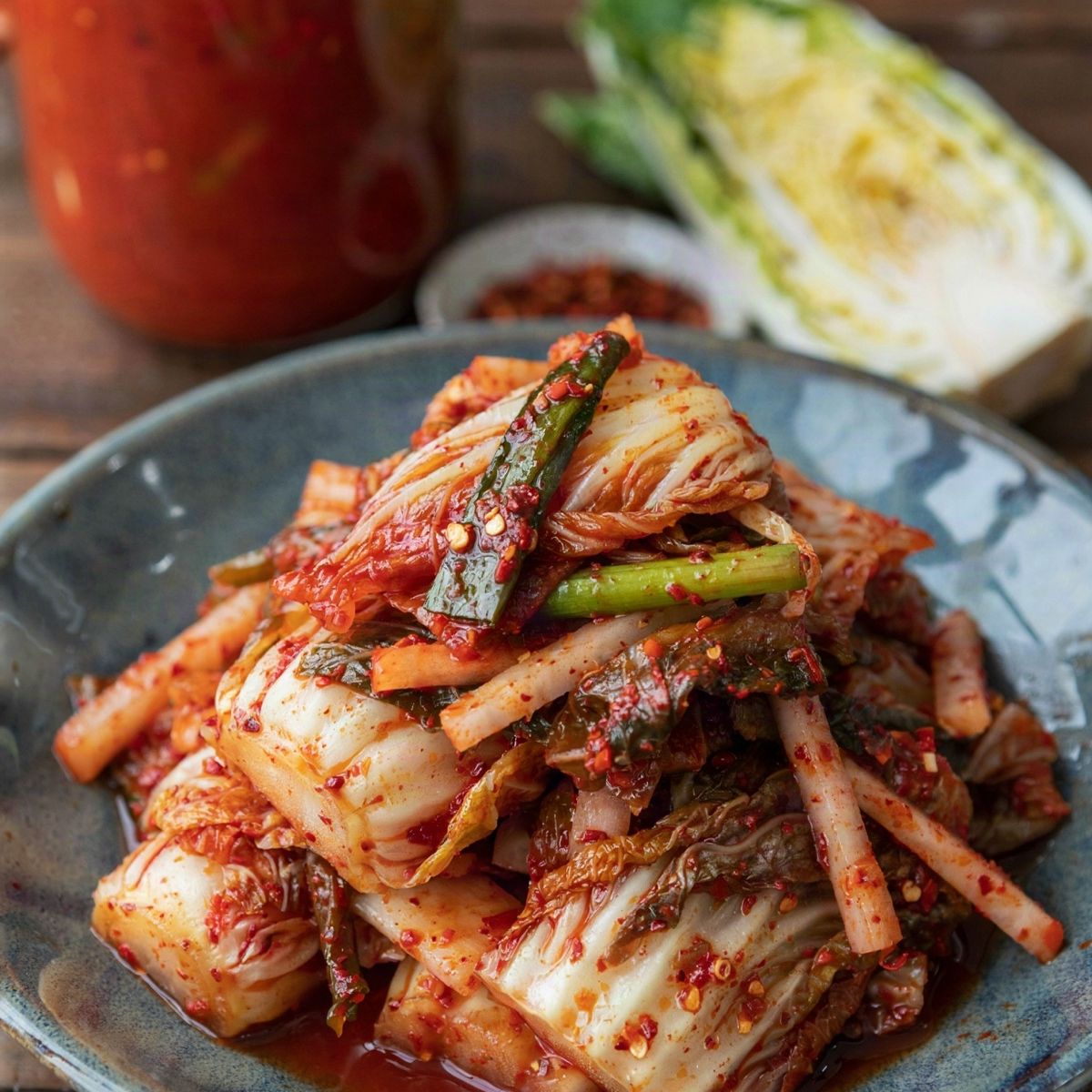
Most jarred kimchi contains fish sauce or salted shrimp, so read the label or use our vegetarian kimchi. The sourer the better. Kimchi that has sat in the fridge for a few weeks brings acidity and depth that a fresh jar cannot, and its juice is seasoning too, which is why the salt waits until the tofu is in.
Soy sauce
Korean cooks season this stew with guk-ganjang, soup soy sauce, which is paler and saltier than the regular kind and does not darken the broth. If you have it, use 2 teaspoons in place of the tablespoon in the list. Regular soy sauce works well, and it is what the quantities are written for.
Eggs
The egg goes in raw and the stew cooks it, the way Korean tofu houses serve it with an egg on the side to crack in yourself. Use the freshest eggs you have. Their whites hold together in the bubbling broth, where older whites spread into thin strands.
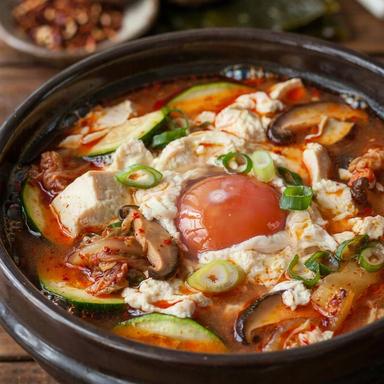
Vegetarian Sundubu Jjigae
A spicy Korean soft tofu stew for two: extra-soft tofu simmered in a kelp and shiitake broth with vegan kimchi, zucchini and chili oil, with an egg poached on top.
Ingredients
Equipment
As an Amazon Associate I earn from qualifying purchases, at no extra cost to you.
Instructions
- 1
Soak the kelp and shiitake
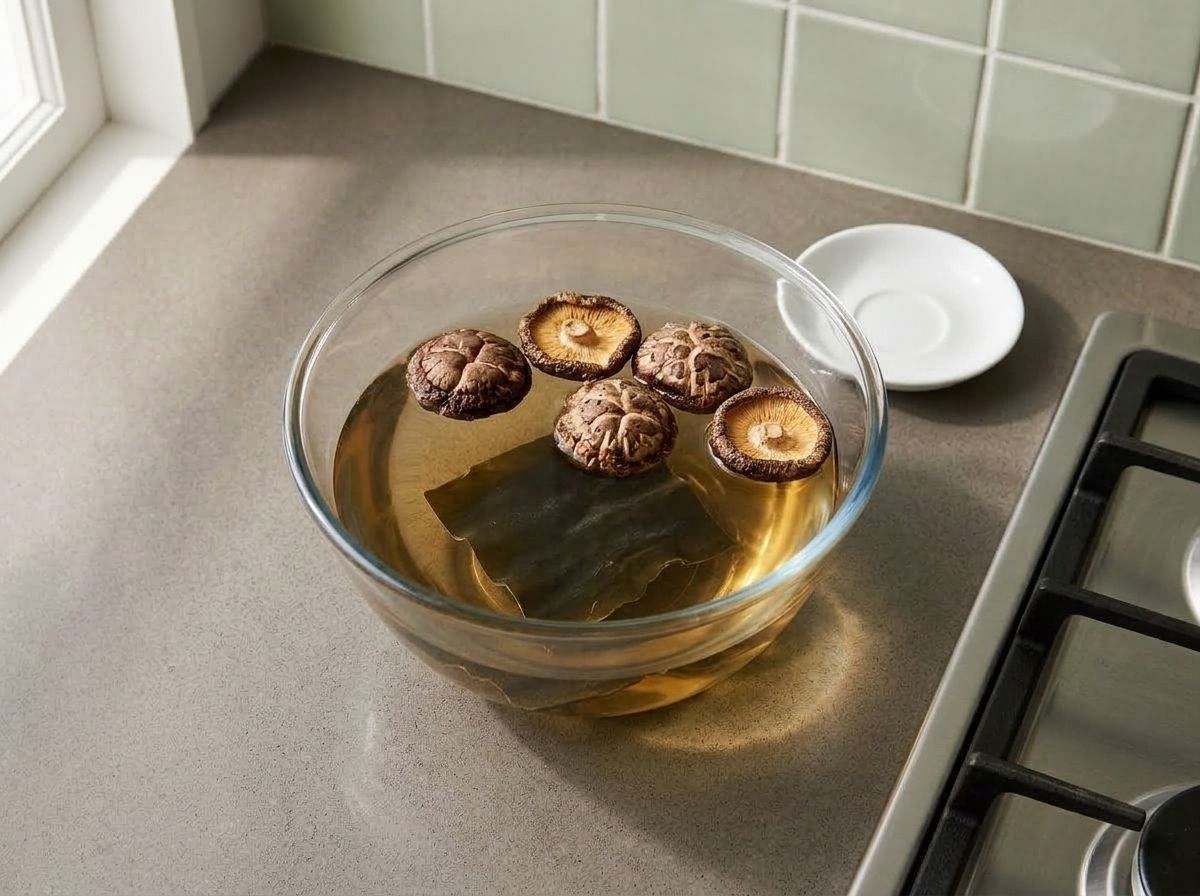
Put the kelp and the dried shiitake in a bowl and pour over the 1 1/2 cups of water, hot but well off the boil. Leave them for 20 minutes, pressing the mushrooms under with a small plate if they float. The water turns pale amber and smells faintly of the sea.
- 2
Chop the vegetables
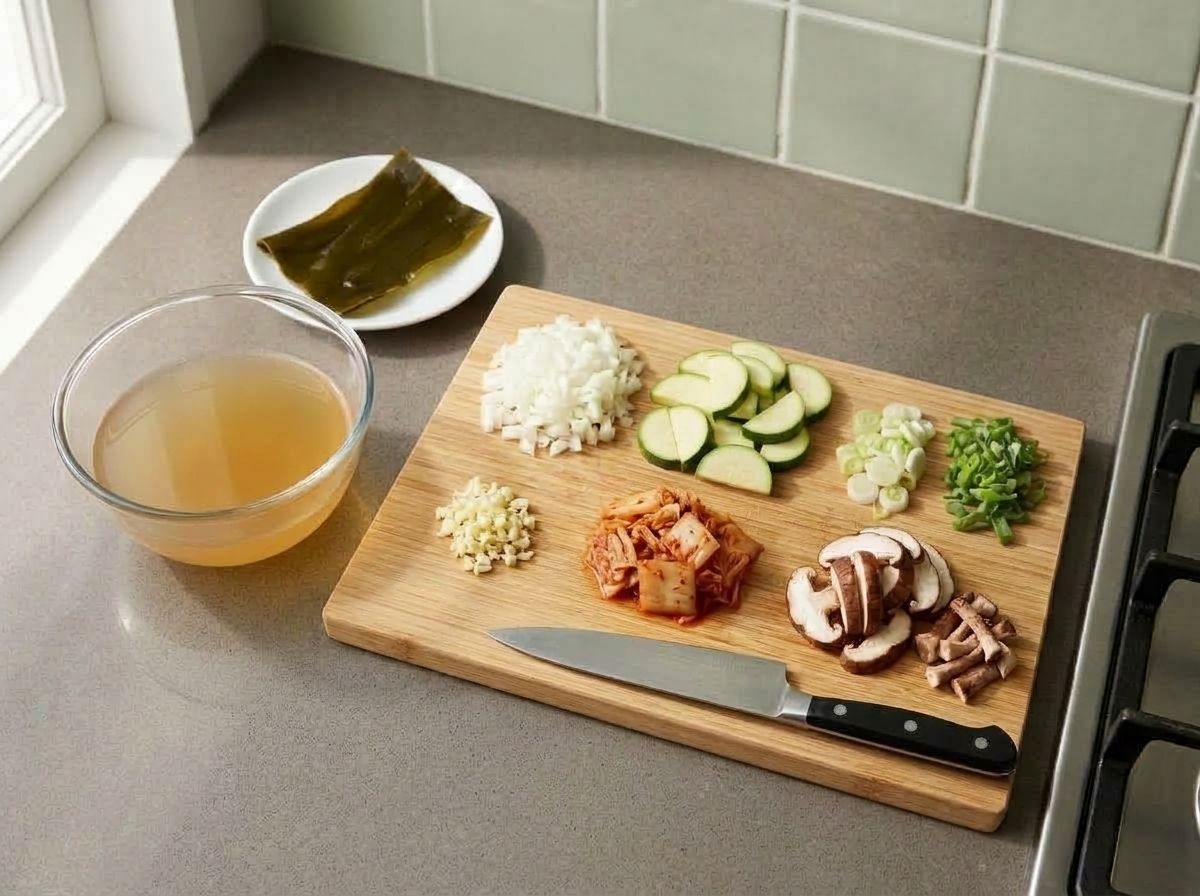
While the stock soaks, finely chop the onion, mince the garlic, slice the zucchini into half-moons about 1/4 inch thick and cut the kimchi into bite-sized pieces. Slice the scallions, keeping the whites and the greens apart. Lift the shiitake out, squeeze them over the bowl, cut off the stems and slice the caps. Lift out the kelp and discard it.
- 3
Soften the onion and garlic
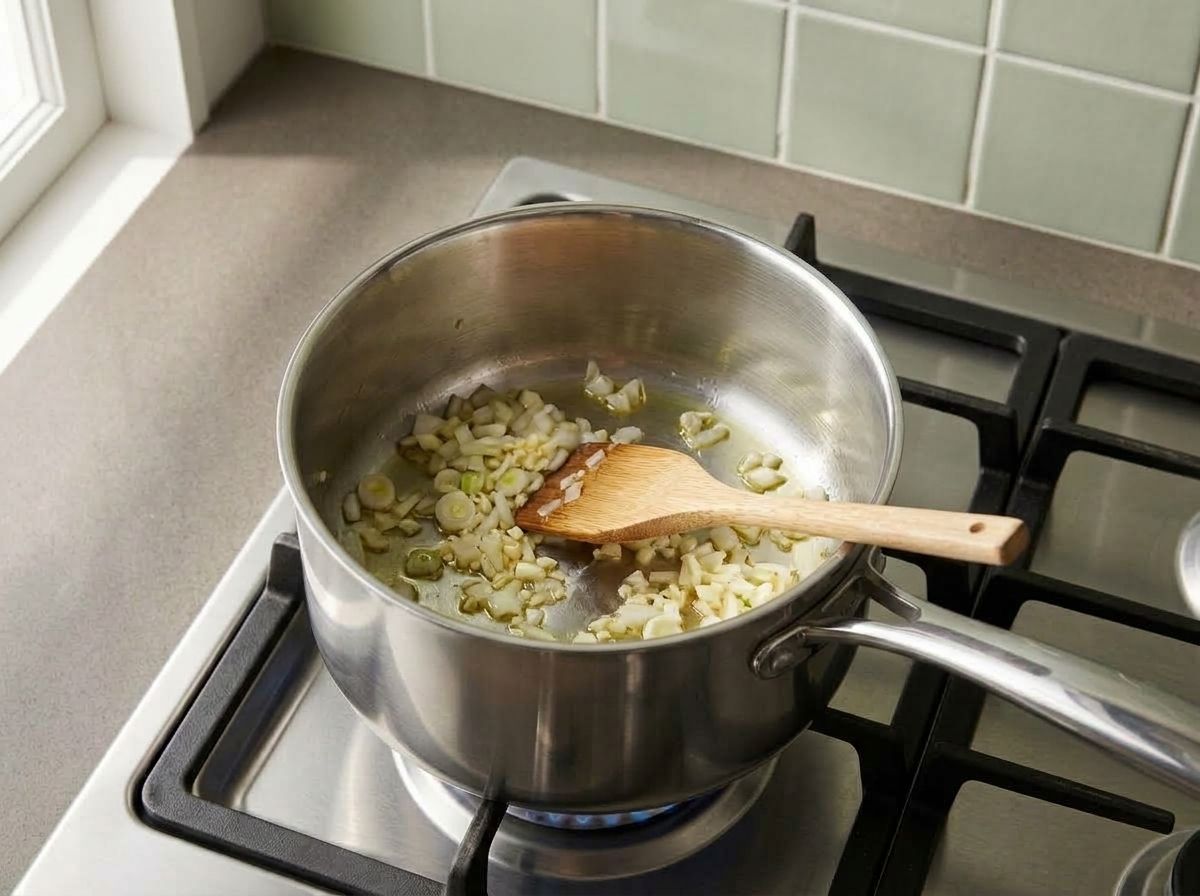
Heat the vegetable oil and sesame oil in a saucepan over medium-low heat. Add the onion, the scallion whites and the garlic and cook for 2 minutes, stirring, until soft and translucent but not browned.
- 4
Bloom the chili flakes off the heat
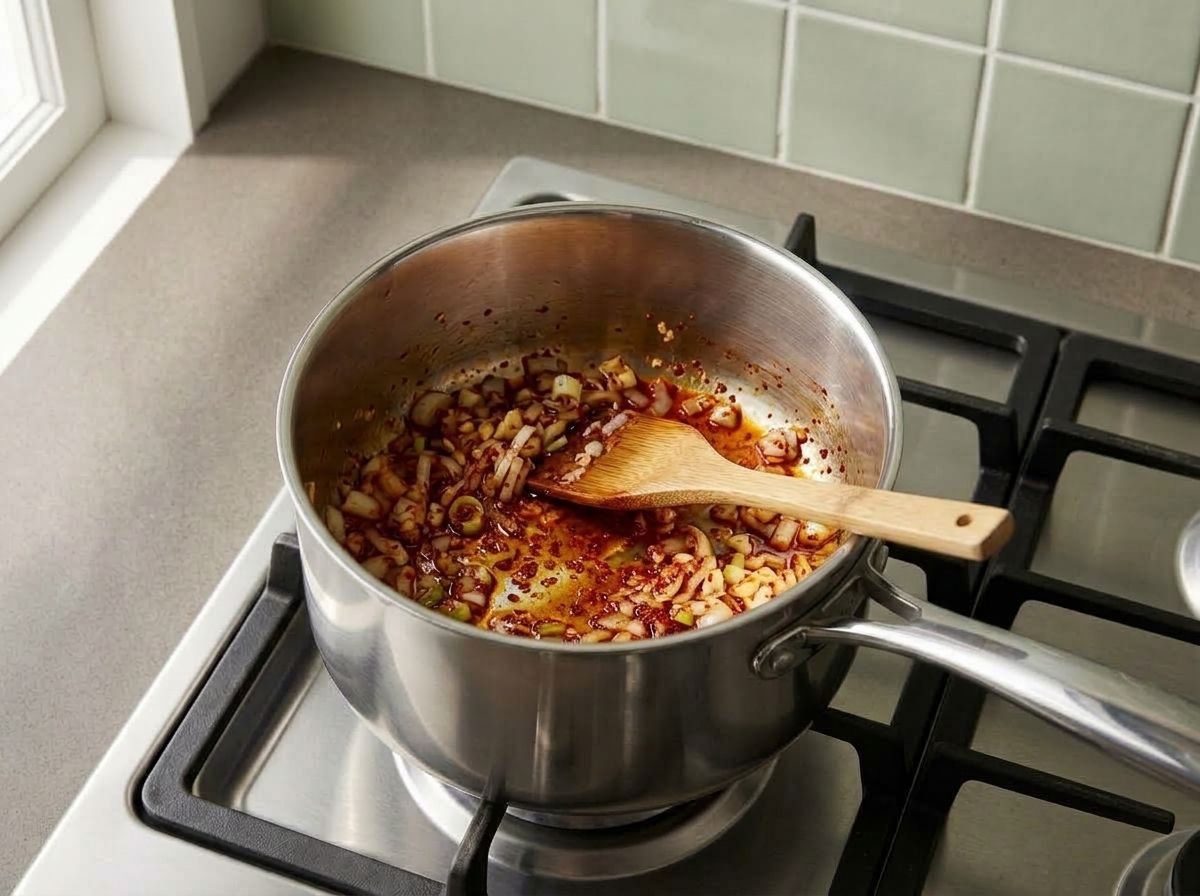
Take the pan off the burner and stir in the gochugaru. Keep stirring for 30 seconds while the oil turns brick red and smells toasty. The heat left in the pan is enough; on a live burner the flakes scorch in seconds and turn bitter.
- 5
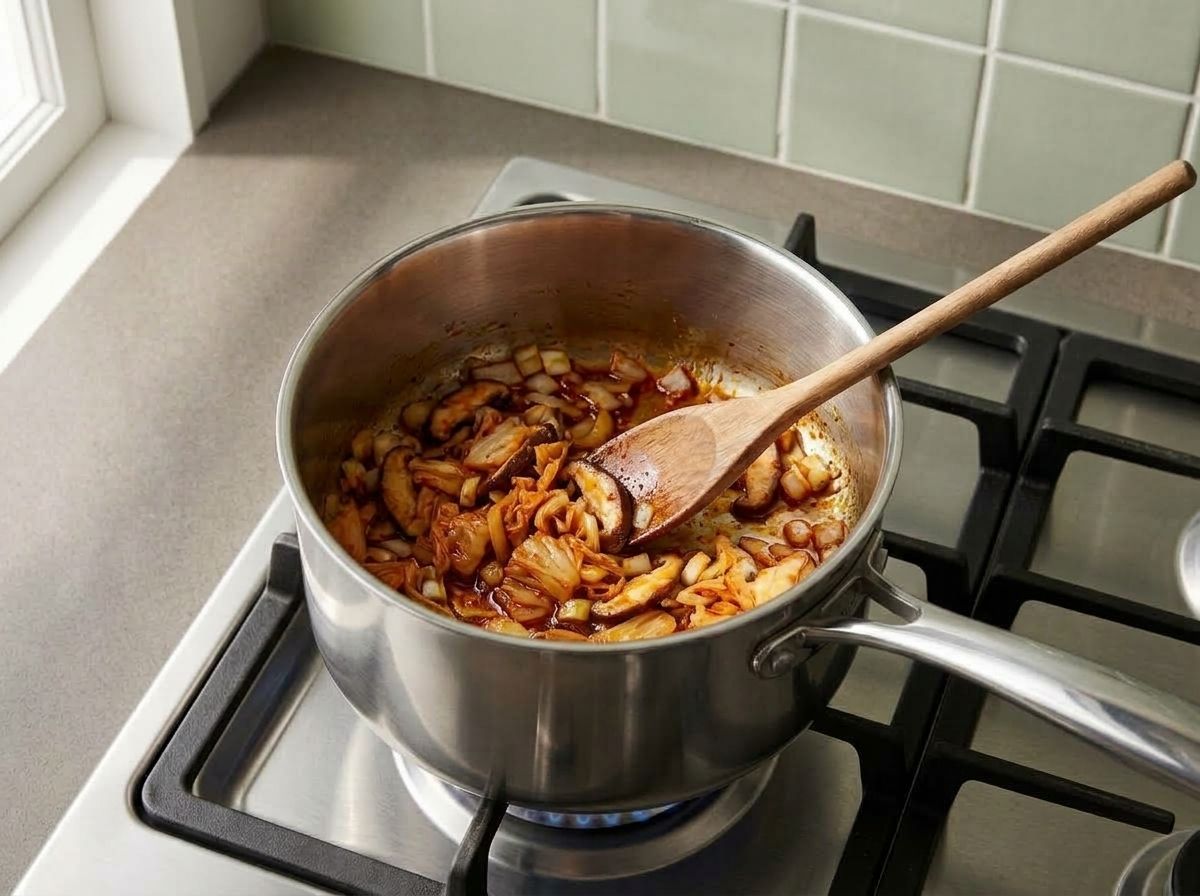
Fry the kimchi and shiitake
Put the pan back over medium heat, add the kimchi and the sliced shiitake and fry for 2 minutes, stirring, until the kimchi softens and everything is coated in the red oil.
- 6
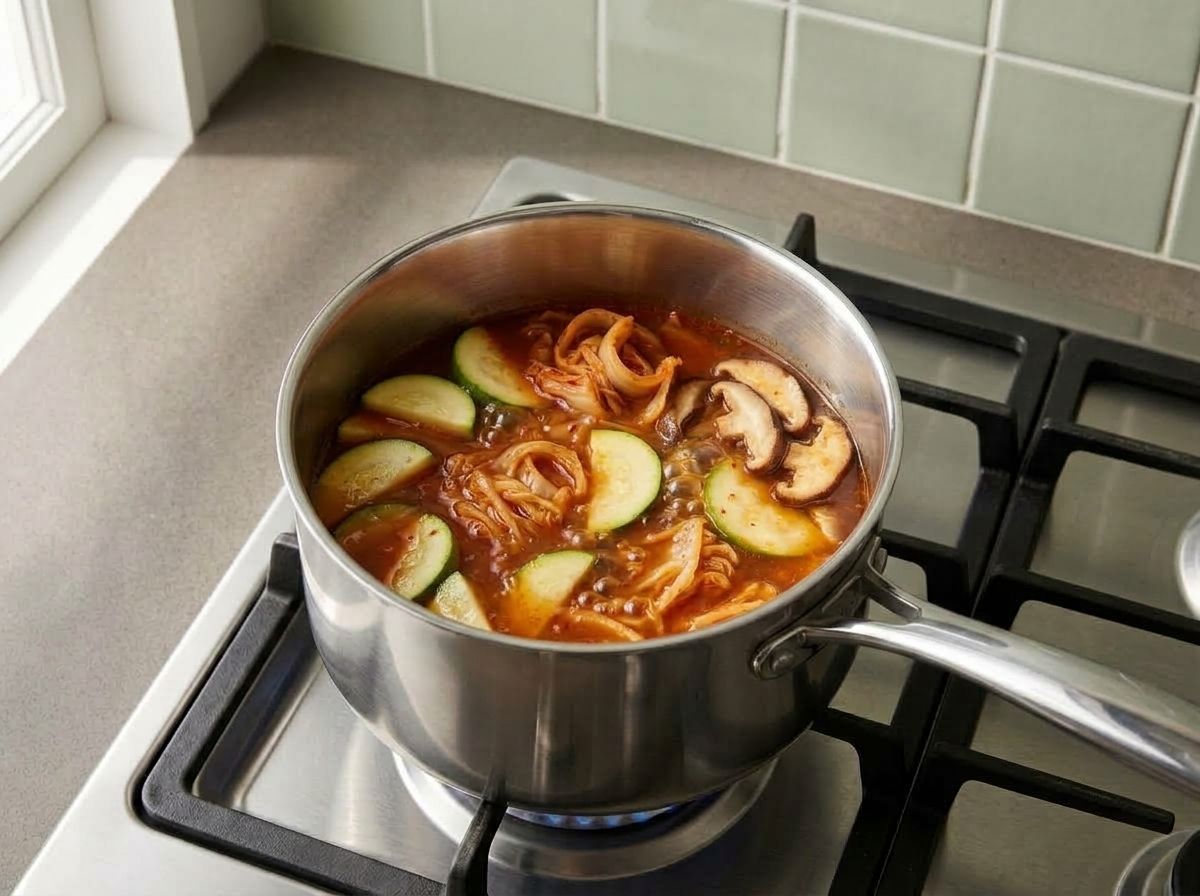
Add the stock and zucchini
Pour in the stock, leaving any grit in the bottom of the bowl, then add the kimchi juice, the soy sauce and the zucchini. Bring to a boil and simmer for 3 minutes, until the zucchini is just starting to soften.
- 7
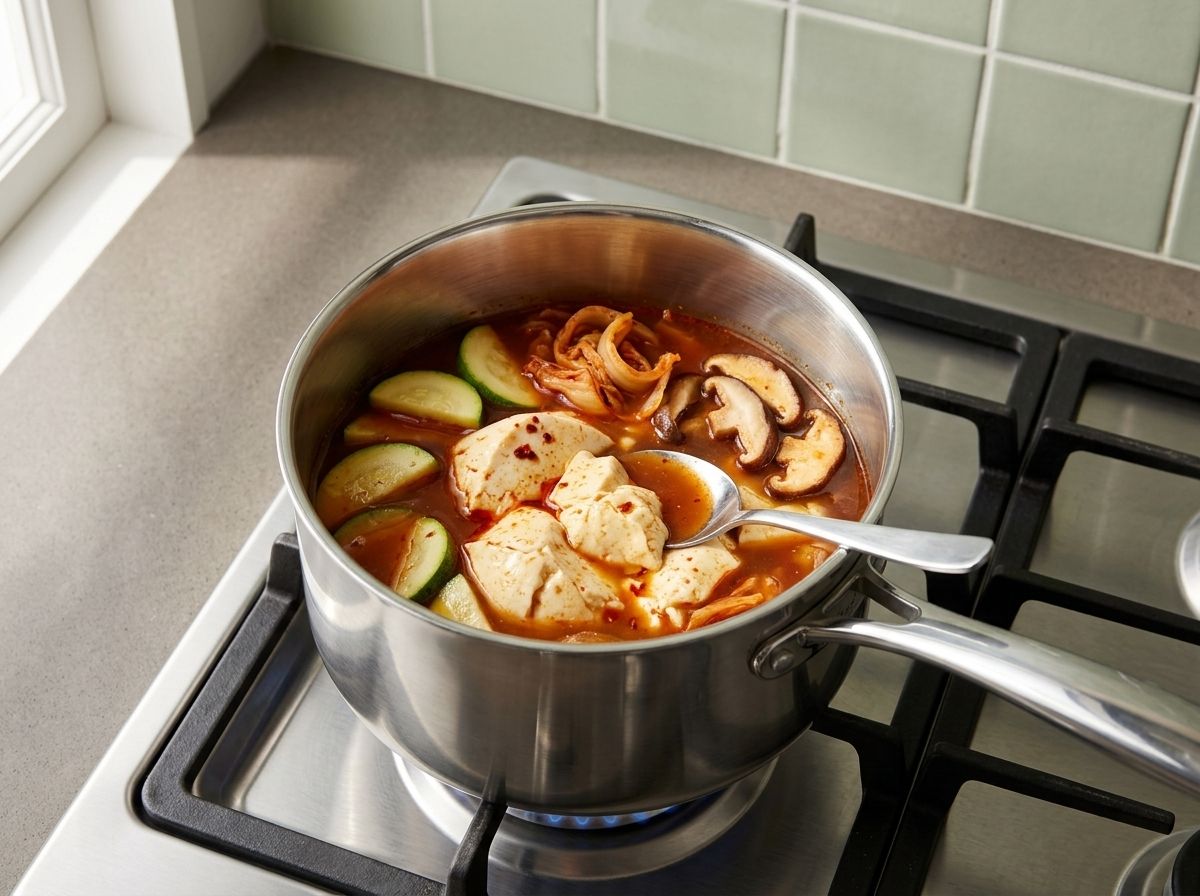
Spoon in the tofu
Cut the tube of tofu in half across the middle and squeeze each half out into the pan, then break it into four or five big pieces with a spoon. Do not stir. Add the enoki if you are using them and simmer for 4 to 5 minutes, spooning broth over the tofu, until it is hot through. Taste the broth and add salt a pinch at a time.
- 8
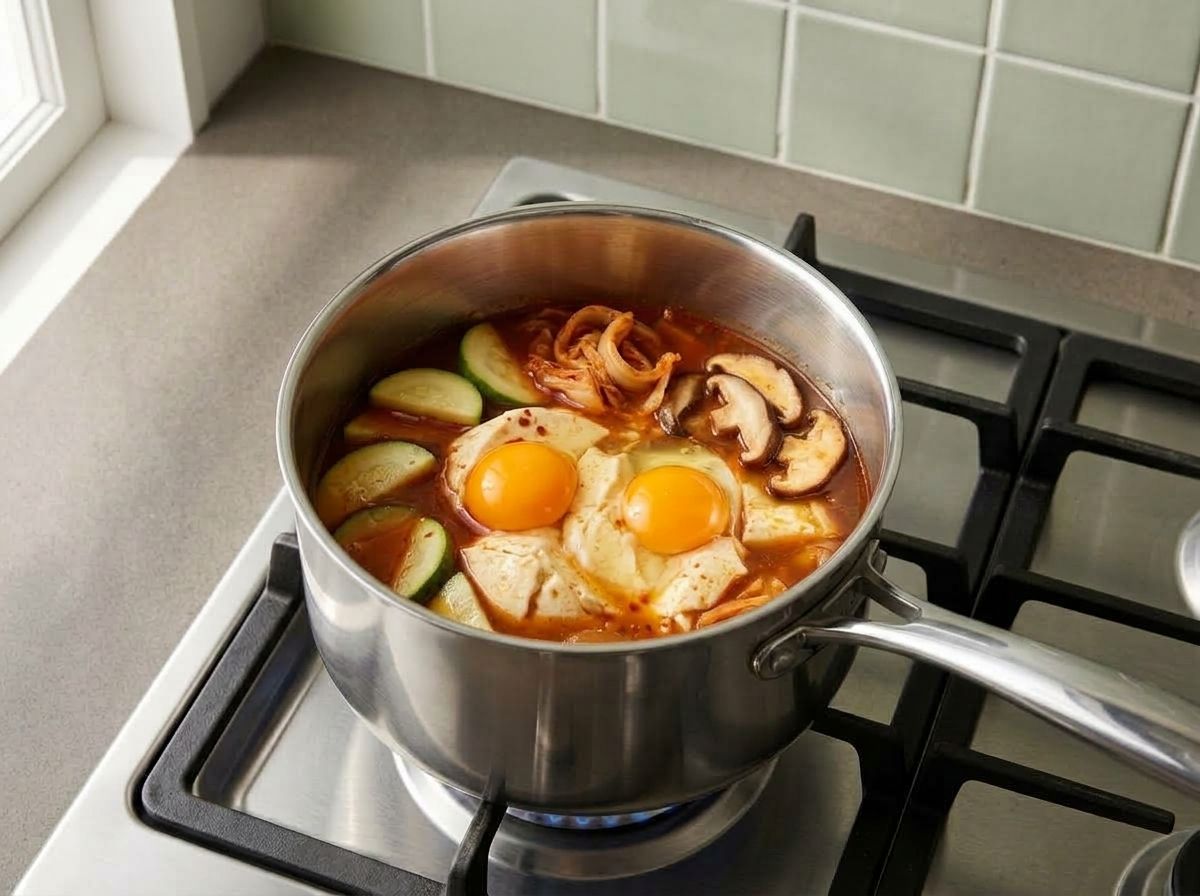
Poach the eggs on top
Turn the heat down to a gentle bubble, press two hollows into the tofu with the back of the spoon and crack an egg into each. Scatter over the green chili, if using, then cover and cook for 2 minutes, until the whites are opaque and the yolks still soft.
- 9
Serve it bubbling
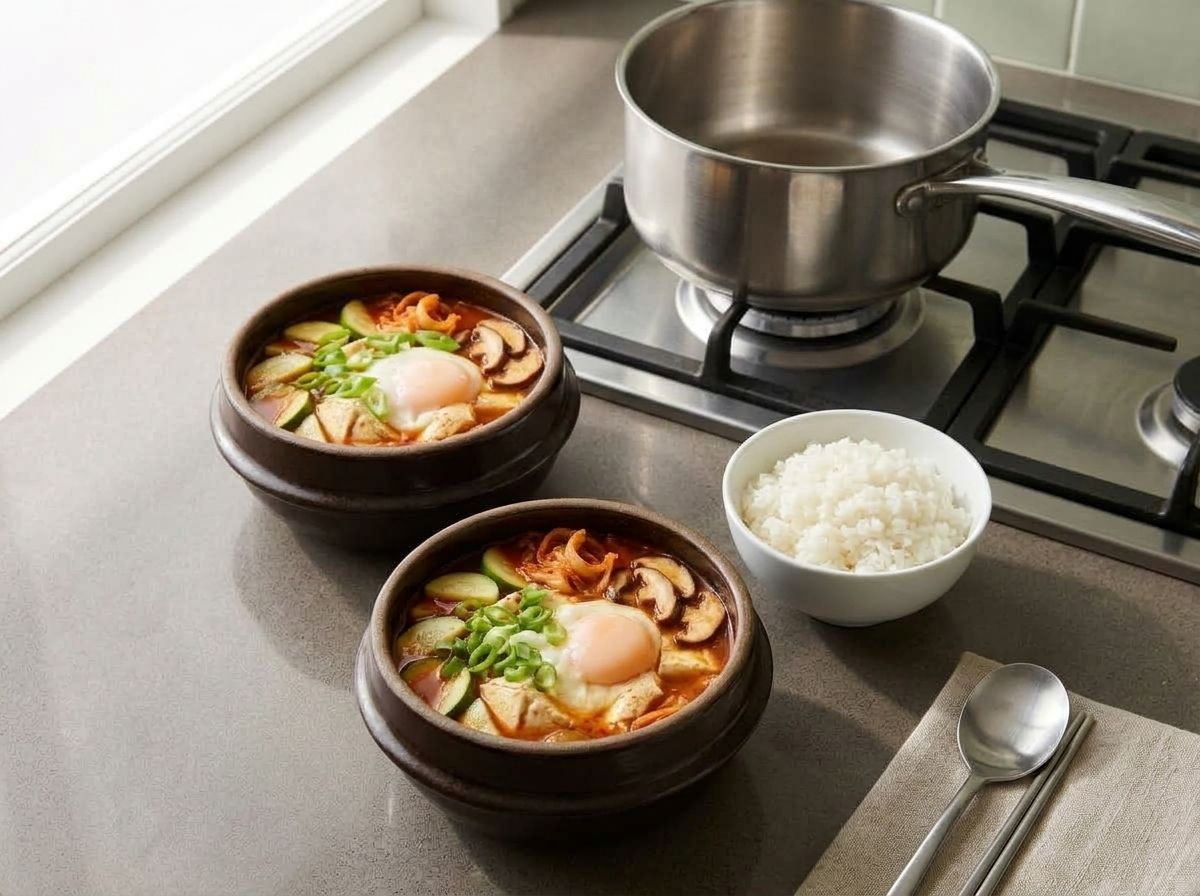
Take the pan straight to the table, or ladle the stew into two warmed bowls, earthenware if you have them, sliding one egg into each. Scatter the scallion greens over the top and serve at once with rice.
Notes
Vegan: leave out the eggs. Everything else is plant based, as long as the kimchi is made without fish sauce or salted shrimp.
Heat: 1 tablespoon of gochugaru makes a medium stew. For the extra-spicy level Korean tofu houses serve, use 2 tablespoons.
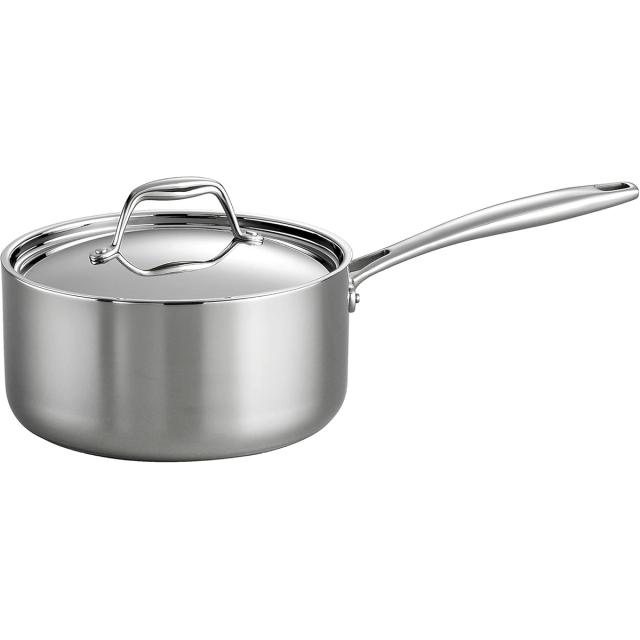
If you own a Korean earthenware pot (ttukbaegi), cook the whole stew in it from the chili oil onward. It holds the boil for several minutes at the table.
Nutrition Facts
2 servings · 593 g per serving
- Calories
- 320 kcal
% Daily Value*
- Total Fat
- 18.1 g23%
- Saturated Fat
- 3.6 g18%
- Sodium
- 1110 mg48%
- Total Carbohydrate
- 19.1 g7%
- Dietary Fiber
- 5.4 g19%
- Sugars
- 5.5 g—
- Protein
- 23.4 g47%
Recipe from veggierecipes.blog
When it goes wrong
Troubleshooting
The chili flakes went dark and the stew tastes bitter
The gochugaru scorched. It burns within seconds on direct heat, which is why the method takes the pan off the burner before it goes in. Once the flakes are brown there is no rescue: wipe out the pan and make the chili oil again. It costs a minute and a tablespoon of flakes, where a bitter base tastes bitter in every spoonful.
The broth tastes thin and flat
It usually needs salt or sourness, not more chili. Add salt a pinch at a time, then a spoonful more kimchi juice. If it still lacks depth, the stock was short: the kelp and shiitake need the full 20 minutes in hot water. For an even deeper stock, soak them in cold water in the fridge the night before.
The tofu broke into tiny grains
It was stirred. Sundubu has no structure to resist a spoon, and stirring breaks it into curds the size of rice. Put it in as four or five big pieces and then move the pot rather than the tofu: tilt it gently, or spoon broth over the top. Broken tofu still tastes right; it just looks like a different dish.
My tofu stayed in neat cubes
That is firm or medium tofu, or silken tofu cut with a knife. The stew depends on tofu that tears into soft, uneven pieces with rough edges that hold the broth. With silken tofu from a carton, scoop it in with a large spoon rather than cubing it. With firm tofu you have a good tofu stew, but not sundubu jjigae.
The yolks were hard by the time it reached the table
The stew keeps cooking after the heat goes off, especially in a heavy pan. Take it off as soon as the whites turn opaque, at about two minutes, while the yolks still wobble. If you are ladling into bowls, slide each egg across whole and serve straight away rather than letting it stand.
It is far too spicy
The heat is in the chili oil, so diluting it is the only fix: add a splash of water or stock and a pinch of salt to keep it seasoned. At the table, breaking the yolk into the broth and eating plenty of rice both soften it. For the next batch, halve the gochugaru. Half a tablespoon still turns the broth red.
Before you serve
Serving & Storage
Sundubu jjigae is a rice meal. In Korea it comes to the table still boiling in a ttukbaegi, a glazed earthenware pot that holds its heat so well the stew keeps bubbling for minutes after it leaves the stove, with a bowl of short-grain rice and a few banchan beside it. Eat a spoonful of rice, then a spoonful of stew, or tip the rice into the broth as it cools.
The best banchan here are cold and crunchy, to set against the heat: kimchi, a quick cucumber salad or seasoned bean sprouts. For a bigger meal, a plate of vegetarian kimbap alongside turns it into the kind of lunch Korean snack shops serve.
Making it ahead
The stock and the chili oil base, with the kimchi fried in, can both be made a day ahead and kept separately in the fridge. The tofu and the eggs cannot. Sundubu keeps breaking down as it sits, and a reheated egg is a hard-boiled egg. Bring the base and stock back to a boil together, then carry on from the zucchini.
Storing leftovers
Leftovers keep for up to two days in a covered container in the fridge, ideally without the egg. Reheat gently in a small pan until just bubbling; the tofu will be softer and the broth a little thicker. It does not freeze. Frozen sundubu thaws spongy and grainy, which is the opposite of the point.
Still wondering
Frequently Asked Questions
Is sundubu jjigae vegetarian?
Not usually. Most restaurant versions are built on an anchovy and kelp stock and topped with seafood, beef or pork, and even the vegetable one on the menu is often made with the same stock. This version is vegetarian with the eggs and vegan without them, as long as the kimchi contains no fish sauce or salted shrimp.
What is the difference between sundubu jjigae and kimchi jjigae?
Which ingredient leads. Kimchi jjigae is built on a lot of kimchi, often a cup or more for two, with tofu in a supporting role. Sundubu jjigae is built on soft tofu, with kimchi as an optional depth. With half a cup of kimchi this recipe sits on the sundubu side, and in Korea it would be called kimchi sundubu.
Can I double the recipe?
Yes. Use two tubes of tofu, double everything else and cook it in a wider pot, so the tofu sits in one layer and the eggs have room on top. Let the oil cool for a few seconds longer before the gochugaru goes in, since a larger pan holds more heat, and allow an extra minute or two for the stew to come back to a simmer after the tofu.
More Spicy Korean Dishes To Try


Made this?