
Vegetarian Tteokbokki Recipe
Published · Updated
The anchovy broth under Korea’s most famous street food is already half kelp, which means the vegetarian version starts from a much stronger position than most people assume.
Jump To Recipe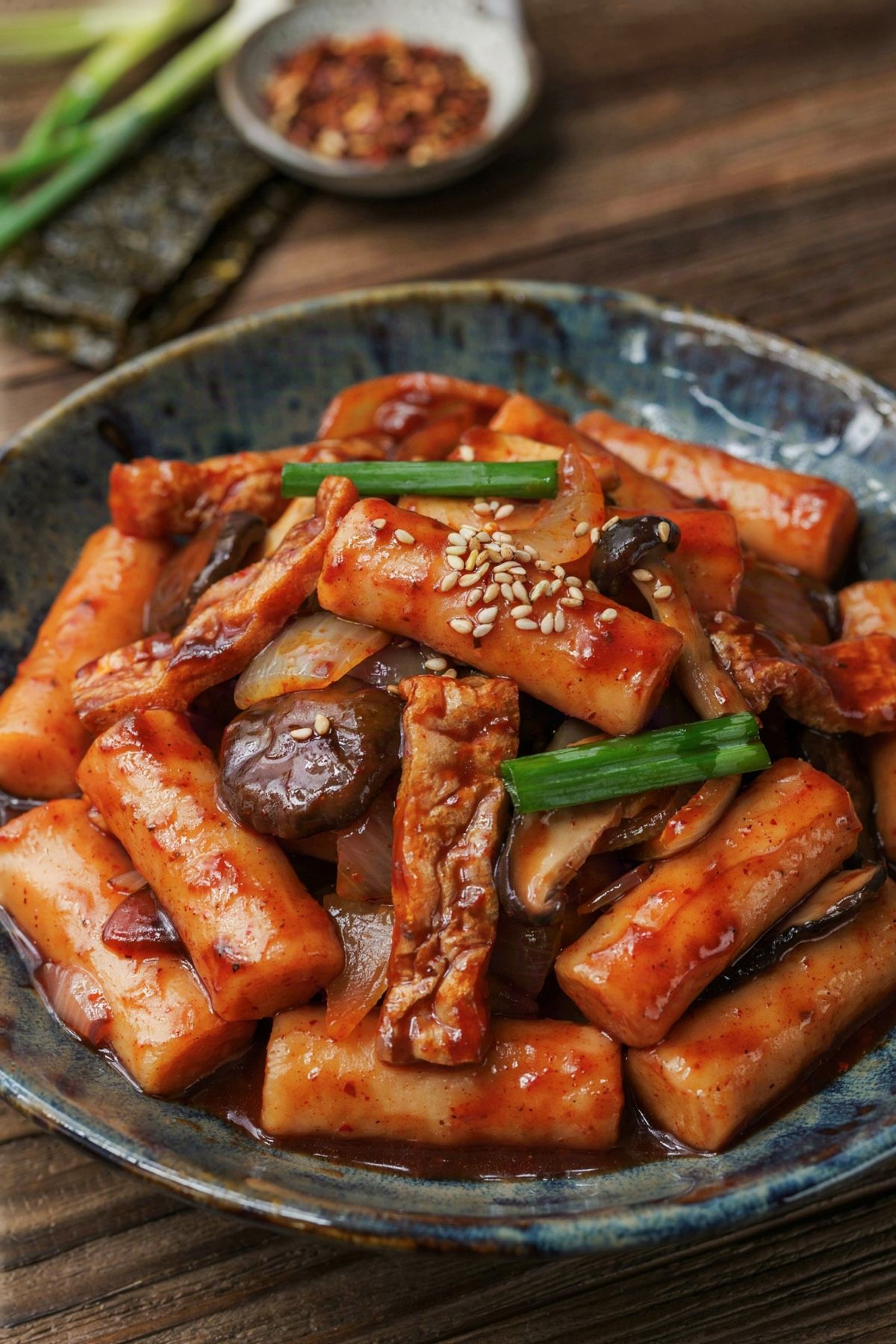
I Spent Two Years Boiling The Rice Cakes First
The first tteokbokki I ever made came off the back of a packet of rice cakes, and the packet said to boil them, drain them, and toss them in sauce. That produced something recognizably tteokbokki and slightly wrong every single time. The sauce sat in a shallow puddle under the rice cakes instead of gripping them, and my fix was always to add more gochujang, which made it saltier without making it cling.
What changed it was watching someone make it properly and noticing what they did not do. They never drained anything. The rice cakes went into the seasoned broth firm and raw and stayed there for the whole cook, and by the end the liquid had gone from thin and red to thick and glossy without a thickener anywhere near it. All of that body is starch the rice cakes give up while they soften. Boil them in a separate pot and you pour the sauce down the sink.
I have not bought a pre-portioned tteokbokki sauce packet since, and I no longer keep anchovy stock in the house for it either. Both turned out to be solving problems that a piece of kelp and twenty minutes solve better.
The story
Tteokbokki Was A Soy Sauce Dish For Most Of Its Life
The tteokbokki in every photograph, glossy and orange red and sweet enough to be a dessert in another country, is about seventy years old. The dish underneath it is not. The earliest written recipe sits in Siuijeonseo, a Korean cookbook from the late 19th century, and it describes something almost unrecognizable: garaetteok stir-fried with sirloin, sesame oil, soy sauce, scallions and pine nuts. Brown, mild, restrained. That version is still made and still has its own name, gungjung tteokbokki, meaning royal court tteokbokki.
Chili could not have been in the original anyway. Capsicum only reached Korea in the late 16th century, carried by Portuguese traders by way of Japan, and gochujang took another long stretch to settle into the fermented paste sold today. The court version is not a milder variant of the red one. It is the older dish, and the red one is the variant.
The red one has a date and a name attached to it. 1953, Sindang-dong in central Seoul, a woman named Ma Bok-rim. The story told in the neighborhood is that a rice cake fell into a bowl of black bean sauce at a restaurant opening, she liked what happened to it, and she worked at the idea until gochujang turned out to be the answer. She sold it from a small stall. Her family still runs restaurants on the same street, and the alley is now signposted as Sindang-dong Tteokbokki Town.
The timing was not a coincidence. The Agricultural Trade Development and Assistance Act of 1954 pushed American surplus wheat into a country that was desperately short of rice, and Korean street cooking reorganized itself around cheap flour more or less overnight. That is where bunsik comes from, a word that means flour food and now just means the snack shops that sell this stuff. It is also why so much street tteokbokki is made with miltteok, wheat rice cakes, rather than the pure rice kind. Fish cakes belong to the same economy: cheap protein stretched with starch, sold by the skewer from the same carts, out of the same broth.
Which is the useful thing to know if you do not eat fish. The two ingredients that make tteokbokki awkward for a vegetarian, the sliced fish cake and the anchovy broth, are the youngest layer on the dish, not the oldest. They arrived because they were cheap in one particular decade, not because the recipe needed them. The version in Siuijeonseo has no fish in it at all. Leaving the anchovies out of the broth is a far smaller edit than the one Ma Bok-rim made.
What to buy
Ingredient Notes
Korean rice cakes (garaetteok)
The cylinders, not the flat oval slices sold for tteokguk soup. You will find them three ways: fresh and soft in the refrigerated case, vacuum sealed and shelf stable, or frozen. Fresh ones bend without cracking and need no soaking. The other two need 20 minutes in warm water, and frozen ones need to be fully thawed before that or the middles stay chalky. Some brands are wheat rather than rice, sold as miltteok. They are traditional street food and they hold their shape better, so they are a fair choice unless you need this gluten free.
Gochujang
The fermented chili paste doing most of the work. Two things worth checking on the tub. Most gochujang lists wheat flour, so it is not gluten free unless the label says so, and a small number of brands include fish or shellfish extract, which quietly undoes the point of this recipe. Brands vary a lot in heat and salt, so taste the sauce before the rice cakes go in rather than after.
Gochugaru
Korean chili flakes, and not optional even though gochujang is already chili. Gochujang brings salt, sweetness and fermented depth but very little clean heat and a dull brick color. Gochugaru brings both. Leave it out and the sauce reads sweet and muddy rather than bright and hot. Do not substitute cayenne or crushed red pepper, which are several times hotter and have none of the fruitiness. Coarse flakes are standard, fine grind dissolves smoother.
Dried kelp (dasima or kombu)
The reason this works. Korean stock for tteokbokki is anchovies and kelp together, and the kelp is not a supporting player: it carries roughly 1,600 to 3,200 mg of free glutamate per 100 g against the anchovies’ 1,000 to 1,500. Drop the fish and you keep the larger half. Wipe it with a barely damp cloth and leave the white bloom on the surface, that is the glutamate. Never boil it hard, which turns the broth slippery and bitter.
Dried shiitake
The other half of the rebuild, and it does something the kelp cannot. Shiitake are rich in guanylate, which multiplies the savoriness of glutamate rather than adding to it, so kelp plus shiitake tastes like considerably more than either on its own. Do not throw them away after steeping. Squeeze them out, slice the caps and put them back in the pan, where they give you the chew the fish cakes used to.
Fried tofu puffs (yubu)
Sold as yubu in Korean shops and aburaage in Japanese ones, in the freezer or the chilled case. This is the fish cake substitute that actually does the fish cake’s job. Eomuk is there for two reasons, a springy bite and a spongy body that soaks up sauce, and most vegan versions replace it with mushrooms, which are soft and repel sauce rather than drinking it. A fried puff does both jobs. If you cannot find them, slabs of firm tofu pan-fried until leathery on both sides are the next best thing.
Sugar
Tteokbokki is genuinely sweet and undersweetening it is the most common way a homemade version tastes wrong without the cook knowing why. The sweetness is what stops the gochujang reading as flat salt. Korean cooks often use mullyeot, a corn syrup, partly for sweetness and partly because it puts a shine on the finished sauce that sugar alone does not. A tablespoon of it swapped in for half the sugar is worth it if you have some.

Vegetarian Tteokbokki
Chewy Korean rice cakes simmered in a glossy gochujang sauce built on a kelp and shiitake broth, with fried tofu puffs standing in for the fish cakes. Vegan, and most of the hour is passive steeping.
Ingredients
Equipment
As an Amazon Associate I earn from qualifying purchases, at no extra cost to you.
Instructions
- 1
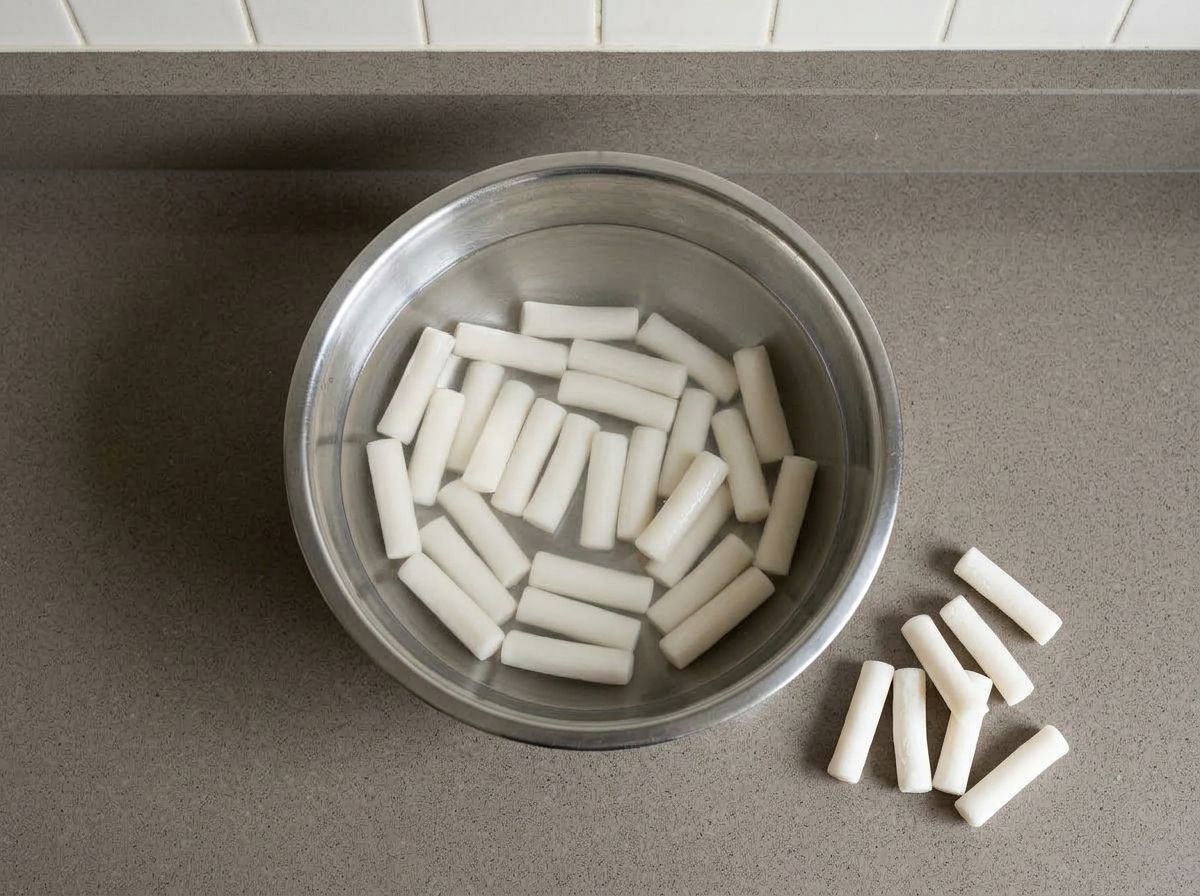
Soak the rice cakes
Separate the rice cakes with your fingers so none are stuck together, put them in a bowl and cover with warm tap water. Leave them for 20 minutes. Skip this only if they are the fresh refrigerated kind that bend without cracking. Frozen rice cakes need to be thawed all the way through before they go in the water, not soaked from frozen.
- 2
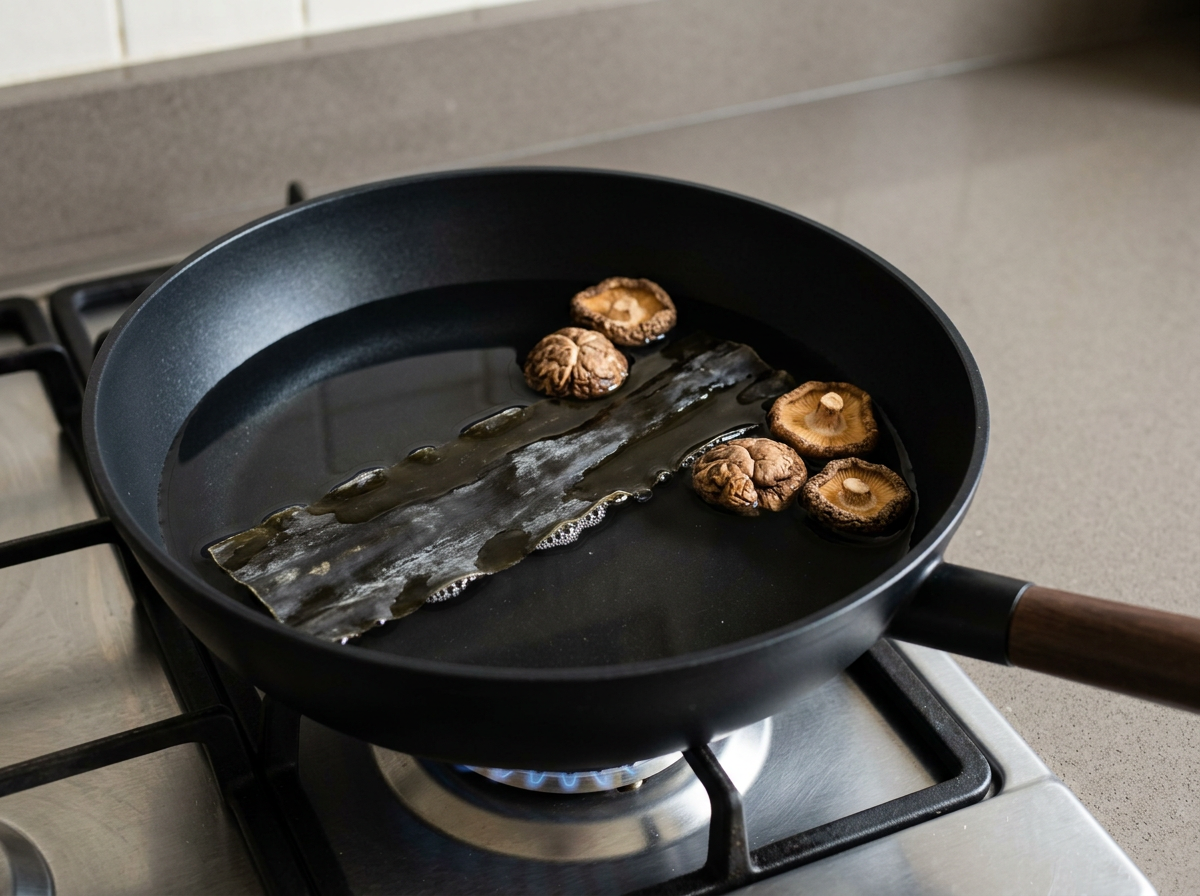
Steep the kelp and shiitake
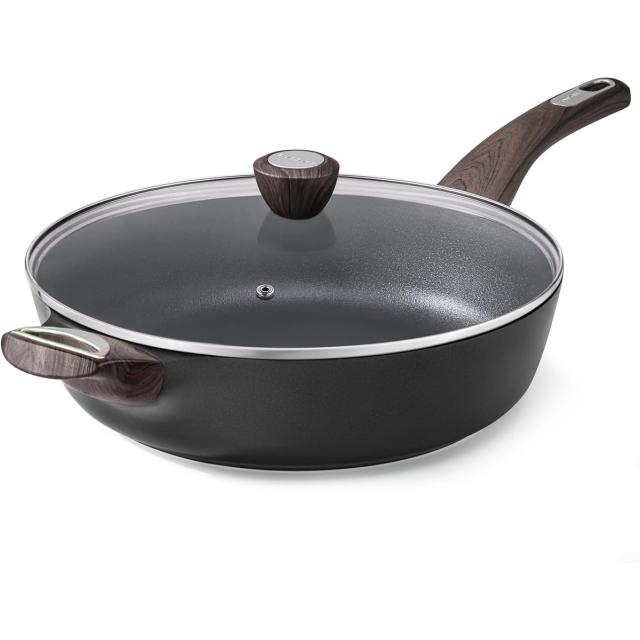
Wipe the kelp with a barely damp cloth, leaving the white bloom on the surface where it is, and put it in a large skillet with the dried shiitake and the cold water. Bring it slowly to the point where the first bubbles break, then take the pan off the heat and leave it to steep for 20 minutes. Do not let it boil hard, which turns the broth slippery and faintly bitter.
- 3
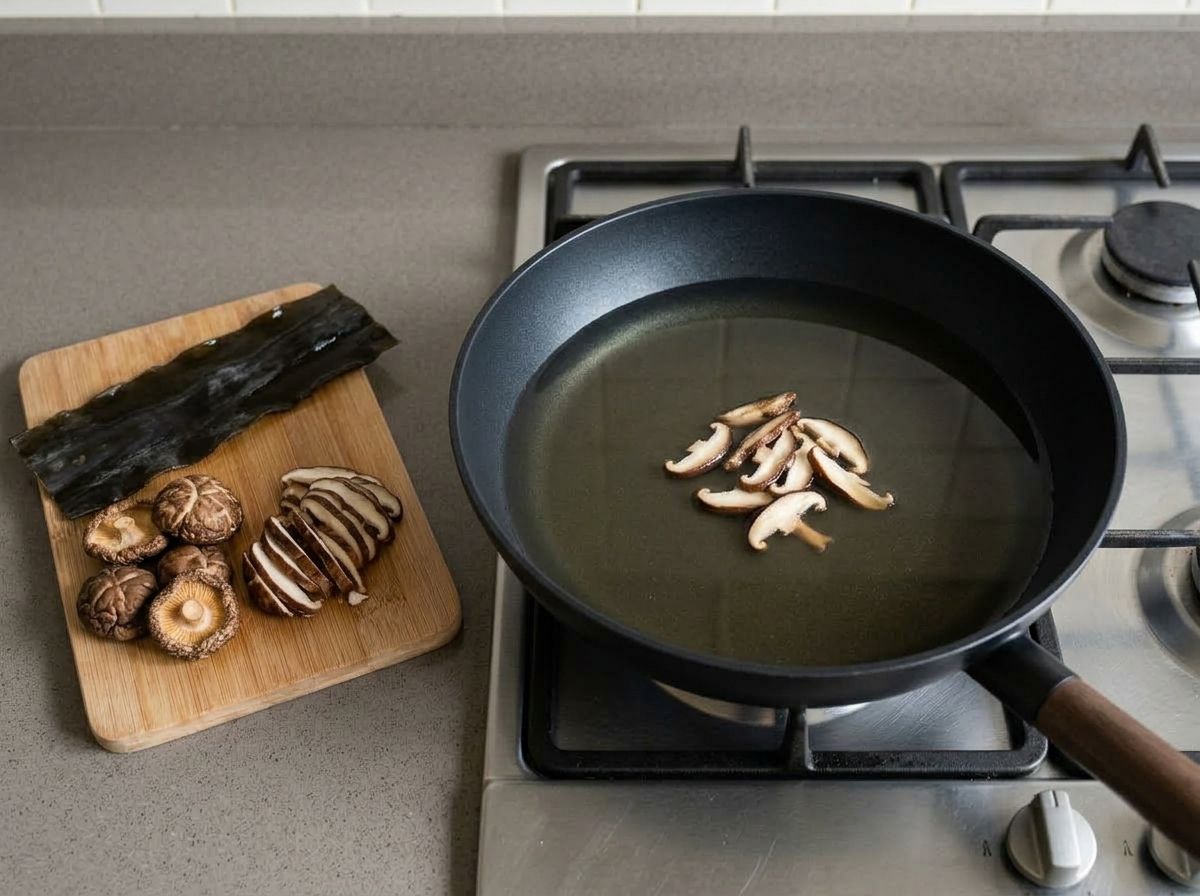
Lift out the kelp and slice the mushrooms
Take the kelp out and discard it, it has given up what it has. Squeeze the shiitake against the side of the pan to get the liquid out of them, cut off and discard the tough stems, slice the caps thinly and drop the slices back into the broth.
- 4
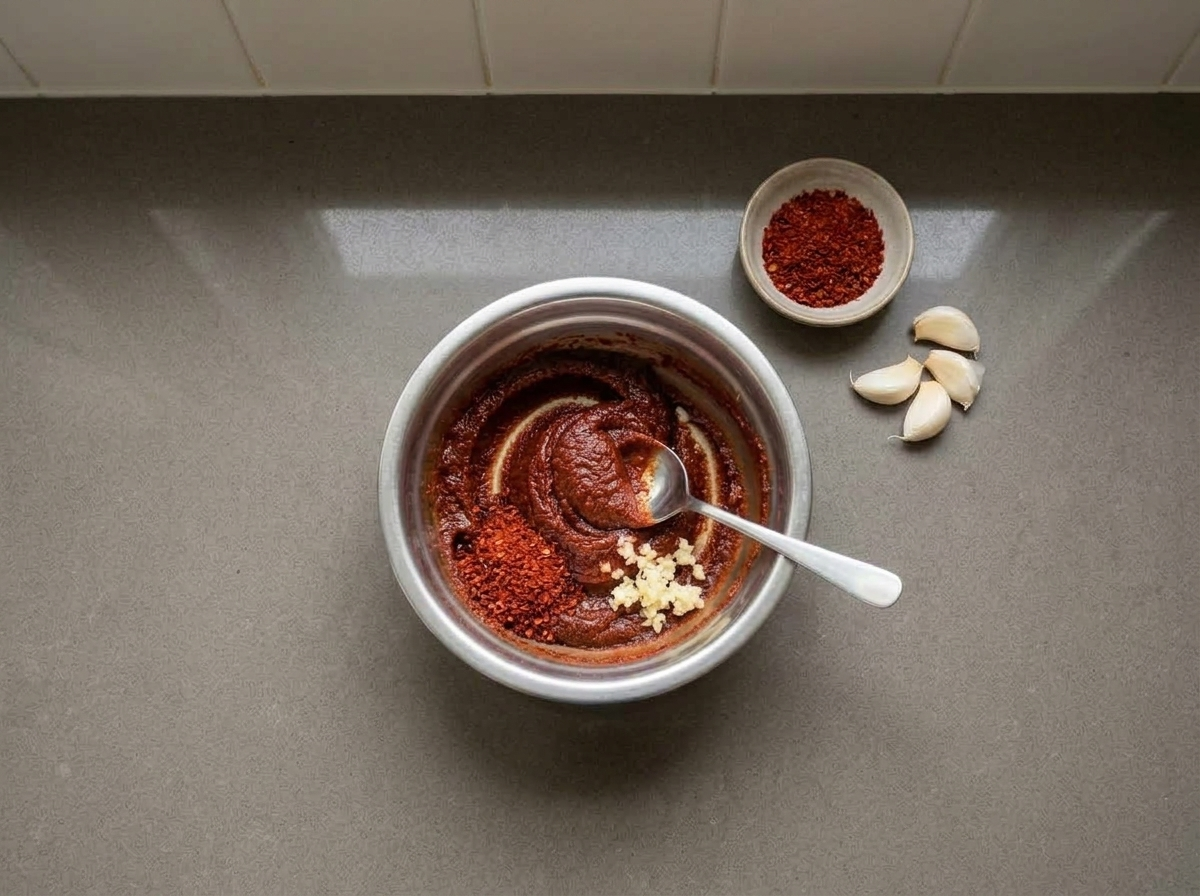
Mix the sauce paste
In a small bowl, stir the gochujang, gochugaru, soy sauce, sugar and minced garlic together into a smooth, stiff paste. Doing this separately rather than dropping the gochujang straight into the pan is what keeps the sauce from staying lumpy.
- 5
Dissolve the sauce into the broth
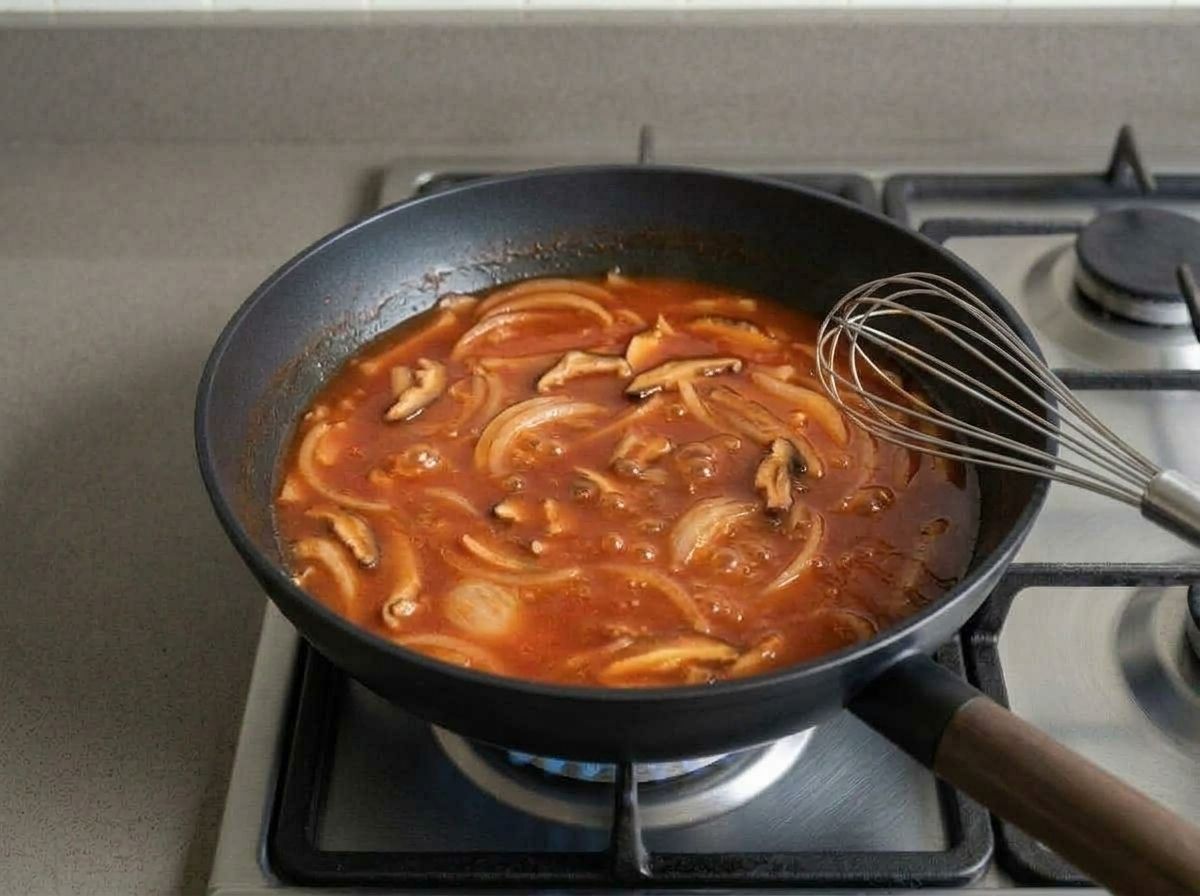
Whisk the paste into the warm broth until no streaks of it are left sitting on the surface, then add the sliced onion. Bring the pan back to a simmer over medium high heat. Taste it now, while you can still fix it: it should be a little too salty and a little too sweet, because the rice cakes will take some of both.
- 6
Add the rice cakes
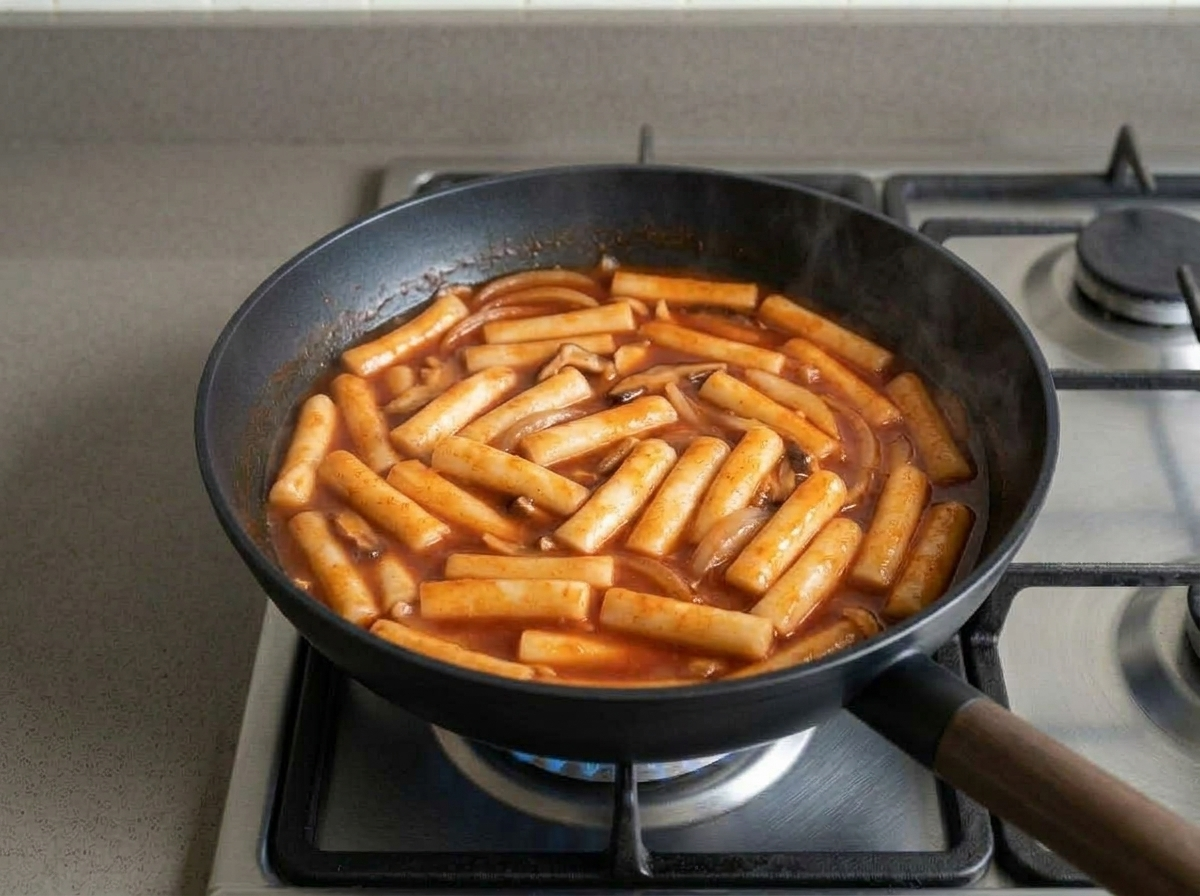
Drain the rice cakes and slide them into the simmering sauce. Cook uncovered for 10 to 12 minutes, stirring up from the bottom of the pan every minute or so, which stops the starch settling and catching. The sauce will go from thin and loose to visibly thicker as the rice cakes release their starch into it.
- 7
Add the tofu puffs and scallions
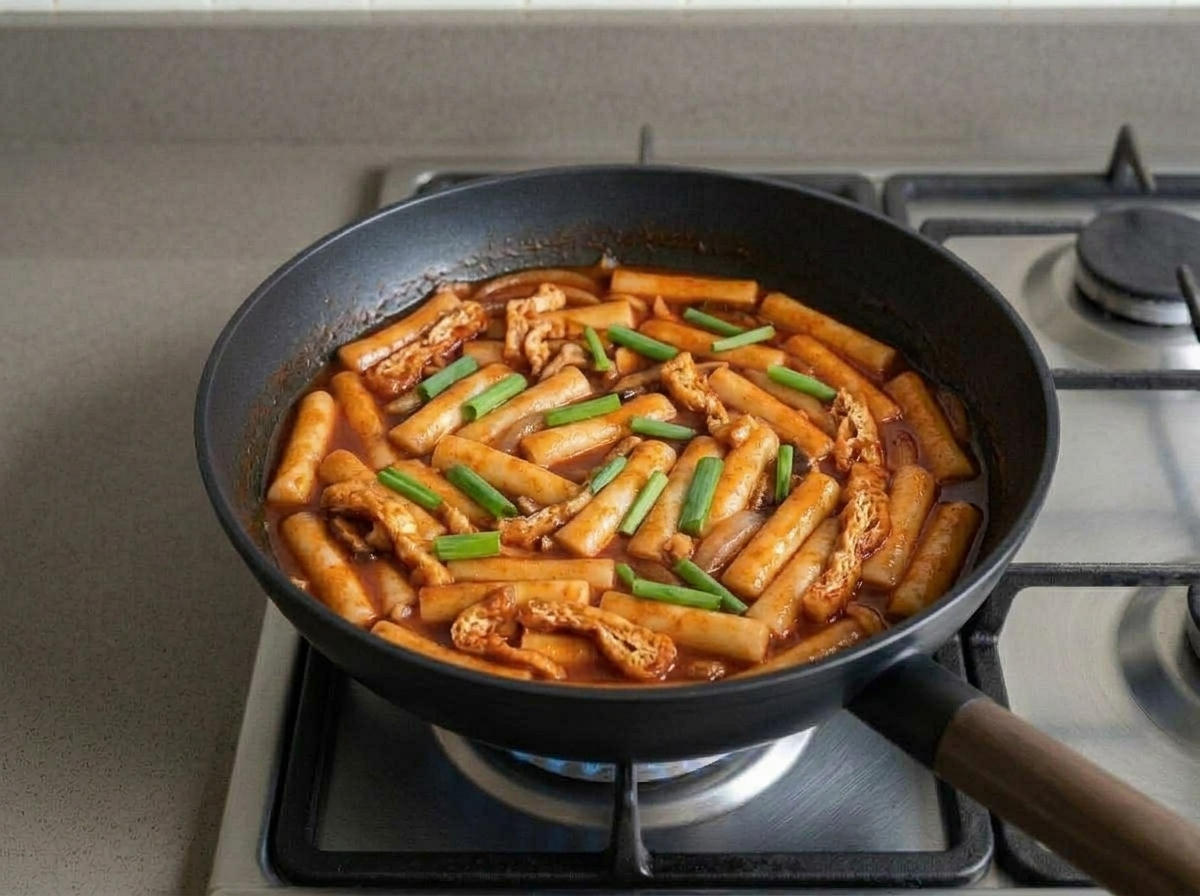
Stir in the tofu puff strips and the scallions and cook for another 2 to 3 minutes, until the puffs have swollen with sauce and the scallions have just lost their raw edge. Stop when the sauce coats a spoon in a layer you can still see through and moves when you tilt the pan.
- 8
Finish off the heat
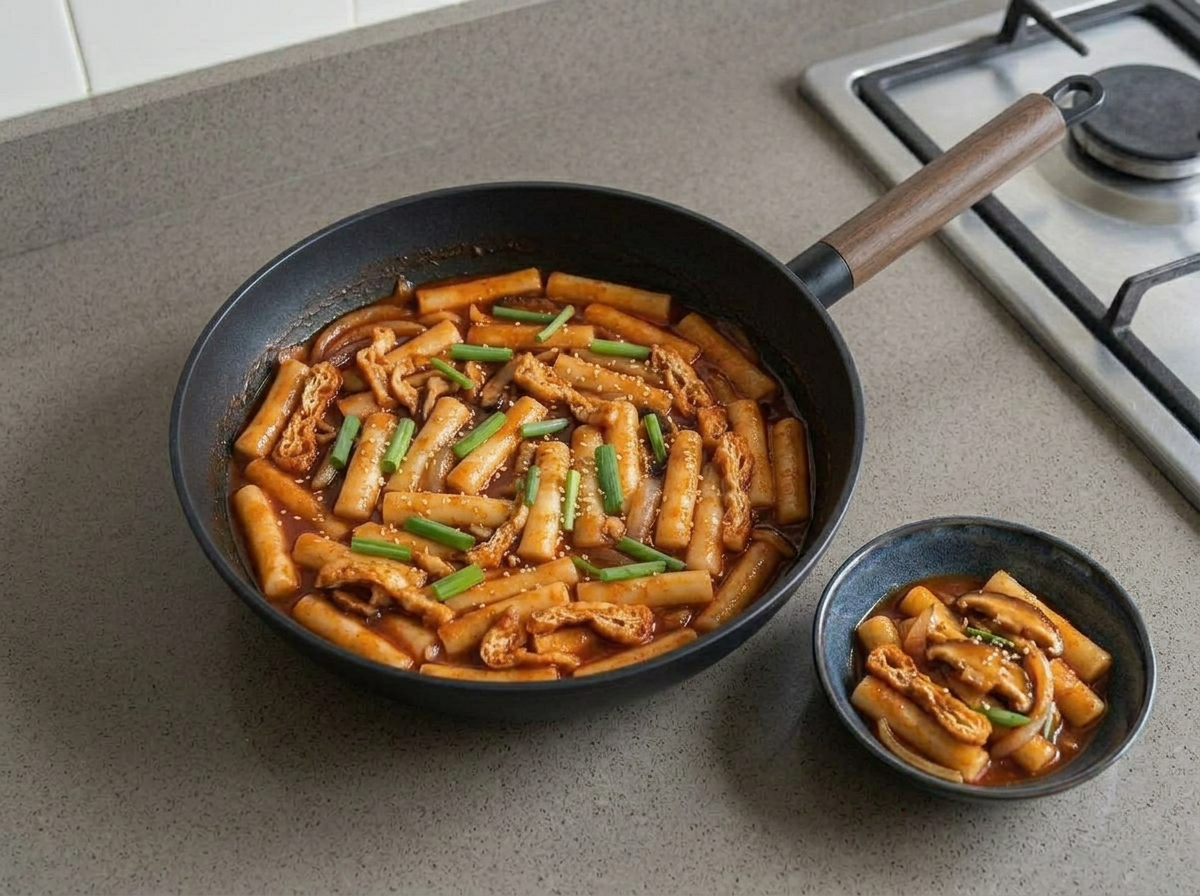
Take the pan off the heat, then stir through the sesame oil and scatter the sesame seeds over the top. Serve straight away in the pan or in shallow bowls. The sauce keeps thickening as it cools, so what looks slightly loose in the kitchen is right by the time it is on the table.
Notes
Gluten free needs three swaps, not one: tamari for the soy sauce, a gochujang labeled gluten free, and rice cakes that are 100 percent rice rather than wheat miltteok.
Rabokki: drop a block of instant ramen noodles in for the last 3 minutes with an extra half cup of water. Discard the seasoning sachet, which usually contains anchovy powder.
Steep the broth double. It keeps 3 days in the fridge and it is the same kelp and shiitake base miso soup and doenjang stew are built on, so the second half is never wasted.
Halved boiled eggs are the standard street stall addition if you eat them. Add them at the very end so they warm through without the yolks going chalky.
Nutrition Facts
4 servings · 371 g per serving
- Calories
- 435 kcal
% Daily Value*
- Total Fat
- 4.2 g5%
- Saturated Fat
- 0.8 g4%
- Sodium
- 462 mg20%
- Total Carbohydrate
- 93.5 g34%
- Dietary Fiber
- 4.8 g17%
- Sugars
- 17.3 g—
- Protein
- 7.5 g15%
Recipe from veggierecipes.blog
When it goes wrong
Troubleshooting
The middles of the rice cakes are still hard
They went into the pan without a soak, or they went in frozen. Refrigerated and vacuum packed rice cakes need 20 minutes in warm water to hydrate all the way through, and frozen ones need thawing first and then soaking. The outside softens fast either way, which is what makes this easy to miss until you bite one. If it has already happened, add a splash of water, cover the pan and give it another four or five minutes on low.
The sauce is thin and slides off the rice cakes
Almost always because the rice cakes were boiled in water first and drained. Everything that thickens this sauce is starch that the rice cakes release while they cook, so cooking them anywhere other than in the sauce sends the body of the dish down the drain. They go into the seasoned broth firm and stay there. The other cause is stopping too early: it needs 10 to 12 minutes at a proper simmer, uncovered, to reduce.
It tastes hot and sweet but somehow flat
This is the broth, or the lack of one. Gochujang, sugar and water make a sauce that hits two notes and holds nothing underneath them. Twenty minutes of kelp and dried shiitake in the water before anything else happens is the entire difference, and it is passive time. The other version of this problem is gochujang carrying the chili on its own, without gochugaru, which leaves the heat blunt and the color dull.
The rice cakes went to mush and the sauce turned into paste
Overcooked, and probably left sitting afterwards. Rice cakes go from chewy to bloated quickly at the end, and the sauce keeps thickening off the heat as it cools. Pull the pan when the sauce still moves when you tilt it and coats a spoon in a layer you can see through. It will be exactly right by the time it reaches the table.
Everything caught and scorched on the bottom of the pan
Rice cake starch sinks and then sticks. Stir from the bottom every minute or so rather than folding the top, and keep it at a lively simmer instead of a hard boil. A heavy skillet helps more than a thin one. If a little has caught, move everything to a clean pan rather than stirring the burnt layer back in, which flavors the whole batch.
It went hard and rubbery in the fridge overnight
This one is not a mistake and there is no technique that prevents it. Rice cake starch recrystallizes as it chills, which is the same process that makes day-old bread firm, and it happens to every tteokbokki everywhere. It is why Korean shops sell it made to order out of a pan that never stops simmering. Heat reverses most of it: add a few tablespoons of water and warm it gently in a pan, and the cakes soften back. The microwave gives you hot rubber.
Before you serve
Serving & Storage
In Korea this is bunsik, snack shop food, and it almost never turns up alone. The standard companions are skewers of eomuk in their own broth, a paper cone of twigim, the fried vegetable fritters, and kimbap cut into rounds for dipping into the leftover sauce. For a vegetarian table, keep the kimbap and swap the fried squid for battered sweet potato and perilla leaf, both of which are traditional twigim anyway.
There are two additions worth knowing. Rabokki is tteokbokki with a block of instant ramen noodles dropped in for the last three minutes and a splash more broth to cook them, and it is a genuine Korean shop item rather than a shortcut. Cheese tteokbokki means a handful of low-moisture mozzarella over the top with the lid on for a minute, which is modern and everywhere. And when the rice cakes are gone, the correct thing to do with the sauce still in the pan is to stir in a bowl of cold cooked rice and a sheet of crumbled gim, and fry it into bokkeumbap. That is not a way of using leftovers, it is the reason some people order tteokbokki at all.
Making it ahead
The broth is the part that keeps, and it is the part that takes the time. Steep the kelp and shiitake up to three days in advance, strain it into a jar and refrigerate it, and the recipe collapses to about twenty minutes on the night. Mixing the gochujang, gochugaru, soy sauce, sugar and garlic into a paste ahead of time works too and the paste keeps a week. What does not work is cooking the rice cakes early. There is no version of this dish that survives being made in advance and reheated properly, so cook them when you intend to eat.
Storing leftovers
Leftovers keep three days in the fridge and they will be hard when they come out, which is normal and reversible. Reheat in a pan over low heat with three or four tablespoons of water per portion, stirring until the sauce loosens and the rice cakes give under a spoon, which takes about five minutes. Do not freeze cooked tteokbokki. Rice cakes freeze well raw and badly once they have been cooked and sauced, and what comes out is grainy in a way reheating will not fix. Freeze the uncooked rice cakes and the strained broth separately instead.
Still wondering
Frequently Asked Questions
Is tteokbokki vegetarian?
Not as it is normally sold. The rice cakes themselves are just rice or wheat, but the sauce is nearly always built on myeolchi yuksu, a broth of dried anchovies and kelp, and sliced fish cakes are a standard addition rather than an optional one. That is two ingredients to deal with, not a whole recipe, which is what this page does. Assume any tteokbokki you did not cook yourself contains fish, including the instant cup versions, where anchovy powder is usually in the seasoning sachet.
Is this gluten free?
Not as written, and it takes three swaps rather than one. Use tamari in place of soy sauce, find a gochujang labeled gluten free because most contain wheat flour, and check that your rice cakes are 100 percent rice rather than the wheat miltteok sold for street style tteokbokki. All three are available, but a recipe that only tells you to swap the soy sauce has left two sources of gluten in the pan.
How spicy is this, and can I make it milder for children?
As written it is medium, noticeably milder than a Seoul street stall. To take it down, drop the gochugaru to a teaspoon and the gochujang to two tablespoons, and add an extra teaspoon of sugar. Below that you lose the dish rather than mellowing it, so for young children the better answer is the soy sauce version, gungjung tteokbokki, which has no chili in it at all and is the older recipe anyway. To go the other way, an extra tablespoon of gochugaru is where most Korean recipes sit.
Can I double it for a crowd?
Yes, but in two pans rather than one. Doubling into a single skillet doubles the depth of the liquid without doubling the surface area, so it takes far longer to reduce and the rice cakes bloat and turn to mush while they wait for the sauce to catch up. Two skillets run side by side hit the same 10 to 12 minutes as a single batch. The broth and the sauce paste scale straight up with no adjustment.
More Spicy Asian Bowls and Tofu Dinners

Made this?